You may have seen a ball roller coaster exhibit (Fig.). Describe how kinetic and potential energy. Class 9
R
RBSEGuide
You may have seen a ball roller coaster exhibit (Fig.). Describe how kinetic and potential energy. Class 9
Question 1.
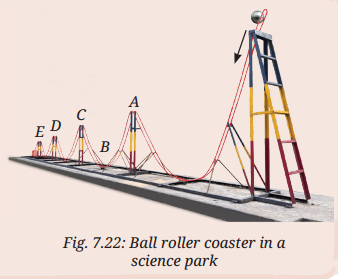
You may have seen a ball roller coaster exhibit (Fig.). Describe how kinetic and potential energy change at points A, B and C. Why do subsequent points such as C, D and E usually have lower heights compared to the previous ones? Could it have anything to do with the energy lost due to friction? (Page 129) Class 9
Answer:
- At A (highest point): Maximum potential energy, minimum (nearly zero) kinetic energy.
- At B (lower than A): Some PE converts to KE; both are intermediate values.
- At C (lower than B): Less PE, more KE than at B.
' At bottom points: Minimum PE, maximum KE. Subsequent peaks D, E are lower because in real life, energy is lost due to friction between the ball and track, and air resistance - this energy is converted to thermal energy. The total mechanical energy decreases progressively, so the ball cannot return to the original height A. Yes, it is entirely due to energy lost because of friction and air resistance.