Election for class representative Grade 8, Suryodaya School Class 8
Election for class representative Grade 8, Suryodaya School Class 8
Election for class representative Grade 8, Suryodaya School (Page 100) Class 8
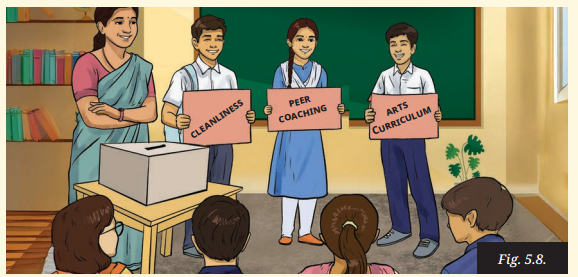
It was time for the annual election of the Class Representative (Class Rep). The Class Rep would represent the class in meetings with teachers, organise events, and act as a bridge between the students and school authorities. Three students, Ahmed, Gurmat, and Ravi-decided to contest for the position. The class teacher, Ms. Usha, was appointed as the Election Officer to ensure the election process was fair, transparent, and followed all the necessary rules.
Answer:
Here's a brief introduction of each of the candidates: Ahmed promised to improve the cleanliness of the classrooms and the playground. Gurmat was interested in helping all her classmates learn better. She proposed creating a system of peer coaching and mutual support. Ravi wanted to make more space in their class timetable for the arts curriculum-music, theatre, and visual art-in line with the new curriculum.
Campaigning: Ahmed put up posters, Gurmat used the noticeboard and spoke to classmates, while Ravi held a lunchtime music performance to promote his idea. As the Election Officer, Ms. Usha had to organise the elections and ensure it was conducted fairly. She explained the rules to the class, ensuring everyone understood how the secret ballot voting process would work; no one would know who voted for whom, ensuring the process was private and fair. She set up the voting booths in the corner of the classroom.
Voting day: On election day, each student was given a ballot paper with the names of the three candidates. The students were asked to mark an 'X' next to the name of the candidate they wished to vote for. Ms. Usha also ensured that there was a ballot paper in Braille for Neha. After all the students voted, Ms. Usha collected the ballots in a box and sealed them until the counting 124 session.
The results: After all the 33 votes were cast, Ms. Usha called Ms Sheeba from the next class to witness the counting process. One of the ballot papers was not marked, so it was declared invalid. The results were announced: Ahmed received 8 votes, Gurmat 12 and Ravi 10. Gurmat, with the most votes, was declared the new Class Representative. She thanked her classmates and promised to fulfil her commitments. Ahmed and Ravi congratulated her and offered to support her.
Question 1.
What are the most important aspects of the election process in this caselet?
Answer:
The most important aspects of the election process in this caselet are:
- Free and fair election without any influence or pressure.
- Every student has the to vote, which shows equality.
- Secret ballot to protect voter privacy.
- Independent election officer to conduct and oversee election.
- Another teacher was called to witness the counting process, which shows transparency and accountabili ₹.
- Voter awareness and participation.
Question 2.
Why was it important to have a secret ballot?
Answer:
The secret ballot was important because it allowed students to vote without pressure. Their choice remained private, which helped them vote freely and honestly. This protected the fairness of the election.
Question 3.
What considerations might the students have had while exercising their choice?
Answer:
While voting, students likely thought about the promises made by the candidates. They considered who could help the class the most, who was responsible and whose ideas matched the needs of everyone.
Question 4.
Do you think the students have any responsibility after Gurmat was elected as the class rep? If yes, what are they?
Answer:
After Gurmat was elected, students also had a role to play. They needed to cooperate with her, share their views and help her succeed in her responsibilities. In a democracy, being a good citizen means participating both before and after elections.
Question 5.
What was the role that Ms. Usha played? Why was it important?
Answer:
Ms. Usha acted as the Election Officer. She explained the rules, arranged the voting both, conducted the counting and even invited another teacher to witness it. Her role was important to make sure the election was conducted fairly and openly.
Question 6.
Why was it important for Ms. Usha to organise a braille ballot paper for Neha?
Answer:
Providing a braille ballot for Neha, a visually impaired student, was a sign of true inclusion. It allowed her to vote on her own, just like the others. This showed respect for every student and ensured that no one was left out of the democratic process.
Question 7.
What would happen if many students in the class chose not to mark a preference?
Answer:
If many students had chosen not to vote or left their ballots blank, the result would not have reflected the class's true opinion. Low participation weakens democracy, so it is important that everyone uses their right to vote and makes a clear choice.