Natural Resources and Their Use Class 8 MCQ
Natural Resources and Their Use Class 8 MCQ
Natural Resources and Their Use Class 8 MCQ
Question 1.
Which one of the following purposes is perfect for a regenerative economy?
(a) Increasing resource extraction for economic growth
(b) Operating in harmony with nature
(c) Enhancing industrial production
(d) Using only non-renewable resources
Answer:
(b) Operating in harmony with nature
Question 2.
Which of the following is not part of a regenerative economy?
(a) Repurposing used resources
(b) Depleting natural resources faster
(c) Replenishing depleted resources
(d) Minimizing waste
Answer:
(b) Depleting natural resources faster
Question 3.
Select the correct word for a renewable resource:
(a) Coal
(b) Petroleum
(c) Iron ore
(d) Tidal Energy
Answer:
(d) Tidal Energy
Question 4.
Identify a non-renewable resource from the following 'terms' :
(a) Coal
(b) Wind energy
(c) Timber
(d) Solar energy
Answer:
(a) Coal
Natural Resources and Their Use Class 8 Assertion and Reason Questions
In the questions given below, there are two statements marked as Assertion (A) and Reason (R). Read the statements and choose the correct option.
(a) Both (A) and (R) are true and R is the correct explanation of (A).
(b) Both (A) and (R) true but (R) is not the correct explanation of (A).
(c) (A) is true but (R) is false.
(d) (A) is false but (R) is true.
1. Assertion (A): Renewable resources can be replenished naturally.
Reason (R): Solar energy, wind energy, and flowing water are examples of renewable resources.
Answer:
(a) Both (A) and (R) are true and R is the correct explanation of (A).
2. Assertion (A): Non-renewable resources are finite.
Reason (R): Coal and petroleum take millions of years to form.
Answer:
(a) Both (A) and (R) are true and R is the correct explanation of (A).
3. Assertion (A): Cement production is environmentally harmless.
Reason (R): Cement production releases dust that causes air and soil pollution.
Answer:
(c) (A) is true but (R) is false.
Natural Resources and Their Use Class 8 Fill in the Blanks
Question 1.
Life on Earth depends on air, ............, and food.
Answer:
Water
Question 2.
A tree produces about ............litres of oxygen per day.
Answer:
275
Question 3.
Coal and petroleum are examples of ............resources.
Answer:
Non-renewable
Question 4.
The phenomenon where having plenty of resources does not guarantee prosperity is called .............
Answer:
Natural resource curse
Question 5.
The sharing of Kaveri River water is an example of resource .............
Answer:
Conflict.
Natural Resources and Their Use Class 8 True or False
Question 1.
Coal and petroleum are examples of renewable resources.
Answer:
False
Question 2.
Vrikshaayurveda is the ancient science of caring for animals.
Answer:
False
Question 3.
Overexploitation means using a resource faster than it can be replenished.
Answer:
True
Question 4.
Air pollution from cement production is harmless to humans.
Answer:
False
Question 5.
Organic farming avoids the use of chemical pesticides.
Answer:
True
Natural Resources and Their Use Class 8 Match the Following
Question 1.
| Column A | Column B |
| 1. Kaveri River dispute | (a) Introduction of high-yield variety seeds and modern farming |
| 2. Compost | (b) Ancient Indian science of plant care |
| 3. Green Revolution | (c) Economy that replenishes depleted resources and minimises waste |
| 4. Vrikshayurveda | (d) Example of inter-state resource-sharing conflict |
| 5. Regenerative economy | (e) Natural fertiliser made from decomposed organic matter |
| 6. Pangong Tso | (f) Himachal Pradesh |
| 7. The Great Himalayan National Park | (g) Ladakh |
Answer:
| Column A | Column B |
| 1. Kaveri River dispute | (d) Example of inter-state resource-sharing conflict |
| 2. Compost | (e) Natural fertiliser made from decomposed organic matter |
| 3. Green Revolution | (a) Introduction of high-yield variety seeds and modern farming |
| 4. Vrikshayurveda | (b) Ancient Indian science of plant care |
| 5. Regenerative economy | (c) Economy that replenishes depleted resources and minimises waste |
Natural Resources and Their Use Class 8 Passage Based Questions
1. Read the following passage carefully and answer the questions that follow:
Ecosystem functions and ecosystem services: Nature has some inherent ways of working. For example, trees naturally produce oxygen. When these natural processes benefit humans, we call them 'ecosystem services'. We can think of it like this: a forest naturally filters water, prevents soil erosion, and provides habitat for animals - these are ecosystem functions. When we benefit from clean water, protected farmland, and pollinated crops because of that forest, we are receiving ecosystem services from Nature.
Question 1.
Which of the following is an ecosystem function?
(a) Oxygen supply for breathing
(b) Farming
(c) Photosynthesis by plants
(d) Foods for humans and animals
Answer:
(c) Photosynthesis by plants
Question 2.
When humans use clean water filtered naturally by forests, it is called:
(a) Ecosystem function
(b) Ecosystem balance
(c) Ecological pyramid
(d) Ecosystem service
Answer:
(d) Ecosystem service
Question 3.
Pollination by bees becomes an ecosystem service when it leads to :
(a) Production of fruits and crops for human use
(b) Transfer of pollen
(c) Growth of flowers
(d) Habitat creation
Answer:
(a) Production of fruits and crops for human use
Question 4.
What kind of benefit/benefits do we get from trees releasing oxygen?
(a) Forest growth
(b) Animal habitat
(c) Human and animal respiration
(d) Soil fertility
Answer:
(c) Human and animal respiration
Natural Resources and Their Use Class 8 Map-Based Questions
Question 1.
On the map of India, mark:
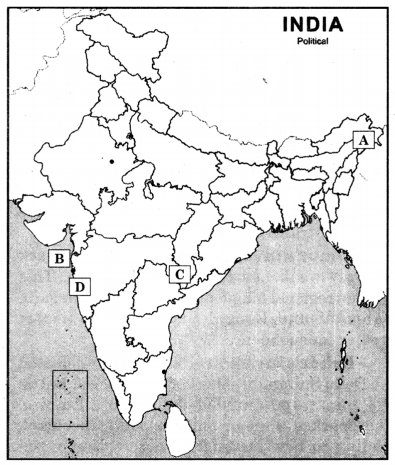
(a) Locate one oil field in Assam on the map.
(b) Locate the Ratnagiri Bauxite deposit on the map
(c) Locate a region famous for Iron ore on the map.
(d) Locate the Mumbai High Oil field on the map.
Answer:
(a) A-Digboi,
(b) D-Ratnagiri (Maharashtra),
(c) C-Bailadila region (Chhattisgarh)
(d) B-Mumbai High Oil field.