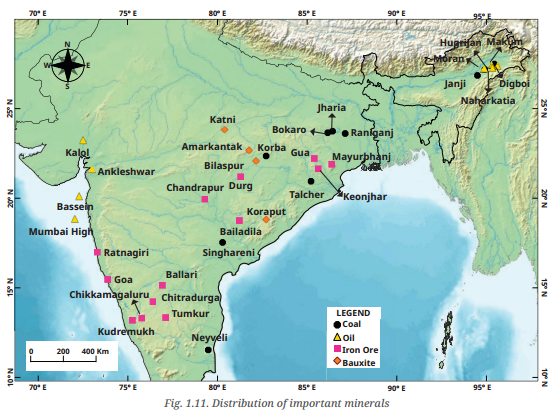
Observe the map in Fig. Notice the uneven distribution of important minerals. What types of resources Class 8
Observe the map in Fig. Notice the uneven distribution of important minerals. What types of resources Class 8
Question 1.
Observe the map in Fig. Notice the uneven distribution of important minerals. What types of resources are available in your region? How are they distributed? (Pagge 9) Class 8
Answer:
The map shows that minerals are unevenly distributed across India. Coal is mainly found in eastern and central regions like Jharia, Raniganj, and Korba, as well as in the south at Neyveli and Singareni. Iron ore is abundant in central, eastern, and southern parts, including Bailadila and Mayurbhanj.
Bauxite deposits are mostly in the central and eastern India, such as Katni and Koraput in southern Odisha. Petroleum and natural gas fields are located along the western coast near Mumbai High and Ankleshwar, and in the northeast at Digboi. This uneven distribution reflects India's varied geology, with certain regions rich in specific minerals.
In India, Jharkhand, several important minerals are found. The state is especially rich in coal, with major coalfields located in Jharia, Bokaro, and Dhanbad. Iron ore is another key resource, mainly found in the Singhbhum district. Jharkhand also has deposits of bauxite, copper, mica, and uranium, spread across different parts of the state.
These minerals are mostly located in the eastern and central parts of Jharkhand, making it one of India's most resource-rich areas. The distribution of these resources supports many industries and plays a vital role in the state's economy. water harvesting, reducing waste, and using resources efficiently are key steps. Restoration efforts, such as reforestation or implementing water conservation technologies, can also play a vital role in maintaining balance. By prioritising responsible practices in areas like agriculture and resource management, the regeneration of these resources can be safeguarded for future generations