Reshaping India’s Political Map Class 8 MCQ
Reshaping India’s Political Map Class 8 MCQ
Reshaping India’s Political Map Class 8 MCQ
Question 1.
Which period among the following belongs to the period of establishment of the Delhi Sultanate?
(a) Before 1206
(b) After 1206
(c) In 1206
(d) None of these
Answer:
(c) In 1206
Question 2.
Look at the facts below and arrange them in ascending order :
i. Timur attacks Delhi
ii. Re-establishment of the Mewar Kingdom
iii. Establishment of the Vijayanagara Empire
iv. First Battle of Panipat
Select the correct answer:
(a) i, ii, iii, iv
(b) ii,iii, i, iv
(c) iv, iii, ii, i.
(d) iii, ii, i, iv
Answer:
(b) ii,iii, i, iv
Question 3.
Who was defeated in 1192 to form the Delhi Sultanate?
(a) Jahangir
(b) Krishnadevaraya
(c) Akbar
(d) Prithviraj Chauhan
Answer:
(d) Prithviraj Chauhan
Question 4.
Which one of the following dynasties is known as the Slave dynasty?
(a) Khilji
(b) Mamluk
(c) Tughlaq
(d) Lodi
Answer:
(b) Mamluk
Question 5.
Which dynasty succeeded the Mamluks?
(a) Khilji
(b) Tughlaq
(c) Sayyid
(d) Rajput
Answer:
(a) Khilji
Reshaping India’s Political Map Class 8 Assertion and Reason Questions
In the questions given below, there are two statements marked as Assertion (A) and Reason (R). Read the statements and choose the correct option.
(a) Both (A) and (R) are true and R is the correct explanation of (A).
(b) Both ( A ) and ( R ) true but (R) is not the correct explanation of (A).
(c) (A) is true but (R) is false.
(d) (A) is false but (R) is true.
Question 1.
Assertion (A): Akbar promoted religious tolerance and abolished jizya.
Reason (R): He believed forcing conversion was wrong and welcomed people of all faiths in his court.
Answer:
(a) Both (A) and (R) are true and R is the correct explanation of (A).
Question 2.
Assertion (A): Aurangzeb imprisoned his father, Shah Jahan.
Reason (R): He wanted to secure the throne for himself.
Answer:
(a) Both (A) and (R) are true and R is the correct explanation of (A).
Question 3.
Assertion (A): The Ahoms maintained independence using guerrilla tactics and knowledge of terrain.
Answer:
(b) Both ( A ) and (R) true but (R) is not the correct explanation of (A).
Reshaping India’s Political Map Class 8 Fill in the Blanks
Question 1.
The Delhi Sultanate was established after the defeat of ............in 1192.
Answer:
Prithviraj Chauhan
Question 2.
The Khilji ruler who conducted campaigns in South India was .............
Answer:
Ala-ud-din Khilji
Question 3.
The capital shifted from Delhi to............during Muhammad bin Tughlaq's reign.
Answer:
Daulatabad
Question 4.
The Vijayanagara Empire was founded by ............and .............
Answer:
Harihara and Bukka
Question 5.
The Mughal emperor who defeated Ibrahim Lodiat Panipat was .............
Answer:
Babur
Reshaping India’s Political Map Class 8 True or False
Question 1.
The Mamluks were the first dynasty of the Delhi Sultanate.
Answer:
True
Question 2.
Muhammad bin Tughlaq successfully shifted the capital permanently to Daulatabad.
Answer:
False
Question 3.
The Mughal administration under Akbar included Diwan, Mir Bakhshi, Khan-iSaman, and Sadr.
Answer:
True
Question 4.
The Ahoms were defeated by Aurangzeb at Saraighat.
Answer:
False
Question 5.
Aurangzeb abolished the jizya tax on non-Muslims.
Answer:
False
Question 6.
The Vijayanagara Empire fell after the Battle of Talikota.
Answer:
True
Reshaping India’s Political Map Class 8 Match the Following
Question 1.
| Column A | Column B |
| 1. Krishnadevaraya | (a) Battle of Talikota |
| 2. Ramaraya | (b) Revenue reforms |
| 3. Babur and Ibrahim Lodi | (c) Vijayanagara Empire |
| 4. Todar Mal | (d) First Battle of Panipat |
| 5. Akbar | (e) Sulh-i-kul |
| 6. Guru Tegh Bahadur | (f) Sikh martyrdom |
Answer:
| Column A | Column B |
| 1. Krishnadevaraya | (c) Vijayanagara Empire |
| 2. Ramaraya | (a) Battle of Talikota |
| 3. Babur and Ibrahim Lodi | (d) First Battle of Panipat |
| 4. Todar Mal | (b) Revenue reforms |
| 5. Akbar | (e) Sulh-i-kul |
| 6. Guru Tegh Bahadur | (f) Sikh martyrdom |
Reshaping India’s Political Map Class 8 Passage Based Questions
Question 1.
Read the following passage carefully and answer the questions that follow:
Babur left a candid autobiography of great historical value, Baburnama ('Babur's Memoirs'). In it, he comes out as cultured and intellectually curious, with a keen appreciation for architecture, poetry, animals (birds in particular, many of which he lists in some detail) and flora (fruit trees especially). But he was also a brutal and ruthless conqueror, slaughtering entire populations of cities, enslaving women and children, and taking pride in erecting 'towers of skulls' made from the slaughtered people of plundered cities.
Babur was nostalgic about Central Asia and found India to be a 'country of few charms'; at the same time, he acknowledged, "Hindustan is a large country and has masses of gold and silver. ... Through the rainy season, the air is remarkably fine, not to be surpassed for healthiness and charm. ... There are countless artisans and workmen of every sort in Hindustan." Perhaps for the last reasons, especially India's wealth, he decided to stay and build his empire in India rather than return to Central Asia.
Question 1.
Baburnama was written by .............
Answer:
Babur
Question 2.
How is Babur, according to the Baburnama?
(a) A killer
(b) Ruthless conqueror
(c) Civilsed
(d) None of these
Answer:
(c) Civilsed
Question 3.
With respect to the Central Asia, he was .............
(a) Homesick
(b) Misanthrope
(c) Arbitrator
(d) Both (b) and (c)
Answer:
(a) Homesick
Question 4.
He did not return to his nation because:
(a) He loved India
(b) He found India a beautiful place to enjoy
(c) He found India a place which was not only good for climate-wise, naturewise, tradewise, but also good from every other aspect.
(d) None of these
Answer:
(d) None of these
Reshaping India’s Political Map Class 8 Map-Based Questions
Question 1.
Locate and label the following on the map of India:
Answer:
The independent states of Deccan Sultanate:
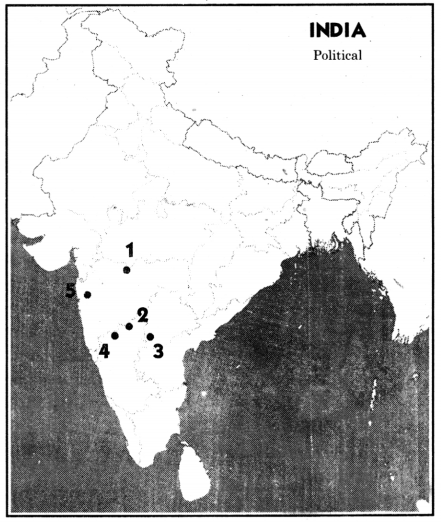
(a) Golconda
(b) Bidar
(c) Berar
(d) Ahmednagar
(e) Bijapur
Answer:
(a) Golconda-3
(b) Bidar-2
(c) Berar-1,
(d) Ahmednagar-5
(e) Bijapur-4