The Colonial Era in India Class 8 MCQ
The Colonial Era in India Class 8 MCQ
The Colonial Era in India Class 8 MCQ
Question 1.
Who was the first European to discover the sea route to India?
(a) Christopher Columbus
(b) Ferdinand Magellan
(c) Vasco da Gama
(d) Bartholomew Diaz
Answer:
(c) Vasco da Gama
Question 2.
Vasco-da-Gama first landed in India at which place?
(a) Bombay
(b) Calicut
(c) Cochin
(d) Surat
Answer:
(b) Calicut
Question 3.
The Portuguese established their first trading centre in India at :
(a) Goa
(b) Calicut
(c) Cochin
(d) Daman
Answer:
(c) Cochin
Question 4.
The main aim of the Portuguese in India was to :
(a) Spread Christianity
(b) Conquer the Mughal Empire
(c) Trade in spices
(d) Teach Indian rulers European culture
Answer:
(c) Trade in spices
Question 5.
The Dutch East India Company was established in :
(a) 1502
(b) 1602
(c) 1652
(d) 1702
Answer:
(b) 1602
The Colonial Era in India Class 8 Assertion and Reason Questions
In the questions given below, there are two statements marked as Assertion (A) and Reason (R). Read the statements and choose the correct option.
(a) Both (A) and (R) are true and R is the correct explanation of (A).
(b) Both (A) and (R) true but (R) is not the correct explanation of (A).
(c) (A) is true but (R) is false.
(d) (A) is false but (R) is true.
1. Assertion (A): The Doctrine of Lapse was a key strategy used by the British to annex princely states.
Reason (R): It allowed any princely state without a natural male heir to be annexed by the British.
Answer:
(a) Both (A) and (R) are true and R is the correct explanation of (A).
2. Assertion (A): The British improved India's economy and increased its share of world GDP.
Reason (R): They invested heavily in Indian industries and local trade.
Answer:
(a) Both (A) and (R) are true and R is the correct explanation of (A).
The Colonial Era in India Class 8 Fill in the Blanks
Question 1.
The ............ East India Company was granted a royal charter by Queen Elizabeth I.
Answer:
British
Question 2.
The battle of ............ (1757) marked the beginning of major British political control in India.
Answer:
Plassey
Question 3.
............ was the queen of Jhansi who fought bravely in the 1857 Rebellion.
Answer:
Rani Lakshmibai
Question 4.
The Great Famine of 1876-78 killed nearly ............ million people in the Deccan region.
Answer:
eight
Question 5.
The ............ Revolt (1859-62) was a peasant uprising against forced cultivation of indigo.
Answer:
Indigo
The Colonial Era in India Class 8 True or False
Question 1.
The Dutch were the first European power to colonize India.
Answer:
False
Question 2.
The British exploited India's wealth to fund the Industrial Revolution.
Answer:
True
Question 3.
Famines under British rule were worsened by the export of grain and free-market policies.
Answer:
True
Question 4.
The British abolished all traditional village councils immediately after arriving.
Answer:
False
Question 5.
The Kol Uprising occurred in northern Bengal.
Answer:
False
The Colonial Era in India Class 8 Match the Following
Question 1.
| Column A | Column B |
| 1. Vasco da Gama | (a) East India Company Governor-General (French) |
| 2. Battle of Colachel | (b) The Dutch were defeated by Travancore |
| 3. Dupleix | (c) Portuguese explorer to India in 1498 |
| 4. Sidhu and Kanhu Murmu | (d) Leaders of the Santhal Rebellion |
| 5. Macaulay | (e) Advocated English education in India |
Answer:
| Column A | Column B |
| 1. Vasco da Gama | (c) Portuguese explorer to India in 1498 |
| 2. Battle of Colachel | (b) The Dutch were defeated by Travancore |
| 3. Dupleix | (a) East India Company Governor-General (French) |
| 4. Sidhu and Kanhu Murmu | (d) Leaders of the Santhal Rebellion |
| 5. Macaulay | (e) Advocated English education in India |
The Colonial Era in India Class 8 Passage Based Questions
1. Read the following passage carefully and answer the questions that follow:
A few centuries ago, the port town of I hal (in present-day southern Karnataka) was an important trading point controlled by Rani Abbakka I. In the latter half of the 16th century, the Portuguese repeatedly attempted to take it over, but Rani Abbakka I formed strategic alliances with neighbouring kingdoms and thwarted their attempts.
She was eventually captured and died fighting in prison. Her successor, Rani Abbakka II, is reported to have created fireballs out of coconut shells and set several ships of the Portuguese navy on fire. Their inspirational stories are remembered even today through the Yakshagana, a traditional form of dance-drama.
Question 1.
Who controlled the port town of Ullal a few centuries ago?
(a) Portuguese
(b) Rani Abbakka I
(c) Rani Abbakka-II
(d) Neighboring kingdoms
Answer:
(b) Rani Abbakka I
Question 2.
In which century did the Portuguese repeatedly attempt to take over Ullal?
(a) 15th century
(b) 16th century
(c) 17th century
(d) 18th century
Answer:
(b) 16th century
Question 3.
How did Rani Abbakka I defend Ullal from the Portuguese?
(a) By forming strategic alliances
(b) By building forts
(c) By negotiating with them
(d) By fleeing the town
Answer:
(a) By forming strategic alliances
The Colonial Era in India Class 8 Map-Based Questions
Question 1.
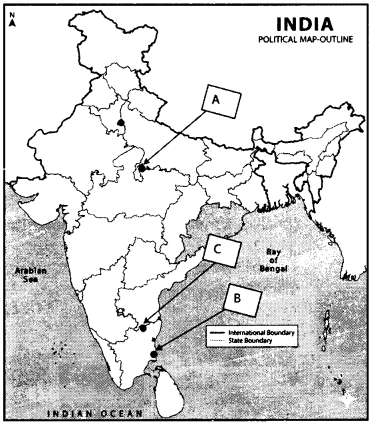
Locate and label the following on the map of India :
1. Port established by the Dutch
2. A place of the Vellore Mutiny (1806)
3. A place associated with Rani Lakshmibai
Answer:
1. Nagapattinam port, Tamil Nadu-B
2. Vellore, Tamil Nadu-C
3. Jhansi, Madhya Pradesh-A.