The Parliamentary System: Legislature and Executive Class 8 MCQ
The Parliamentary System: Legislature and Executive Class 8 MCQ
The Parliamentary System: Legislature and Executive Class 8 MCQ
Question 1.
Who was Sukhwinder?
(a) A student of Navodaya Vidyalaya
(b) A student of Nalanda Vidyalaya
(c) A visitor
(d) A great philosopher
Answer:
(b) A student of Nalanda Vidyalaya
Question 2.
According to the Students, what did they feel about the Museum of India?
(a) The old Parliament building
(b) The new Parliament building
(c) The campus of their school
(d) None of these
Answer:
(b) The new Parliament building
Question 3.
How was the new parliament building, according to a female student?
(a) It's like a square
(b) It's like a round
(c) It's like a soft triangle
(d) None of these
Answer:
(c) It's like a soft triangle
Question 4.
Who said that the Constitution is a "vehicle of life" and must reflect the spirit of the age?
(a) B.R. Ambedkar
(b) Rajendra Prasad
(c) Alladi Krishnaswami Ayyar
(d) Jawaharlal Nehru
Answer:
(c) Alladi Krishnaswami Ayyar
Question 5.
What was the first major step after India gained independence?
(a) Formation of the Planning Commission
(b) Drafting of the Constitution
(c) Reorganization of States
(d) Introduction of Five-Year Plans
Answer:
(b) Drafting of the Constitution
The Parliamentary System: Legislature and Executive Class 8 Assertion and Reason Questions
In the questions given below, there are two statements marked as Assertion (A) and Reason (R). Read the statements and choose the correct option.
(a) Both (A) and (R) are true and R is the correct explanation of (A).
(b) Both (A) and (R) true but (R) is not the correct explanation of (A).
(c) (A) is true but ( R ) is false.
(d) (A) is false but (R) is true.
1. Assertion (A): The President is the constitutional head of India.
Reason (R): The President exercises real executive powers.
Answer:
(c) (A) is true but ( R ) is false.
2. Assertion (A): The Council of Ministers functions independently of the Prime Minister.
Reason (R): The Prime Minister leads the Council of Ministers.
Answer:
(d) (A) is false but (R) is true.
3. Assertion (A): The Judiciary ensures that no law violates the Constitution.
Reason (R): It performs this function through judicial review.
Answer:
(a) Both (A) and (R) are true and R is the correct explanation of (A).
The Parliamentary System: Legislature and Executive Class 8 Fill in the Blanks
Question 1.
The Constitution of India came into effect on .............
Answer:
26th January 1950
Question 2.
The Indian Parliament consists of the ............, ............, and .............
Answer:
President, Lok Sabha, Rajya Sabha
Question 3.
The Rajya Sabha is presided over by the .............
Answer:
Vice President of India
Question 4.
The ............, placed near the - Speaker's chair in the Lok Sabha, symbolizes righteous and just rule.
Answer:
Sengol
Question 5.
The Prime Minister must have the...........of the Lok Sabha to remain in office.
Answer:
Confidence
The Parliamentary System: Legislature and Executive Class 8 True or False
Question 1.
The Constitution of India provides for aunicameral legislature at the Union level.
Answer:
False
Question 2.
Members of the Rajya Sabha serve a fixed 5-year term.
Answer:
False
Question 3.
The President of India can dissolve the Lok Sabha on the advice of the Prime Minister.
Answer:
True
Question 4.
The Judiciary can strike down unconstitutional laws.
Answer:
True
Question 5.
The Governor is appointed by the President of India.
Answer:
True
The Parliamentary System: Legislature and Executive Class 8 Match the Following
Question 1.
| Column A | Column B |
| 1. Lok Sabha | (a) Constitutional Head of India |
| 2. Rajya Sabha | (b) Real Executive Head |
| 3. President | (c) Presiding officer of the Lok Sabha |
| 4. Prime Minister | (d) Council of States |
| 5. Speaker | (e) House of the People |
Answer:
| Column A | Column B |
| 1. Lok Sabha | (e) House of the People |
| 2. Rajya Sabha | (d) Council of States |
| 3. President | (a) Constitutional Head of India |
| 4. Prime Minister | (b) Real Executive Head |
| 5. Speaker | (c) Presiding officer of the Lok Sabha |
The Parliamentary System: Legislature and Executive Class 8 Passage Based Questions
1. Read the following passage carefully and answer the questions that follow:
In 1956, Railway Minister Lal Bahadur Shastri resigned after a train accident. Although he was not blamed for the accident, he believed that a minister must take moral responsibility for anything that happens in their ministry. He offered his resignation to the then Prime Minister Jawaharlal Nehru; Nehru declined at first, but Shastri insisted. Finally, his resignation was accepted.
Question 1.
In which year did Lal Bahadur Shastri resign as Railway Minister of India?
(a) 195
(b) 1954
(c) 195
(d) 1958
Answer:
(c) 195
Question 2.
What was the reason behind Lal Bahadur Shastri's resignation?
(a) Political pressure from the opposition
(b) His ill health
(c) Conflict with the Prime Minister
(d) Moral responsibility for a train accident
Answer:
(d) Moral responsibility for a train accident
Question 3.
Who was the Prime Minister of India when Shastri offered his resignation?
(a) Sardar Vallabhbhai Patel
(b) Jawaharlal Nehru
(c) Dr. Rajendra Prasad
(d) Indira Gandhi
Answer:
(b) Jawaharlal Nehru
The Parliamentary System: Legislature and Executive Class 8 Map-Based Questions
Question 1.
Locate and label the following on the map of India:
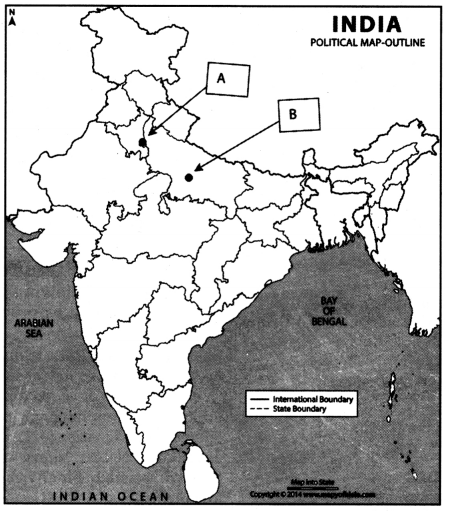
1. Name the State Legislature of Uttar Pradesh and locate that on the Map.
2. Locate the place where the Punjab and Haryana High Court is situated.
Answer:
1. Lucknow-B
2. Chandigarh-A