The Story of Indian Farming Class 7 MCQ
The Story of Indian Farming Class 7 MCQ
The Story of Indian Farming Class 7 MCQ
Question 1.
Which of the following practices is NOT a traditional method used by farmers to maintain soil health?
(a) Crop rotation
(b) Hydroponics
(c) Multiple cropping
(d) Contour ploughing
Answer:
(b) Hydroponics
Question 2.
What is the average size of landholding for farmers in India, and why does this pose a challenge?
(a) 1 hectare; it allows for efficient use of machinery.
(b) 0.75 hectares; it limits income and the use of large machinery.
(c) 2 hectares; it provides sufficient space for diverse crops.
(d) 0.5 hectares; it encourages farmers to diversify their income sources.
Answer:
(b) 0.75 hectares; it limits income and the use of large machinery.
Question 3.
Identify the appropriate option to fill in the empty boxes:
| Soil Type | Characteristics |
| Alluvial Soil | Ideal for the growth of sugarcane, paddy, wheat, and other cereal and pulse crops. |
| ? | Ideal for growing cotton. |
| ? | Suitable for crops like tea, coffee, and rubber. |
(a) Black soil, Laterite soil
(b) Red soil, Laterite soil
(c) Black soil, Red soil
(d) Laterite soil, Black soil
Answer:
(a) Black soil, Laterite soil
Question 4.
The Ganga basin has historically been vital for agriculture due to its rich alluvial soil. However, recent challenges threaten its sustainability. Which of the following statements best describes these challenges?
(a) The Ganga river is becoming navigable year-round.
(b) Increased water diversion and climate change are stressing the river's ecosystem.
(c) The soil quality in the Ganga basin has improved significantly.
(d) Farmers in the Ganga basin are experiencing record profits.
Answer:
(b) Increased water diversion and climate change are stressing the river's ecosystem.
Question 5.
Farmers often diversify their income sources by engaging in activities beyond crop cultivation. Which of the following is NOT typically a source of additional income for farmers?
(a) Rearing livestock
(b) Practicing apiculture
(c) Investing in technology stocks
(d) Collecting forest produce
Answer:
(c) Investing in technology stocks
Question 6.
Image below shows a modern farming method. Which of the following statements about it is true?
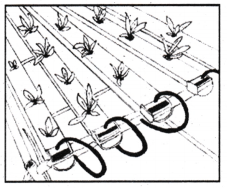
(a) It requires large amounts of soil for plant growth.
(b) It is primarily used in rural areas with rich soil.
(c) It allows for farming in controlled environments with nutrient-rich water.
(d) It is an outdated method that is no longer practiced.
Answer:
(c) It allows for farming in controlled environments with nutrient-rich water.
Question 7.
The Green Revolution in India significantly increased food grain production, particularly of wheat and rice. However, it also led to several environmental challenges. Which of the following is a major long-term consequence of the agricultural practices introduced during the Green Revolution?
(a) Improved soil fertility through organic farming techniques
(b) Depletion of groundwater resources due to excessive irrigation
(c) Increase in biodiversity in agricultural ecosystems
(d) Enhanced resilience of traditional farming methods
Answer:
(b) Depletion of groundwater resources due to excessive irrigation
Case Study:
I. Traditional irrigation systems
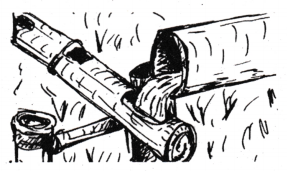
Farmers also create small ponds that collect rainwater and provide moisture to the soil for a longer period of time.
Question 1.
What is the traditional irrigation system found in Maharashtra that uses small canals to divert river water to fields?
Answer:
Phad system.
Question 2.
In which part of India commonly practices the traditional irrigation system shown in the image?
Answer:
Northeastern India.
Question 3.
Explain why irrigated agriculture is important for farmers in India, particularly in relation to monsoon rains.
Answer:
Irrigated agriculture enhances farm productivity by providing a reliable water supply, reducing farmers' dependence on unpredictable monsoon rains. This is crucial for ensuring consistent crop yields and food security.
II. Healthy soil is essential for robust harvests, acting as a complex ecosystem teeming with organisms that enhance its fertility. Traditional conservation methods include crop rotation, which prevents nutrient depletion, and contour ploughing to combat erosion. Farmers also historically utilised organic fertilisers like cow dung. Currently, techniques such as terracing and afforestation are employed to reduce erosion and promote soil health, while some traditional practices like mulching remain relevant. The efficient application of fertilisers is also vital for sustainable soil management."
Fill in the blanks with appropriate words from the extract:
Question 1.
Farmers use ............ to replenish soil nutrients, and ............ is a method that involves creating flat steps on hilly areas to reduce soil erosion.
Answer:
organic fertilisers; terracing.
Question 2.
Which of the following practices is NOT a traditional method of soil conservation mentioned in the extract?
(a) Crop rotation
(b) Multiple cropping
(c) Hydroponics
(d) Contour ploughing
Answer:
(c) Hydroponics
Question 3.
What is panchagavya, and how does it benefit soil health?
Answer:
Panchagavya is a fermented mixture of five cow products: dung, urine, milk, curd, and ghee. It acts as a biofertiliser, enhancing crop growth and productivity while increasing resistance to diseases.
Question 4.
Afforestation is a traditional method used to prevent soil erosion.
Answer:
False