Universal Franchise and India’s Electoral System Class 8 MCQ
Universal Franchise and India’s Electoral System Class 8 MCQ
Universal Franchise and India’s Electoral System Class 8 MCQ
Question 1.
Name who described India's adoption of adult franchise as a bold experiment in world history?
(a) B.R. Ambedkar
(b) Jawaharlal Nehru
(c) Mahatma Gandhi
(d) Alladi Krishnaswami Ayyar
Answer:
(d) Alladi Krishnaswami Ayyar
Question 2.
Which one of the following means adult franchise?
(a) Every adult citizen has one vote of equal value
(b) Only educated citizens can vote
(c) Only men above 25 can vote
(d) Voting rights are limited to certain regions
Answer:
(a) Every adult citizen has one vote of equal value
Question 3.
What is the age of an adult determined by the Election Commission of India for casting a vote?
(a) 16
(b) 18
(c) 21
(d) 25
Answer:
(b) 18
Question 4.
Which article of the Indian Constitution mentions Universal Adult Franchise?
(a) Article 19
(b) Article 370
(c) Article 326
(d) Article 14
Answer:
(c) Article 326
Question 5.
Which elections does the Universal Adult Franchise apply to in India?
(a) Only Lok Sabha
(b) Only State Assemblies
(c) Only Local body elections
(d) All of these
Answer:
(d) All of these
Universal Franchise and India’s Electoral System Class 8 Assertion and Reason Questions
In the questions given below, there are two statements marked as Assertion (A) and Reason (R). Read the statements and choose the correct option.
(a) Both (A) and (R) are true and R is the correct explanation of (A).
(b) Both (A) and (R) true but (R) is not the correct explanation of (A).
(c) (A) is true but ( R ) is false.
(d) (A) is false but (R) is true.
1. Assertion (A): Before independence, Indian women did not have the right to vote.
Reason (R): The British government had already given voting rights to all Indians.
Answer:
(c) (A) is true but ( R ) is false.
2. Assertion (A): NOTA helps in improving voter accountability.
Reason (R): It gives voters the right to reject all candidates.
Answer:
(a) Both (A) and (R) are true and R is the correct explanation of (A).
3. Assertion (A): The President of India is elected directly by the citizens.
Reason (R): The President represents the people's mandate.
Answer:
(d) (A) is false but (R) is true.
4. Assertion (A): T.N. Seshan brought major reforms to India's election process.
Reason (R): A coalition is a group of two or more parties working together.
Answer:
(b) Both (A) and (R) true but (R) is not the correct explanation of (A).
Universal Franchise and India’s Electoral System Class 8 Fill in the Blanks
Question 1.
The Universal Adult Franchise in India is mentioned in the Article ............ of the Constitution.
Answer:
326
Question 2.
There are ............ reserved constituencies for the Scheduled Castes and ............ for the Scheduled Tribes in the Lok Sabha.
Answer:
84, 47
Question 3.
India follows the ............ electoral system for the Lok Sabha elections.
Answer:
First-Past-the-Post
Question 4.
The Rajya Sabha members serve for a term of ............ years, with onethird retiring every ............ years.
Answer:
6, 2, 5
Question 5.
The NOTA option stands for ............ .
Answer:
None of the Above
Universal Franchise and India’s Electoral System Class 8 True or False
Question 1.
The Universal Adult Franchise allows only educated citizens to vote.
Answer:
False
Question 2.
Every citizen aged 18 or above can vote in India.
Answer:
True
Question 3.
The President of India is directly elected by the people.
Answer:
False
Question 4.
Before independence, all Indians had the 'right to vote.
Answer:
False
Question 5.
The Rajya Sabha is known as the Permanent House.
Answer:
True
Universal Franchise and India’s Electoral System Class 8 Match the Following
Question 1.
| Column A | Column B |
| 1. First General Elections | (a) 1951-1952 |
| 2. NOTA | (b) None Of The Above |
| 3. President of India | (c) 543 Constituencies |
| 4. Lok Sabha | (d) 6 years |
| 5. Rajya Sabha term | (e) Elected by Electoral College |
Answer:
| Column A | Column B |
| 1. First General Elections | (a) 1951-1952 |
| 2. NOTA | (b) None Of The Above |
| 3. President of India | (e) Elected by Electoral College |
| 4. Lok Sabha | (c) 543 Constituencies |
| 5. Rajya Sabha term | (d) 6 years |
Universal Franchise and India’s Electoral System Class 8 Passage Based Questions
1. Read the following passage carefully and answer the questions that follow :
Ahmed put up posters, Gurmat used the noticeboard and spoke to classmates, while Ravi held a lunchtime music performance to promote his idea. As the Election Officer, Ms. Usha had to organise the elections and ensure it was conducted fairly. She explained the rules to the class, ensuring everyone understood how the secret ballot voting process would work; no one would know who voted for whom, ensuring the process was private and fair.
She set up the voting booths in the corner of the classroom. On Election Day, each student was given a ballot paper with the names of the three candidates. The students were asked to mark an ' X ' next to the name of the candidate they wished to vote for. Ms. Usha also ensured that there was a ballot paper in braille for Neha. After all the students voted, Ms. Usha collected the ballots in a box and sealed it until the counting session.
Question 1.
Select the location of the voting booths set up.
(a) In the school hall
(b) In the library
(c) In the playground
(d) In the classroom corner
Answer:
(d) In the classroom corner
Question 2.
What did Ms. Usha do after collecting all the ballot papers?
(a) Sealed the box
(b) Threw them away
(c) Counted them immediately
(d) Showed them to the class
Answer:
(a) Sealed the box
Question 3.
Point out the purpose of a secret ballot.
(a) To allow teachers to see who voted for whom
(b) To make the process open and visible
(c) To keep the vote private and fair
(d) To make counting easier and noticeable
Answer:
(c) To keep the vote private and fair
Universal Franchise and India’s Electoral System Class 8 Map-Based Questions
Question 1.
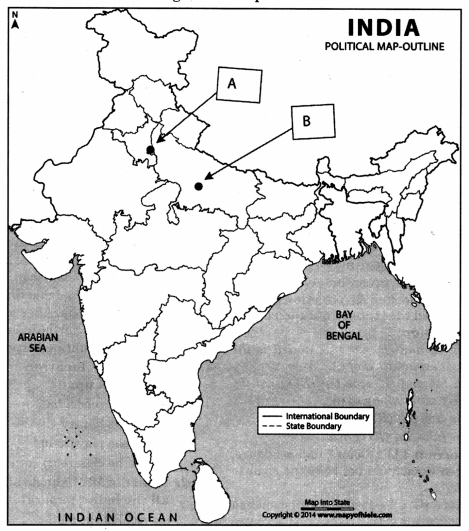
Locate and label the following on the map of India:
Answer:
1. The state that sends the largest number of MPs to the Lok Sabha.
2. The state/UT where the Election Commission of India headquarters is located.
Answer:
1. Uttar Pradesh-B
2. New Delhi-A.