A Peek Beyond the Point Class 7 Notes
hardA Peek Beyond the Point Class 7 Notes
A Peek Beyond the Point Class 7 Notes
Need for Smaller Units of Measurement
Fractions [latex]\frac {1}{10}[/latex], [latex]\frac {1}{100}[/latex], [latex]\frac {1}{1000}[/latex] etc.
One tenth [latex]\frac {1}{10}[/latex] One hundredth [latex]\frac {1}{100}[/latex]
One thousandth [latex]\frac {1}{1000}[/latex]
Decimal point and extending place value system on the right side of the decimal point.
Decimal numbers
Comparing decimals using >, = or <
Adding and subtracting decimals
Conversion
From cm to mm and mm to cm
From kg to g and g to kg
From ₹ to paise and paise to ₹
From fractions to decimals such as
3[latex]\frac {7}{10}[/latex] [latex]\frac {6}{100}[/latex] = [latex]\frac {376}{100}[/latex] = 3.76 etc.
CHAPTER AT A GLANCE
Important Terms and Their Meanings
1. Measurement : The process of determining the size, length, or amount of something using standard units. In this context, we measure lengths of objects like screws using a ruler.
2. Ruler/Scale : A tool used for measuring lengths. It typically has markings in centimetres (cm) and millimetres (mm). The unit length between two consecutive numbers (like 1 cm) is often divided into smaller parts for more precise measurements.
3. Centimetre (cm) : A metric unit of length equal to one hundredth of a metre. It is commonly used for measuring small objects.
4. Decimal Notation : A way of expressing numbers that includes a decimal point to separate the whole number part from the fractional part. For example, in the number 2.7, ‘2’ is the whole number and ‘T represents seven-tenths.
5. Place Value System : A numerical system where the position of a digit determines its value. For example, in the number 705 :
- 7 is in the hundreds place (7 × 100)
- 0 is in the tens place (0 × 10)
- 5 is in the units place (5 × 1)
6. Fractional Parts: Parts of a whole expressed as fractions. In decimal notation, these are represented as tenths, hundredths, etc. For example, 0.5 is five-tenths.
7. Decimal Point : A dot used to separate the whole number from the fractional part in decimal notation. For instance, in 3.14, the decimal point separates 3 (whole number) from 14 (fractional part).
8. Tenths, Hundredths, Thousandths: Terms used to describe the fractional parts of a whole: Understanding Tenths
- A tenth is one part of ten equal parts of a whole.
- The length 3.4 can be read as 3 units and 4 tenths.
- Real-world example : Fuel gauges in cars often show fuel levels in tenths.
Understanding A Hundredth Part
The concept of a hundredth part is rooted in the decimal system, which is based on the number 10. When we talk about splitting a unit into smaller parts, we can divide it into tenths, hundredths, and even smaller fractions.
Splitting a Unit:
- When we split a whole unit into 10 equal parts, each part is called a one-tenth ([latex]\frac {1}{10}[/latex]).
- If we take each one-tenth and split it further into 10 equal parts, we get one-hundredth ([latex]\frac {1}{100}[/latex]). Thus, there are 100 parts in a whole unit.
- Thousandths : One part of one thousand equal parts of a whole (e.g., 0.001).
9. Decimal Fractions : Fractions that have denominators that are powers of ten, such as 1/10, 1/100, and 1/1000. They can be expressed in decimal form.
10. Conversion : The process of changing a number from one form to another, such as converting fractions to decimals or vice-versa.
Main Components Explained
1. Why Divide Units into Smaller Parts : Dividing a unit into smaller parts allows for more accurate and precise measurements. For example, measuring a screw length as 2 cm and 7 tenths (2.7 cm) gives a clearer understanding of its size than just saying it is “about 2 cm.”
2. Reading and Writing Decimal Numbers : Understanding how to read decimal numbers is crucial. For example :
- 2.7 is read as “two point seven,” indicating two whole units and seven-tenths of a unit.
- 3.2 is read as “three point two,” indicating three whole units and two-tenths of a unit.
3. Place Value Table : A place value table helps visualize how numbers are constructed. For example, for the number 2.375 :
- 2 is in the units place (2 ones)
- 3 is in the tenths place (3 tenths)
- 7 is in the hundredths place (7 hundredths)
The Need for Smaller Units
The Importance of Smaller Units
- Smaller units help in achieving precise measurements.
- Real-world example: Tailors use millimetres to ensure clothing fits perfectly.
- Practical application : Engineers use precise measurements to ensure machinery parts fit together.
Units of Measurement
Length Conversion Scale between millimetres, centimetres, and meters:
| Millimeters (mm) | Centimeters (cm) | Meters (m) |
| 1 mm | 0.1 cm | 0.001 m |
| 10 mm | 1 cm | 0.01 m |
| 100 mm | 10 cm | 0.1 m |
| 1000 mm | 100 cm | 1 m |
Weight Conversion table
| Grams (g) | Kilograms (kg) |
| lg | 0.001 kg |
| 5 g | 0.005 kg |
| 10 g | 0.010 kg |
| 100 g | 0.100 kg |
| 500 g | 0.500 kg |
| 1000 g | 1.000 kg |
| 1500 g | 1.500 kg |
To convert grams to kilograms, you can use the formula:
Kilograms = [latex]\frac{\text { Grams }}{1000}[/latex]
Rupee to Paise Conversion Table
| Rupees (₹) | Paise (p) |
| 0.01 | 1 |
| 0.05 | 5 |
| 0.10 | 10 |
| 0.25 | 25 |
| 0.50 | 50 |
| 1.00 | 100 |
| 2.00 | 200 |
1 Rupee (₹) is equal to 100 Paise (p)
Locating and Comparing Decimals
Step-by-Step Process to find a missing value on a number line.
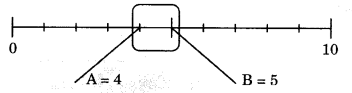
1. Identify the Starting and Ending Values:
Let’s say your starting value is (A) and your ending value is (B). For example, if (A = 1) and (B = 2), then you are looking at the segment of the number line between 1 and 2.
2. Determine the Total Length of the Segment : The total length of the segment on the number line is given by the difference (B - A). In our example, this would be :
B - A = 2 - 1 = 1.
3. Calculate the Length of Each Division : If the segment is divided into (n) equal parts, the length of each division is :
Length of each division = [latex]\frac{\mathrm{B}-\mathrm{A}}{n}[/latex]
For example, if (n = 10):
Length of each division = [latex]\frac {1}{10}[/latex] = 0.1
Addition and Subtraction of Decimals
When adding or subtracting decimal numbers, the process is similar to that of whole numbers, but we must pay attention to the decimal point. Here’s a step-by-step approach :
Step 1 : Align the Decimal Points. Make sure that the decimal points of the numbers you are adding or subtracting are aligned vertically. This helps in keeping the place values consistent.
Step 2 : Fill in Zeros if Necessary. If the numbers have different lengths, you can fill in zeros to make them of the same length. For example, if you are adding 2.72 and 3.5, you can write them as 2.72 and 3.50.
Step 3: Perform the Operation. Add or subtract as you would do with whole numbers, starting from the rightmost digit and moving to the left. Don’t forget to place the decimal point in the result directly below the other decimal points.
Example:

Decimal Sequences : A decimal sequence is a list of numbers that follow a specific pattern. To identify the change in a sequence, observe the difference between consecutive terms.
Estimating Sums and Differences : The sums and differences of decimal numbers is insightful. When adding two decimal numbers, the sum will always be greater than the sum of their whole number parts and less than two more than that sum.