A Square and a Cube Class 8 MCQ
mediumA Square and a Cube Class 8 MCQ
A Square and a Cube Class 8 MCQ
Question 1.
Consider the given set of numbers. {576, 615, 784, 961, 972, 1024, 1225, 1396} Which of these options correctly classifies the numbers as perfect and non- perfect square numbers?
(a)
| Perfect square numbers | Non-perfect square numbers |
| 615, 972, 1396 | 576, 784, 961, 1024, 1225 |
(b)
| Perfect square numbers | Non-perfect square numbers |
| 576, 784, 1024, 1225 | 615, 961, 972, 1396 |
(c)
| Perfect square numbers | Non-perfect square numbers |
| 576, 784, 961, 1024, 1225 | 615, 972, 1396 |
(d)
| Perfect square numbers | Non-perfect square numbers |
| 615, 972, 1024, 1396 | 576, 784, 961, 1225 |
Solution:
(c)
| Perfect square numbers | Non-perfect square numbers |
| 576, 784, 961, 1024, 1225 | 615, 972, 1396 |
Question 2.
Which of these is the digit at unit’s place in square of 1458?
(a) 1
(b) 4
(c) 5
(d) 6
Solution:
(b) 4
Question 3.
The digit at unit’s place of a square of a number is 2 more than the digit at unit place of that number. Which of these can be the digit at the unit’s place of the square of the number?
(a)1
(b) 3
(c) 5
(d) 9
Solution:
(d) 9
Question 4.
What is the square root of 144?
(a) 6
(b) 12
(c) 24
(d) 72
Solution:
(b) 12
Question 5.
Which of these is a prime factorisation of a square number?
(a) 2 × 3 × 5 × 5
(b) 3 × 3 × 4 × 5 × 5
(c) 2 × 2 × 3 × 5 × 5 × 7 × 7
(d) 2 × 2 × 3 × 3 × 5 × 5 × 11 × 11
Solution:
(d) 2 × 2 × 3 × 3 × 5 × 5 × 11 × 11
Question 6.
The prime factorisation of an even square number is as shown.
3 × 3 × 5 × 5 × 7 × 7 × 7 × p
What is the smallest value of p?
(a) 2
(b) 4
(c) 14
(d) 28
Solution:
(d) 28
Question 7.
Is 343 a perfect cube?
(a) Yes, because 3 is in one’s place.
(b) No, because it is an odd number.
(c) No, because the sum of the digits is not a perfect cube.
(d) Yes, because all its prime factors can be grouped in triples.
Solution:
(d) Yes, because all its prime factors can be grouped in triples.
Question 8.
Consider the given set of numbers. {215, 625, 841, 1000, 1331, 2744, 12321, 27000, 35937, 64000}
Which option correctly classifies the given numbers as cube numbers and non-cube numbers?
(a) There are 6 cube numbers and 4 non-cube numbers in the given set.
(b) There are 5 cube numbers and 5 non-cube numbers in the given set.
(c) There are 4 cube numbers and 6 non-cube numbers in the given set.
(d) There are 3 cube numbers and 7 non-cube numbers in the given set.
Solution:
(c) There are 4 cube numbers and 6 non-cube numbers in the given set.
Question 9.
Which digit comes in one’s place in the cube of 17325483?
(a) 1
(b) 3
(c) 7
(d) 9
Solution:
(c) 7
Question 10.
Which digit comes in one’s place in the result of the expression (21476 + 31520 + 41305 + 50697)3?
(a) 2 because 6 + 0 + 5 + 7 = 18 and 8 × 8 × 8 = 512
(b) 2 because 2 + 3 + 4 + 5 = 14 and 4 + 4 + 4 = 12
(c) 4 because 2 + 3 + 4 + 5 = 14 and 4 × 4 × 4 = 64
(d) 4 because 6 + 0 + 5 + 7 = 18 and 8 + 8 + 8 = 24
Solution:
(a) 2 because 6 + 0 + 5 + 7 = 18 and 8 × 8 × 8 = 512
Question 11.
How many consecutive odd numbers must be added to get the sum equal to 243?
(a) 2
(b) 4
(c) 20
(d) 24
Solution:
(d) 24
Question 12.
Which of the following expressions can be used to find the value of [(43 + 45 + 47 + 49 + 51 + 53 + 55) - (31 + 33 + 35 + 37 + 39 + 41)]?
(a) 1 × 6 × 5 + 3
(b) 1 × 6 × 5 × 3
(c) 1 × 7 × 6 + 3
(d) 1 + 7 × 6 × 3
Solution:
(d) 1 + 7 × 6 × 3
Case Study
Question 1.
Perfect Squares
(a) Which of these is not a perfect square number?
(i) 121
(ii) 196
(iii) 289
(iv) 325
(b) What is the square root of 121 ?
(c) What is the square root of 196 ?
(d) What is the square root of 289 ?
(e) What is the square root of 325 ?
(f) With what smallest number, the non-perfect square should be multiplied to make it a perfect square ?
Solution:
(a) (iv)
(b) 11
(c) 14
(d) 17
(e) not possible
(f) 13.
Question 2.
(a) The digit at unit place of a square of a number is 2 more than the digit at unit place of that number. Which of the following can be the digit at the unit place of the square of the number ?
(i) 1
(ii) 2
(iii) 5
(iv) 6
(b) Can there be some other digit(s) at the unit place of the square of the number in such a case ?
(c) If answer to (b) above is yes, write those digit(s).
(d) Are there numbers whose squares have the same unit digit as that of the number itself ?
(e) If answer to (d) above is yes, write the unit digits of such numbers.
Solution:
(a) (iv)
(b) Yes
(c) 4 and 9
(d) Yes
(e) 1, 5 and 6.
Perfect Cubes
Question 3.
Some numbers are written on the black-board :
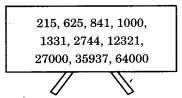
(a) For these numbers, which of the following statements is correct ?
(i) There are 5 perfect cubes and 5 are not perfect cubes.
(ii) There are 6 perfect cubes and 4 are not perfect cubes.
(iii) There are 3 perfect cubes and 7 are not perfect cubes.
(iv) There are 4 perfect cubes and 6 are not perfect cubes.
(b) What is the cube root of 2744 ?
(c) What is the cube root of 1331 ?
(d) What is the cube root of 35937 ?
(e) What is the cube root of 64000 ?
(f) By which least number 625 should be multiplied to make it a perfect cube ?
Solution:
(a) (ii)
(b) 14
(c) 11
(d) 33
(e) 40
(f) 25