The Baudhayana-Pythagoras Theorem Class 8 Notes
mediumThe Baudhayana-Pythagoras Theorem Class 8 Notes
The Baudhayana-Pythagoras Theorem Class 8 Notes
Doubling a Square
Baudhayana’s Sulba-Sutra
- Combine squares to form a right triangle.
- Use the hypotenuse to create a new square.
- The new square's area equals the sum of the original squares.
- This method shows how to double a square’s area.
Diagonal of a Square : When you draw the diagonal of a square, the area of the new square formed using this diagonal will be double the area of the original square.
Halving a Square
The side of a square whose area is half that of the original square:
s' = [latex]\sqrt{\frac{s^2}{2}}=\frac{s}{\sqrt{2}}[/latex].
The area of the new square will be [latex]\frac{s^2}{2}[/latex].
Hypotenuse of an Isosceles Right Triangle
The hypotenuse is the longest side of 'a right triangle opposite the right angle.
Length of the Hypotenuse : In an isosceles right triangle, if the lengths of the two equal sides are (1) unit each, the length of the hypotenuse is given by:
Hypotenuse = [latex]\sqrt{1^2+1^2}[/latex] = [latex]\sqrt{2}[/latex] units.
Decimal Representation of [latex]\sqrt{2}[/latex]:
- [latex]\sqrt{2}[/latex] cannot be expressed as a fraction [latex]\frac{m}{n}[/latex], where (m) and (n) are counting numbers.
- It is a non-terminating decimal, approximately (1.41421356...).
Terminating and Non-Terminating Decimals:
- Terminating Decimal: A decimal that ends, like (0.75).
- Non-Terminating Decimal: A decimal that goes on forever, like [latex]\sqrt{2}[/latex] = 1.41421356...).
Combining Two Different Squares
Area of the Square from the Diagonal: The area of the square formed by the diagonal of a rectangle is equal to the sum of the areas of the squares formed by the two sides.
Combining Different Squares : To combine two different squares:
- Mark a rectangular portion of the larger square using the side of the smaller square.
- The diagonal of this rectangle will be the side of a new square.
- This new square’s area equals the sum of the areas of the two smaller squares.
Baudhayana’s Theorem on Right-Angled Triangles : Baudhayana’s Theorem states that in a right triangle, the square of the length of the hypptenuse (c) is equal to the sum of the squares of the lengths of the other two sides (a) and (b):
a² + b² = c².
Right-Triangles Having Integer Sidelengths
Baudhayana Triples : Baudhayana triples (or Baudhayana-Pythagorean triples) are sets of three positive integers ((a, b, c)) that satisfy the equation a² + b² = c². They are also known as Pythagorean triples.
Conjecture on Baudhayana Triples : The conjecture states that ((3k, 4k, 5k)) is a Baudhayana triple, where (k) is any positive integer. This means we can generate more triples by multiplying each termofthe basic triple (3, 4, 5) by (k).
Scaled Version: A scaled version of a Baudhayana triple is obtained by multiplying all three sides of a basic triple by the same positive integer (k).
Primitive Baudhayana Triple : A primitive Baudhayana triple is one where (a), (b), and (c) are coprime (they have no common factors other than 1). For example, (3,4,5) is a primitive triple, while (6,8,10) is not because they share a common factor of 2.
Sum of the First (n) Odd Numbers : The sum of the first (n) odd numbers is given by (n²).
Sum of the First ((n - 1)) Odd Numbers : The sum of the first ((n -1)) odd numbers is ((n -1 )²).
Using the Equation : Yes, we can obtain a Baudhayana triple using the equation ((n - 1)² + (2n - 1) = n²) by substituting the appropriate values for (n).
Doubling a Square
Baudhayana’s Sulba-Sutra
- Baudhayana lived around 800 BCE and studied geometry.
- He explored constructing squares with specific areas.
- Doubling a square’s area is achieved using diagonals.
- His work influenced later mathematicians, including Pythagoras.
How to Construct a Square with Double the Area of a Given Square
To construct a square that has double the area of a given square, follow these steps :
1. Start with a Square : Begin with a square, let’s call it Square A, with a side length of (s). The area of this square is given by the formula : Area of square = A = s²
2. Understand the Area Relationship : To find a new square (Square B) that has double the area of Square A, we need :
Area of square = B = 2 × s²
This means the area of Square B should equal 2s².
3. Using the Diagonal : Baudhayana discovered that the diagonal of Square A can be used to construct Square B. The diagonal d of Square A can be calculated using the Pythagorean theorem :
d = [latex]\sqrt{s^2+s^2}[/latex]2 = [latex]\sqrt{2 s^2}[/latex] = s[latex]\sqrt{2}[/latex].
4. Constructing Square B : Now, construct a square using the diagonal d as one of its sides. The area of Square B is :
Area of square = B = d² = [latex](s \sqrt{2})^2[/latex] = 2s².
Thus, Square B has double the area of Square A.
We learn - The diagonal of a square produces a square of double the area of the original square.
Halving a Square
Constructing a square whose area is half of the original square
Start with a square : Imagine you have a square with a side length of (s). The area of this square is given by the formula :
Area = s²
Finding half the area : To find a square with half this area, we need to calculate :
[latex]\frac{s^2}{2}[/latex]
Finding the side length of the new square:
Let’s denote the side length of the new square as (s'). The area of the new square will be :
Area = (s')²
We want this area to equal half of the original area:
(s')² = [latex]\frac{s^2}{2}[/latex]
Solving for (s') : To find (s'), we take the square root of both sides :
s' = [latex]\sqrt{\frac{s^2}{2}}[/latex] = [latex]\frac{s}{\sqrt{2}}[/latex]

Hypotenuse of an Isosceles
Right Triangle
Definition of Hypotenuse: In a right triangle, the hypotenuse is the side opposite the right angle. It is the longest side of the triangle. For an isosceles right triangle, where the two other sides are of equal length, the hypotenuse can be found using the Pythagorean theorem.
Length of the Hypotenuse in an Isosceles Right Triangle
For an isosceles right triangle with equal sides of length a, the relationship between the sides and the hypotenuse c is given by :
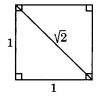
c² = a² + a² = 2 a²
Thus, the length of the hypotenuse (c) is :
c = [latex]\sqrt{2 a^2}[/latex] = a[latex]\sqrt{2}[/latex]
If we take (a = 1), then :
c = 1[latex]\sqrt{2}[/latex] = [latex]\sqrt{2}[/latex]
So, for an isosceles right triangle with each side of length 1, the hypotenuse is [latex]\sqrt{2}[/latex] .
Decimal Representation of [latex]\sqrt{2}[/latex]
Can [latex]\sqrt{2}[/latex] be expressed as a fraction [latex]\frac{m}{n}[/latex] ?
The number [latex]\sqrt{2}[/latex] cannot be expressed as a fraction [latex]\frac{m}{n}[/latex], where (m) and (n) are counting numbers (positive integers). This is because if we assume [latex]\sqrt{2}[/latex] = [latex]\frac{m}{n}[/latex], squaring both sides gives :
2 = [latex]\frac{m^2}{n^2}[/latex] ⇒ 2n² = m².
This means that m² is even, which implies m is also even. If m = 2k for some integer k, substituting back gives :
2n² = (2k)² = 4k² ⇒ n² = 2k².
This means n2 is also even, so (n) must be even as well. This leads to a contradiction because both (m) and (n) cannot be even if they are in their simplest form.
Therefore, [latex]\sqrt{2}[/latex] is a non-terminating decimal.
Definitions of Decimal Types
Non-Terminating Decimal : A non-terminating decimal is a decimal that goes on forever without repeating. For example, [latex]\sqrt{2}[/latex] is approximately (1.41421356...) and continues indefinitely.
Terminating Decimal: A terminating decimal is a decimal that has a finite number of digits after the decimal point. For example, (0.75) is a terminating decimal because it ends after two decimal places.
Combining Two Different Squares
When we have two squares with side lengths (a) and (b), their areas are given by :
• Area of the first square : (A = a²)
• Area of the second square : (B = b²)
To find the area of a new square that combines these two squares, we need to understand how the diagonal of a rectangle formed by these two squares relates to their areas.
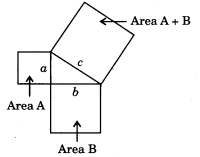
1. Constructing the Right Triangle :
Imagine placing the two squares next to each other such that one square has side length (a) and the other has side length (b).
If we draw a right triangle where the two sides are the lengths of the squares, we can denote the hypotenuse as (c).
2. Using the Diagonal:
The diagonal of the rectangle formed by the two squares is (c), which can be calculated using the Pythagorean theorem:
c² = a² + b²
Area of the new square = c² = a² + b²
This method shows how different squares can be combined geometrically to form a new square.
Baudhayana’s Theorem on Right-angled Triangles
Baudhayana’s Theorem is a fundamental theorem in geometry that applies to right-angled triangles. It states :
If a right-angled triangle has side lengths (a), (b), and (c), where (c) is the length of the hypotenuse, then :
a² + b² = c².
Practical Example :
Suppose we have a right triangle where (a = 3) cm and (b = 4) cm. According to Baudhayana’s Theorem :
c² = a² + b² = 3² + 4² = 9 + 16 = 25
Thus, c = [latex]\sqrt{25}[/latex] = 5 cm.
Right-Triangles Having Integer Sidelengths
Definition of Baudhayana Triples
Baudhayana triples, also known as Baudhayana- Pythagoras triples, Pythagorean triples, or right-angled triangle triples, are sets of three positive integers ((a, b, c)) that satisfy the equation :
a² + b² = c²
In this equation, (c) represents the length of the hypotenuse (the longest side) of a right-angled triangle, while (a) and (b) are the lengths of the other two sides. This relationship is fundamental in geometry and is known as the Pythagorean Theorem.
Baudhayana Triples with Numbers Less Than or Equal to 20
The Baudhayana triples with integer values less than or equal to 20 are :
((3, 4, 5)), ((6, 8, 10)), ((9, 12, 15)), ((12, 16, 20)) These triples can be verified by checking that the sum of the squares of the two shorter sides equals the square of the hypotenuse. For example, for the triple ((3, 4, 5)):
3² + 4² = 9 + 16 = 25 = 5²
Conjecture on Baudhayana Triples
From the observation of the triples listed, we can form a conjecture :
Conjecture : ((3k, 4k, 5k)) is a Baudhayana triple, where (k) is any positive integer.
This means that if we multiply each side of the primitive triple ((3, 4, 5)) by a positive integer (k), we will still have a valid Baudhayana triple.
To verify this conjecture, we can check :
(3k)² + (4k)² = 9k² + 16k² = 25k² = (5k)²
Thus, the conjecture holds true, confirming that there are infinitely many Baudhayana triples.
Scaled Version of Baudhayana Triples
A scaled version of a Baudhayana triple is obtained by multiplying each element of a Baudhayana triple ((a, b, c)) by a positive integer (k). For example, if we take the triple ((3, 4, 5)) and scale it by (k = 2), we get:
(2 × 3, 2 × 4, 2 × 5) = (6, 8, 10)
This new triple ((6, 8, 10)) is also a Baudhayana triple, as it satisfies the Pythagorean theorem :
6² + 8² = 36 + 64 = 100 = 10²
Primitive Baudhayana Triples
A primitive Baudhayana triple is a triple where the three numbers have no common factor greater than 1. For example, the triple ((3, 4, 5)) is primitive because the greatest common divisor (GCD) of 3,4, and 5 is 1.
In contrast, the triple ((6, 8, 10)) is not primitive because all three numbers can be divided by 2.
Examples of Primitive Baudhayana Triples :
((3, 4, 5)), ((5, 12, 13))
The Sum of the First (n) Odd Numbers
The sum of the first (n) odd numbers is given by the formula:
1 + 3 + 5 + ... + (2n - 1) = n²
This means that if you add up the first (n) odd numbers, the result will always be a perfect square.
The Sum of the First ((n - 1)) Odd Numbers
The sum of the first ((n - 1)) odd numbers can be expressed as :
1 + 3 + 5 + ... + (2 (2n - 1) - 1) = (n - 1)²
This follows from the same principle that the sum of the first (n) odd numbers is (n²).
Using the Equation ((n - 1)² + (2n - 1) = n²)
Yes, we can obtain a Baudhayana triple using the equation ((n - 1)² + (2n - 1) = n²).
For example, if we take (n = 5):
• The (M)th odd number is (2n - 1= 9).
• The sum of the first ((n - 1)) odd numbers is ((n- 1)² = 4² = 16).
Thus, we have:
4² + 9 = 16 + 9 = 25 = 5²
This confirms that ((4, 9, 5)) is indeed a Baudhayana triple, illustrating how we can generate such triples through this method.
A Long-Standing Open Problem
Fermat’s Last Theorem
Fermat’s Last Theorem is a famous statement in mathematics that was proposed by Pierre de Fermat in the 17th century. The theorem states that:
There are no three positive integers (x), (y), and (z) that satisfy the equation :
xn + yn = zn
for any integer value of (n) greater than 2.
This means that while it is possible to find sets of integers that satisfy the equation when (n = 2) (like the well- known Pythagorean triples such as ((3, 4, 5)), no such sets exist for (n = 3) or higher.
In 1994, a British mathematician named Andrew Wiles, after years of intense study and work, finally proved Fermat’s Last Theorem. His proof was complex and involved advanced concepts from algebraic geometry and number theory.
Further Applications of the Baudhayana-Pythagoras Theorem
A Problem from Bhaskaracharya’s Lllavat
The Lotus Problem
One famous problem from the Lilavati is as follows : “In a lake surrounded by chakra and krauncha birds, there is a lotus flower peeping out of the water, with the tip of its stem 1 unit above the water. On being swayed by a gentle breeze, the tip touches the water 3 units away from its original position. Quickly tell the depth of the lake.”
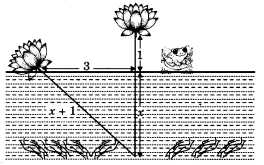
- One side (the distance the tip moves) is 3 units.
- The other side (the submerged part of the stem) is (x).
- The hypotenuse (the total length of the stem) is (x + 1).
Applying the Baudhayana-Pythagoras Theorem : According to the theorem, we have :
a² + b² = c²
Here, substituting our sides, we get:
3² + x² = (x + 1)²
Simplifying this :
9 + x² = x² + 2x + 1
Subtracting (x²) from both sides gives :
9 = 2x + 1
Now, we can slove for (x):
9 - 1 = 2x
8 = 2x
x = 4
So, the depth of the lake is 4 units.