A Story of Numbers Class 8 Notes
easyA Story of Numbers Class 8 Notes
A Story of Numbers Class 8 Notes
Yajurveda Samhita
Ancient Indian text part of the Vedas.
Contains hymns and rituals.
References to numbers based on powers of ten:
One = eka
Ten = dasha
Hundred = shata
Thousand = sahasra
Early understanding of counting and the decimal system.
Arabic Numerals
Ten symbols :0,1,2,3,4,5,6,7,8,9.
Originated in India, transmitted to the Arab world, and then to Europe.
Introduction of 0 was revolutionary for place value.
Mechanism of Counting
Counting = determining quantity of objects.
One-to-one correspondence : Each object gets a number.
Number System
Standardized way to represent numbers using symbols or names.
Most common today : Hindu-Arabic numeral system (0-9, place value).
Roman Number System
Uses Latin letters to represent numbers: I = 1, V = 5, X = 10, L = 50, C = 100, D = 500, M = 1000.
Limitations : Difficult for large numbers and arithmetic.
Numerals
Symbols representing numbers.
In Hindu-Arabic: 0-9, with positional value
(e.g., in 345,3 = 300).
Some Early Number Systems
Tally Marks
Simple counting method using lines.
Example: 1 = |, 2 = ||, 3 = |||, 4 = ||||, 5 = |||||.
Counting in Twos (Gumulgal People)
Unique naming based on pairs.
Roman Numerals
Instructions for writing: Combine letters, subtract smaller before larger, add otherwise.
| Numeral | Value | Mnemonics |
| I | 1 | Ι |
| V | 5 | Value |
| X | 10 | X-Rays |
| L | 50 | Like |
| C | 100 | Cows |
| D | 500 | Do |
| M | 1000 | Milk |
Landmark N umbers
Significant reference points (1,10,100,1000) . Helps in breaking down larger numbers for calculations.
The Abacus
Ancient tool for counting using beads on rods.
Each rod represents different place values.
Advantages of Hindu Number System
Place Value System : Position of digits determines value.
Use of Zero : Allows representation of empty values and efficient calculations.
Simple Arithmetic : Easier than Roman numerals for calculations.
The Idea of a Base
Egyptian Number System
Non-positional, fixed symbol values.
Used symbols for landmark numbers.
Base-n System
Refers to unique digits used (e.g., base-10 uses 0-9).
Example: Base-5 uses digits 0,1,2,3,4.
Advantages of Base-n Systems
Efficient representation, simplified arithmetic, flexibility.
Place Value Representation
Mayan Number System
Base-20, using dots and bars.
Placeholder for zero.

Chinese Number System
Written system for recording quantities.
Rod numerals for calculations.
Hindu Number System
Positional system, discovery of zero.
Foundation for modem algebra with concepts of rings.
Reema’s Curiosity
Yajurveda Samhita : The Yajurveda Samhita is an ancient Indian text that is part of the Vedas, which are the oldest sacred scriptures of Hinduism. This text contains hymns and rituals used in sacrifices and ceremonies. Importantly, it also includes references to numbers, showcasing how ancient Indians had names for numbers based on powers of ten. For example :
One is called eka.
Ten is called dasha.
Hundred is called shata.
Thousand is called sahasra.
These names illustrate an early understanding of counting and the decimal system, which is foundational to our modem number system.
Arabic Numerals : Arabic numerals are the ten symbols we use today to represent numbers : 0, 1, 2, 3, 4, 5, 6, 7, 8, and 9. They originated in India and were transmitted to the Arab world, where they were popularised and then brought to Europe.
The introduction of the numeral 0 was particularly revolutionary, as it allowed for the represen¬tation of large numbers and the concept of place value.
The Mechanism of Counting: Counting is the process of determining the quantity of a collection of objects. The mechanism of counting involves creating a one-to-one correspondence between the objects and a standard sequence of numbers. This means that for every object, you assign one number from your counting system. For example, if you have five apples, you would count them as follows :
- Apple |
- Apple ||
- Apple |||
- Apple ||||
- Apple |||||
This method ensures that you account for each object without missing any.
Number System : A number system is a standardised way of representing numbers using symbols or names. It provides a consistent method for counting, performing calculations, and communicating numerical information. The most common number system today is the Hindu-Arabic numeral system, which uses ten digits (0-9) and is based on place value.
Roman Number System: The Roman numeral system uses combinations of letters from the Latin alphabet to represent numbers. Here are some basic Roman numerals :
I = 1 V = 5 X = 10 L = 50
C = 100 D = 500 M = 1000
For example, the number 27 is represented as XXVII (10 + 10 + 5 + 1 + 1). While this system was widely used in Europe, it has limitations in representing large numbers and performing arithmetic operations efficiently.
Numerals : Numerals are the symbols used to represent numbers in a number system. In the Hindu-Arabic system, numerals include digits from 0 to 9. Each numeral has a specific value depending on its position in a number. For example, in the number 345, the numeral 3 represents 300 (3 hundreds), 4 represents 40 (4 tens), and 5 represents 5 (5 units).
Arithmetic with Sticks : To perform arithmetic operations using sticks (Method 1), you can use the following methods :
- Addition : Combine the collections of sticks. For example, if you have 3 sticks and you want to add 2 more, you simply put them together to have a total of 5 sticks.
- Subtraction : Remove sticks from the collection. If you have 5 sticks and you take away 2, you count how many are left, which would be 3 sticks.
- Multiplication : Create groups of sticks. For example, if you want to multiply 3 by 2, you can make 2 groups of 3 sticks each, resulting in a total of 6 sticks.
- Division : Split the sticks into equal groups. If you have 6 sticks and want to divide them into 3 equal groups, you would have 2 sticks in each group.
Extending Method 2 : To extend the number system in Method 2 using strings with more than one letter, you can create combinations of letters to represent larger numbers. For example :
‘a’= 1
‘b’ = 2
......
‘z’ = 26
‘aa’ = 27
‘ab’ = 28
‘ac’ = 29
and so on.
You can continue this pattern by adding more letters to represent larger numbers. For instance, ‘aaa’ could represent 703 (26 × 26 + 1). This method allows you to represent an infinite number of values by combining letters creatively.
Some Early Number Systems
Tally Marks : Tally marks are a simple way of counting and recording numbers using lines. Each line represents one unit, and when a group of five is reached, the fifth line is drawn diagonally across the previous four lines to create a bundle. This method allows for quick counting and is especially useful when keeping track of quantities, such as items or events.
For example:
- 1 is represented as |
- 2 is represepted as ||
- 3 is represented as |||
- 4 is represented as ||||
- 5 is represented as |||||
This system is intuitive and easy to use, making it one of the earliest forms of numerical representation.
Number Names Obtained by Counting in Twos : In some cultures, like the Gumulgal people of Papua New Guinea, counting is done in groups of two. This method is efficient because it reduces the number of distinct words needed for larger numbers.
The Gumulgal people of Australia have a unique way of naming numbers that is based on counting in twos.
The Gumulgal number names are formed by combining the word for 2, which is ‘ukasar’, with the word for 1, which is ‘urapon’.
| Number | Gumulgal Name |
| 1 | urapon |
| 2 | ukasar |
| 3 | ukasar-urapon |
| 4 | ukasar-ukasar |
| 5 | ukasar-ukasar-urapon |
| 6 | ukasar-ukasar-ukasar |
The Roman Numerals : Roman numerals are a numeral system originating from ancient Rome, using combinations of letters from the Latin alphabet. Here’s a table summarizing the basic Roman numerals :
| Roman Numeral | Value | Mnemonics |
| I | 1 | Ι |
| V | 5 | Value |
| X | 10 | X-Rays |
| L | 50 | Like |
| C | 100 | Cows |
| D | 500 | Do |
| M | 1000 | Milk |
Mnemonics for Remembering Roman Numerals : A helpful mnemonic to remember the values is : ‘I Value Xylophones Like Cows Do Milk’. Each first letter corresponds to the Roman numeral.
Instructions to Write Roman Numerals :
- Combine letters to form numbers, starting from the largest value to the smallest.
- If a smaller numeral precedes a larger one, subtract its value (e.g., IV = 4).
- If a smaller numeral follows a larger one, add its value (e.g., VI = 6).
Landmark Numbers : Landmark numbers are significant numbers that serve as reference points for counting and calculations. For example, in the Hindu number system, landmark numbers include 1, 10, 100, 1000, etc. These numbers help in breaking down larger numbers into manageable parts, making arithmetic operations easier.
For instance, to add the number 2367, you can break it down into landmark numbers :
2367 = 2000 + 300 + 60
So in Roman numerals, this number is MMCCCLXVII.
The Abacus : .The abacus is an ancient counting tool that consists of a frame with rods or wires, on which beads are moved to represent numbers. Each rod typically represents a different place value (units, tens, hundreds, etc.). The abacus allows users to perform arithmetic operations like addition, subtraction, multiplication, and division efficiently by manipulating the beads.
Advantages of Hindu Number System over Roman Number System
- Place Value System : The Hindu number system uses a place value system where the position of a digit determines its value (e.g., in the number 2367, the ‘2’ represents 2000, not just 2). This allows for concise representation of large numbers.
- Use of Zero : The inclusion of zero as a numeral is a significant advancement. It allows for the representation of empty values and facilitates calculations, making it easier to perform arithmetic operations.
- Simple Arithmetic Operations : The Hindu number system is designed to support straightforward arithmetic operations. Unlike Roman numerals, which can be cumbersome for calculations (e.g., adding CCXXXII + CCCCXIII), the Hindu system allows for direct addition and multiplication using the digits 0-9.
The Idea of a Base
I. The Egyptian Number System
The Egyptian number system is one of the earliest known numeral systems. It was a non- positional system, meaning that the value of a symbol did not depend on its position in a number. Instead, each symbol had a fixed value. The Egyptians used specific symbols to represent different landmark numbers, which were primarily based on powers of 10.
Symbols of the Egyptian Number System
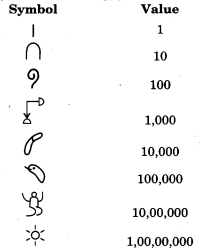
Example of the Egyptian Number System
To represent the number 123 in the Egyptian system, you would use :
1 symbol for 100 
2 symbols for 10 
3 symbols for 1 
So, 123 would be written as : 
Variations on the Egyptian System : While the Egyptian system was effective for its time, it had limitations. One significant limitation was that it required an ever-increasing number of symbols for larger numbers. This led to the exploration of different bases for number systems.
The Notion of Base : A base in a number system refers to the number of unique digits, including zero, that a numeral system uses to represent numbers. The most common base is base 10 (decimal), which uses the digits 0 through 9.
Base-5 System : A number system based on grouping collections of size equal to a previous landmark number. For instance, if we group collections of 5, we can create a base-5 system.
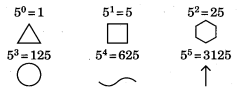
In a base-5 system, the digits used would be 0, 1, 2, 3, and 4. Each digit’s position represents a power of 5. For example, the base-5 number 243 would be calculated as follows :
2 × 5² + 4 × 51 + 3 × 50 = 2 × 25 + 4 × 5 + 3 × 1
= 50 + 20 + 3 = 73 in base 10.
Decimal Number System : The decimal number system, also known as the base-10 system, is the most widely used number system today. It is a positional system where the value of a digit depends on its position in the number. Each position represents a power of 10.
Example of the Decimal System
For example, in the number 345 :
- The digit 3 is in the hundreds place, representing (3 × 10² = 300).
- The digit 4 is in the tens place, representing (4 × 101 = 40).
- The digit 5 is in the ones place, representing (5 × 100 = 5).
So, (345 = 300 + 40 + 5).
Advantages of a Base-n System
- Efficient Representation : A base-n system allows for a compact representation of numbers. For example, in base-2, the number 10 is represented with just two digits (1 and 0), rather than needing a separate symbol for each quantity.
- Simplified Arithmetic : When using land¬mark numbers (powers of the base), multiplication and division become easier. For instance, multi¬plying by 10 in the decimal system simply involves shifting digits.
- Place Value : The position of a digit in a base-n system determines its value, which allows for a systematic way to represent large numbers without needing an infinite number of symbols.
- Flexibility: Different bases can be used for different applications. For example, base-2 (binary) is used in computing, while base-60 (sexagesimal) is used for measuring time.
Abacus that Makes Use of the Decimal System
The abacus is an ancient calculating tool that uses a series of rods and beads to represent numbers. In the decimal system, each rod represents a different power of 10.
- The rightmost rod represents (10°) (ones).
- The next rod to the left represents (101) (tens).
- This continues with (10²) (hundreds), (103) (thousands), and so on.
To represent a number, you place beads on each rod according to the value of the number. For example, to represent the number 3426 :
- 3 beads on the hundreds rod,
- 4 beads on the tens rod,
- 2 beads on the ones rod,
- 6 beads on the thousands rod.
Shortcomings of the Egyptian System
- Non-Positional: The Egyptian system was non-positional, meaning that the value of a symbol did not change based on its position. This made it less efficient for representing large numbers compared to positional systems like the decimal system.
- Limited Symbols : The number of symbols was limited, which made it cumbersome to represent very large numbers without using many symbols.
- Ambiguity : Without a clear positional value, it could be confusing to read numbers, especially when they were written without spaces or separators.
- Complexity in Arithmetic : Performing arithmetic operations like addition and multi¬plication was more complicated in the Egyptian system compared to a base-n system, where land¬mark numbers simplify calculations.
Place Value Representation
I. The Mesopotamian Number System
The Mesopotamian number system is one of the earliest known number systems, used by ancient civilizations in the region of Mesopotamia (modern- day Iraq). This system is particularly interesting for a few reasons :
1. Sexagesimal System: The Mesopotamians developed a sexagesimal system, which is a base- 60 number system. This means that instead of counting in tens (like our decimal system), they counted in sixties. The choice of 60 as a base is thought to be influenced by various factors, such as the lunar calendar and the ease of dividing’ 60 into fractions (for example, 60 can be divided by 2, 3, 4, 5, 6, 10, 12, 15, 20, 30, etc.). This system is still evident today in our time measurements : 1 hour = 60 minutes and 1 minute = 60 seconds.

2. Babylonian Number System : The Babylonian number system is a specific implemen-tation implementation of the sexagesimal system. It used a combination of symbols to represent numbers. For instance, they had a symbol for 1 and a different symbol for 10. Numbers were represented by stacking these symbols vertically, where the position indicated the value (e.g., the symbol for1 in the units place, the symbol for 10 in the tens place, and so on). This system, however, had some limitations, such as ambiguity in reading numbers due to inconsistent spacing.
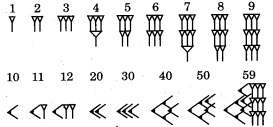
3. Positional Number System or Place Value System : The Mesopotamian system is an early example of a positional number system. In a positional system, the value of a numeral depends on its position. For example, in our decimal system, the number 21 means 2 tens and 1 unit. Similarly, in the Babylonian system, the position of a symbol determined its value, which was a significant advancement in the representation of numbers.
II. The Mayan Number System
The Mayan number system was used by the ancient Maya civilization and is notable for its unique features :
- It is a base-20 system, meaning it counts in twenties. This is different from our base-10 system.
- The Mayans used a combination of dots and bars to represent numbers. A dot represented 1, and a bar represented 5. For example, the number 7 would be represented by two dots and one bar.
-

- They also had a placeholder symbol for zero, which was a significant advancement in number systems. This allowed them to represent large numbers efficiently.
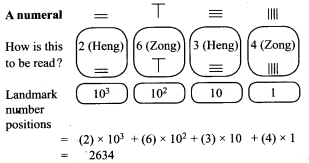
III. The Chinese Number System
The Chinese number system is quite interesting as it includes two distinct systems :
1. Written System : This system was used for recording quantities and is similar to how we write numbers today.
2. Rod Numerals : The rod numeral system was developed for performing calculations. This system used rods of different lengths to represent numbers. For example, a long rod might represent 10, while a short rod might represent 1. This system was efficient for both writing and computing, allowing for quick calculations.
3. 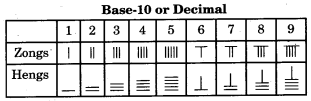
Note : The zongs represent units, hundreds, tens of thousands, etc. and the hengs tens, thousands, hundreds of thousands, etc.
4. Example Number 2634
IV. The Hindu Number System
The Hindu number system, also known as the Hindu-Arabic number system, is the most widely used number system today. It has several key features :
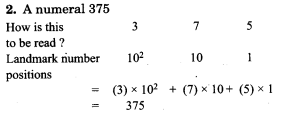
1. Place Value System: Like the Mesopotamian system, the Hindu number system is a positional or place value system. Each digit’s value is determined by its position in the number. For example, in the number 345, the 3 represents 300, the 4 represents 40, and the 5 represents 5.
3. Discovery of Zero : One of the most significant contributions of the Hindu number system is the concept of zero (0). Zero was not just a placeholder but was also treated as a number in its own right. This allowed for the representation of all numbers unambiguously and enabled efficient computation. The mathematician Brahmagupta formalised the rules for using zero in arithmetic operations, which was revolutionary.
4. Ring : In mathematics, a ring is a set of numbers that is closed under certain operations, such as addition and multiplication. This means that if you take any two numbers in the set and add or multiply them, the result will also be in the set. The introduction of zero and negative numbers by Indian mathematicians helped form the foundation of modem algebra, making the concept of a ring very important.