A Tale of Three Intersecting Lines Class 7 MCQ
hardA Tale of Three Intersecting Lines Class 7 MCQ
A Tale of Three Intersecting Lines Class 7 MCQ
Question 1.
In a ∆PQR, ZP = 55° and the length of side QR is 18 cm. What could be the measures of remaining parts of the triangle such that ∆PQR is an obtuse scalene triangle?
(a) ∠Q = 100°, ∠R = 25°, PQ = 18 cm and PR = 12 cm.
(b) ∠Q = 110°, ∠R = 15°, PQ = 6 cm and PR = 20 cm.
(c) ∠Q = 90°, ∠R = 35°, PQ = 18 cm and PR = 18 cm.
(d) ∠Q = 65°, ∠R = 60°, PQ = 12 cm and PR = 14 cm.
Solution:
(b) ∠Q = 110°, ∠R = 15°, PQ = 6 cm and PR = 20 cm.
Question 2.
Observe the figure below :
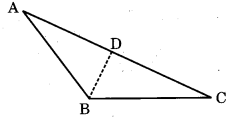
Which of these statements is NOT correct?
(a) Angle opposite to side AB in ∆ABC. is ∠BCA.
(b) Vertex opposite to the side DA in ∆ABD is A.
(c) The side opposite to vertex D in ∆BCD is BC.
(d) The side opposite to vertices A and C in ∆ABD and ∆BCD is BD.
Solution:
(b) Vertex opposite to the side DA in ∆ABD is A.
Question 3.
Observe the figure below :
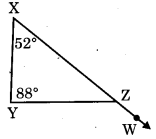
What is the measure of ∠YZW?
(a) 36°
(b) 40°
(c) 140°
(d) 144°
Solution:
(c) 140°
Question 4.
Two triangles are joined to form a rectangle. How many side(s) in each triangle is/are also the altitude(s)?
(a) no side
(b) 1
(c) 2
(d) 3
Solution:
(c) 2
Question 5.
In the triangle shown, m∠RST = 2(m∠QRS) and m∠PQS = 2(m∠QSR).
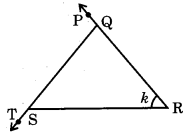
Which of the following is true about the triangle QRS?
(a) It is a scalene triangle
(b) It is an isosceles triangle
(c) It is an equilateral triangle
(d) It is a right-angled triangle
Solution:
(c) It is an equilateral triangle
Case Study
Question 1.
Here is a Model depicting how a shell grows:
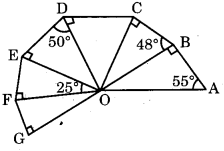
Fill in the blanks :
(a) Measure of angle AOB is _______.
(b) Measure of angle BOC is _______.
(c) Measure of angle FOG is _______.
(d) Measure of angle AOG is _______.
(e) Measure of angle DOE is _______.
(f) Measure of angle DCO is _______.
(i) 25° (ii) 28° (iii) 55° (iv) 62°
Solution:
(a) 35°;
(b) 42°;
(c) 35°;
(d) 145°;
(e) 40°;
(f) (iv).
Question 2.
The teacher draw two triangles adjacent to each other on the blackboard and name them as ABC and ADC.
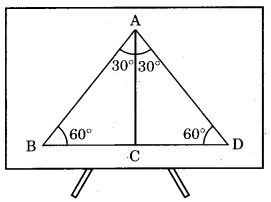
(a) What is the measure of ∠ACB?
(b) What is the measure of ∠ACD?
(c) Are B, C and D are collinear points?
(d) What type of triangle is ∆ABD?
(e) Is AC an altitude of ∆ABD?
Answer:
(a) 180° - 60° - 30° = 90°
(b) 180° - 60° - 30° = 90°
(c) Yes, because 90° + 90° = 180°.
(d) Equilateral triangle.
(e) Yes, because ∠ACB = ∠ACD = 90°.