A Tale of Three Intersecting Lines Class 7 Notes
hardA Tale of Three Intersecting Lines Class 7 Notes
A Tale of Three Intersecting Lines Class 7 Notes
Triangles
Equilateral
Isosceles
Scalene
Right angled
Obtuse angled
Acute angled
Properties of Triangles
Sum of any two sides is greater than the third side
Difference of any two sides is less than the third side
Sum of the three angles = 180°
An exterior angle of a triangle is equal to sum of two interior opposite angles
Constructing Triangles
Given three sides (SSS) Given two sides and included angle (SAS) Given two angles and the included side (ASA) Draw altitudes of a triangle, using set-square
CHAPTER AT A GLANCE
Important Terms and Their Meanings
1. Understanding Triangles
- A triangle is a basic closed shape with three vertices and three sides.
- The vertices are the corner points, and the sides are the line segments connecting these vertices.
- Triangles can be named using their vertices in any order, such as ∆ABC or ∆CAB.
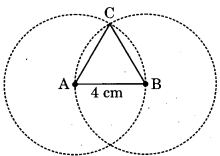
In an equilateral triangle all three sides are of equal length. This property also means that all three angles in an equilateral triangle are equal, each measuring 60°.
To construct an equilateral triangle with a given side length(s), follow these steps :
(a) Draw the Base : Start by drawing a straight line segment (AB) of length(s).
(b) Set the Compass: Place the compass point on point (A) and draw an arc with radius(s).
(c) Draw Another Arc : Without changing the compass width, place the compass point on point (B) and draw another arc. The two arcs will intersect at a point, which we can label as point (C).
(d) Join the Points : Finally, join points (A) and (C), and points (B) and (C) to form triangle (ABC).
2. Vertices : The points where two sides meet. In ∆ABC, the vertices are A, B, and C.
3. Triangle Inequality : A principle stating that for any triangle, the sum of the lengths of any two sides must be greater than the length of the third side. For sides a, b and c, this can be expressed as :
a + b > c
a + c > b
b + c > a
Constructing a Triangle When its Sides are Given
Let’s say we want to construct a triangle with side lengths of 4 cm, 5 cm, and 6 cm. Here’s how you can do it step by step :
1. Draw the Base: Start by drawing the longest side of the triangle, which in this case is 6 cm. Label the end-points as points A and B.
2. Construct an Arc for the Second Side : Using a compass, set the width to 5 cm (the length of side AC). Place the compass point on point A and draw an arc above the line segment AB.
3. Construct an Arc for the Third Side: Now, set the compass width to 4 cm ("the length of side BC). Place the compass point on point B and draw another arc that intersects the first arc.
4. Mark the Intersection Point: Let the point where the two arcs intersect be point C. This point is crucial as it ensures that both AC and BC are the correct lengths.
5. Join the Points: Finally, draw line segments AC and BC to complete the triangle ABC. Triangle Inequality Theorem states that the sum of the lengths of any two sides must be greater than the length of the third side. For example.
- (4 + 5 > 6)
- (4 + 6 > 5)
- (5 +6 > 4)
Since all these conditions are satisfied, a triangle can indeed be constructed with these side lengths.
Construction of Triangles When Some Sides and Angles are Given
1. Understanding Triangle Construction
When constructing a triangle, we often have certain measurements provided, which can include:
- The lengths of two sides and the angle . included between them (SAS).
- The measures of two angles and the included side (ASA).
2. Two Sides and the Included Angle (SAS)
Example : Constructing Triangle ABC with AB = 5 cm, AC = 4 cm, and ∠A = 45°.
Steps:
(a) Draw the Base : Start by drawing a line segment AB of length 5 cm.
(b) Construct the Angle : At point A, use a protractor to measure and draw an angle of 45°.
(c) Mark the Second Side : From point A, measure 4 cm along the angle, you just drew to find point C.
(d) Complete the Triangle : Finally, join points B and C with a straight line to form triangle ABC.
3. Two Angles and the Included Side (ASA)
Example : Constructing Triangle ABC with AB = 5 cm, ∠A = 45°, and ∠B = 80°.
Steps:
(a) Draw the Base : Start by drawing a line segment AB of length 5 cm.
(b) Construct Angles : At point A, draw an angle of 45° and at point B, draw an angle of 80°.
(c) Find the Third Vertex: Extend the lines from points A and B until they intersect. This intersection point is point C.
(d) Complete the Triangle : Join points A, B, and C to form triangle ABC.
4. Types of Triangles
While constructing triangles, you may encounter different types based on their angles:
- Acute-angled triangles : All angles are less than 90°.
- Right-angled triangles : One angle is exactly 90°.
- Obtuse-angled triangles : One angle is greater than 90°.
Angle Sum Property of Triangles
The angle sum property states that the sum of the interior angles of a triangle is 180°.
The angle formed between the extension of a side of a triangle and the other side is called an exterior angle of the triangle.
Constructions Related to Altitudes of Triangles
An altitude of a triangle is a perpendicular line segment drawn from a vertex of the triangle to the line containing the opposite side. This opposite side is often referred to as the base of the triangle.
1. Types of Triangles and Altitudes:
- In an acute triangle (where all angles are less than 90 degrees), all altitudes lie inside the triangle.
- In a right triangle (where one angle is exactly 90 degrees), the altitude from the right angle vertex to the hypotenuse is inside the triangle, while the altitudes from the other two vertices will be the sides of that triangle itself.
- In an obtuse triangle (where one angle is greater than 90 degrees), the altitudes from the other vertices of the obtuse angle will fall outside the triangle.
Types of Triangles
Types of Triangles Based on Sides
1. Equilateral Triangle
- All three sides are of equal length.
- All three angles are equal, each measuring 60°.
2. Isosceles Triangle
- Two sides are of equal length.
- The angles opposite the equal sides are also equal.
3. Scalene Triangle
- All three sides have, different lengths.
- All three angles are different.
Types of Triangles Based on Angles
1. Acute-angled Triangle
- All three angles are acute (less than 90°).
2. Right-angled Triangle
- One angle is exactly 90°.
3. Obtuse-angled Triangle
- One angle is obtuse (greater than 90°).