Algebra Play Class 8 Notes
mediumAlgebra Play Class 8 Notes
Algebra Play Class 8 Notes
Algebra
Algebra is a branch of mathematics that uses symbols and letters to represent numbers and quantities in formulas and equations. The main purpose of algebra is to find unknown values.
Key Concepts:
Variables : Symbols (like x, y, or a) that represent unknown values.
Expressions : Combinations of numbers, variables, and operations (like 2x + 3).
Equations : Statements that two expressions are equal (like 2x + 3 = 7).
Thinking about ‘Think of a Number’ Tricks
These tricks often involve a series of steps that lead to a predictable outcome, regardless of the initial number chosen.
Example:
- Think of a number :x.
- Add 5 : x + 5.
- Multiply by 2 : 2(x + 5) = 2x+10
- Subtract 4 : 2x + 10 - 4 = 2x + 6.
The final result is always 2x + 6, showing how the operations relate back to the original number.
Number Pyramids
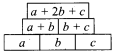
A number pyramid is a structure where numbers are placed in a triangular arrangement, and each number is derived from the numbers directly below it.
Rules : Each number in a higher row is the sum of the two numbers directly below it.
Example : For a pyramid with a bottom row of a, b and c:
Exploring a Pyramid with Two Rows
Let’s create a pyramid with the bottom row consisting of the numbers a and b.

The number at the top is calculated as follows:
The number above (a) and (b) is (a + b).
Exploring a Pyramid with Three Rows
Bottom Row: Let’s say we have the bottom row as (a), (b), and (c).
Constructing the Pyramid:
1. The second row will have two numbers:
The first number is (a + b)
The second number is (b + c)
2. The topmost number will be :
((a + b) + (b + c) = a + 2b+ c)
So, the pyramid looks like this:
Fun with Grids
Calendar Magic : Find the sum of numbers in a 2 × 2 grid of a calendar.
Consider a 2 × 2 grid from a calendar. Let the top- left number be a.
| a | a + 1 |
| a + 7 | a + 8 |
Explanation:
Right of a is a + 1
Below a is a + 7
Diagonal bottom-right is a + 8
Sum of the four numbers:
a + (a + 1) + (a + 7) + (a + 8) = 4a + 16
Algebra Grids Using Shapes:
Create grids using shapes.
For example, if you have a grid with shapes representing numbers, you can assign values to each shape and find the total or relationships among them.
The Largest Product
Suppose p, q and r are the three digits such that p < q < r
As before, we have six possible products, which we group by the multiplier:
qr × p, rq × p
pr × q, rp × q
pq × q, qp × r
To make the largest product possible where
r > q > p.
The largest digit should be the multiplier or r and the other two digits should' be arranged in decreasing order to form the multiplicand which is qp.
The largest product is qp × r
Decoding Divisibility Tricks
Let a two-digit number be ab.
ab= 10a + b, ba = 10b + a
Difference:
(10b + a) - (10a + b) = 9(b - a)
Since the difference is always a multiple of 9, it is divisible by 9 in all cases.
Algebra
Algebra is a branch of mathematics that uses symbols, letters, and numbers to represent and solve problems.
In algebra, we often use letters (like (x) or (y)) to stand for unknown values or quantities.
This allows us to create equations and expres¬sions that can be manipulated according to specific rules.
Why is Algebra Important?
Algebra helps us model real-world situations, solve problems, and understand relationships between different quantities. It is a foundational skill that is used in many areas of math, science, and everyday life.
Thinking about ‘Think of a Number’ Tricks
These are fun mathematical tricks where you ask someone to think of a number, perform a series of operations on it, and then reveal a surprising result. These tricks often work because of the properties of numbers and algebraic manipulation.
Example of a ‘Think of a Number’ Trick :
- Think of a number : (x)
- Double it: (2x)
- Add four : (2x + 4)
- Divide by two : (x + 2)
- Subtract the original number : (x + 2 - x = 2)
No matter what number you start with, you
always end up with 2! This is because the operations you perform on (x) simplify down to a constant value.
Number Pyramids
A number pyramid is a triangular arrangement of numbers where each number is derived from the numbers directly below it. The numbers in the bottom row are added together in pairs to form the numbers in the row above.
Rules for Filling a Number Pyramid :
- Start with a row of numbers at the bottom.
- Each number in the row above is the sum of the two numbers directly below it.
- Continue this process until you reach the top of the pyramid.
Exploring a Pyramid with Two Rows
Let’s create a pyramid with the bottom row consisting of the numbers a and b.

The number at the top is calculated as follows: The number above (a) and (b) is (a + b).
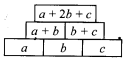
Exploring a Pyramid with Three Rows Bottom Row : Let’s say we have the bottom row as (a), (b), and (c).
Constructing the Pyramid:
The second row will have two numbers :
The first number is (a + b)
The second number is (b + c)
The topmost number will be :
((a + b) + (b + c) = a + 2b + c)
So, the pyramid looks like this :
Relationship between the Numbers
The top number is a combination of the bottom numbers, specifically incorporating the middle number twice. This shows how each number in the pyramid builds upon the previous numbers.
Virahanka-Fibonacci Numbers
- The Virahanka-Fibonacci sequence starts with 1, 2, and each subsequent number is the sum of the two preceding numbers.
- Initial Terms : The first few terms of the sequence are 1, 2, 3, 5, 8, 13, 21, and so on, showcasing growth.
- The next number in Virahanka-Fibonacci series is the sum of preceding two numbers.
- Recurrence Relation : Mathematically, the sequence can be expressed as F(n) = F(n - 1) + F(n - 2), for n ≥ 3
- Applications : These numbers appear in various fields, including nature, art, computer science, and financial modeling, demonstrating their universal relevance.
If the sum is Fun with Grids
Calendar Magic
Consider a 2 x 2 grid from a calendar. Let the top-left number be a.
| a | a + 1 |
| a + 7 | a + 8 |
Explanation :
Right of a is a + 1
Below a is a + 7
Diagonal bottom-right is a + 8
Sum of the four numbers :
a + (a + 1) + (a + 7) + (a + 8) = 4a + 16
If the sum is 36 :
4a + 16 = 36
4a = 20
a = 5
So, the grid becomes :
| 5 | 6 |
| 12 | 13 |
Algebra Grids
Let shapes represent numbers.
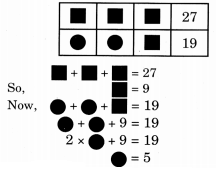
The Largest Product
Suppose p, q, and r are the three digits such that p < q < r
As before, we have six possible products, which we group by the multiplier :
qr × p, rq × p
pr × q, rp × q
pq × r, qp × r
To make the largest product possible where r > q > p. The largest digit should be the multiplier or r and the other two digits should be arranged in decreasing order to form the multiplicand which is qp.
The largest product is qp × r.
Decoding Divisibility Tricks
Let a two-digit number be ab.
ab = 10a + b, ba = 10b + a
Difference :
(10b + a) - (10a + b) = 9 (b - a)
Since the difference is always a multiple of 9, it is divisible by 9 in all cases.