Area Class 8 Notes
mediumArea Class 8 Notes
Area Class 8 Notes
Rectangles
Definition : A rectangle is a four-sided polygon (quadrilateral) with all angles equal to 90 degrees (right angles).
Properties:
Opposite sides are equal in length.
Diagonals bisect each other and are equal in length.
Squares
Definition : A square is a special type of rectangle where all four sides are of equal length.
Properties:
All angles are right angles,
Diagonals are equal and bisect each other at right angles.
Area of a Rectangle
Area = Length × Width
Example:
If length = 7 cm and width = 4 cm
Area = 7 cm × 4 cm = 28 cm².
Area of a Square
Area = Side × Side
Example:
If side = 5 cm, area = 5 cm × cm = 25 cm².
Triangles in a Rectangle
Diagonals : Drawing a diagonal divides the rectangle into two congruent triangles.
Area of Each Triangle:
Each triangle has an area equal to half of the rectangle’s area.
If the rectangle’s area is 28 cm², then each triangle s area is : [latex]\frac{28 \mathrm{~cm}^2}{2}[/latex] = 14 cm².
Why Can’t Perimeter Measure Area ?
Definition of Perimeter : The total length around a shape.
Key Points:
Different shapes can have the same perimeter but different areas.
Example : Rectangle (2 cm × 6 cm, Area =12 cm²) and Square (4 cm sides, Area =16 cm²) both have a perimeter of 16 cm.
A shape can have a larger perimeter but a smaller area (e.g., a long, thin rectangle vs. a square).
Area of a Triangle
Formula: Area= [latex]\frac{1}{2}[/latex] × Base × Height
Example: If base = 4 cm and height=3 cm,
Area= [latex]\frac{1}{2}[/latex] × 4cm × 3cm = 6cm².
Dissection
Definition : A method of cutting a shape into smaller pieces that can be rearranged to form a different shape with the same area.
Application : Useful for transforming geometric figures while preserving area.
Area of a Parallelogram
Area = Base × Height
Explanation : A parallelogram can be dissected into a rectangle of the same area.
Area of a Rhombus
Area= [latex]\frac{1}{2}[/latex] × d1 × d2
where (d1) and (d2) are the lengths of the diagonals.
Area of a Trapezium
Area= [latex]\frac{1}{2}[/latex] × Height × (Base1 + Base2)
Explanation : A trapezium can be dissected into a rectangle and two triangles.
Rectangle and Squares
A rectangle is a four-sided polygon (quadrilateral) where each angle is a right angle (90 degrees). The opposite sides of a rectangle are equal in length.
A square is a special type of rectangle where all four sides are of equal length.
Area of a Rectangle : The area of a rectangle can be calculated using the formula :
Area = Length × Width
This means that to find the area, you simply multiply the length of the rectangle by its width.
For example, if a rectangle has a length of 7 cm and a width of 4 cm, the area would be :
Area = 7 cm × 4 cm = 28 cm²
Area of Triangles in a Rectangle : When you draw a diagonal in a rectangle, it divides the rectangle into two congruent triangles. This means that both triangles have the same area. Since the area of the rectangle is given by the formula above, the area of each triangle is half the area of the rectangle.
For example, using the previous rectangle with an area of 28 cm², the area of each triangle would be :
Area of each triangle = [latex]\frac{1}{2}[/latex] × Area of rectangle
= [latex]\frac{1}{2}[/latex] × 28 cm²
= 14 cm²
Area of a Square = Side × Side
Why can’t perimeter be a measure of area?
Perimeter is the total length around a shape, calculated by adding the lengths of all the sides. However, it does not give us information about the area of a shape.
Reasoning:
1. Different Areas with Same Perimeter :
Two different shapes can have the same perimeter but different areas.
For example, consider a rectangle with dimensions 2 cm by 6 cm (perimeter = 16 cm, area = 12 cm²) and a square with sides of 4 cm (perimeter = 16 cm, area = 16 cm²). So, both shapes have the same perimeter, but their areas are different.
2. Larger Perimeter, Smaller Area: It is also possible to have a shape with a larger perimeter but a smaller area.
For instance, consider a long, thin rectangle (like a strip) compared to a more compact shape like a square. The strip can have a larger perimeter while having a smaller area than the square.
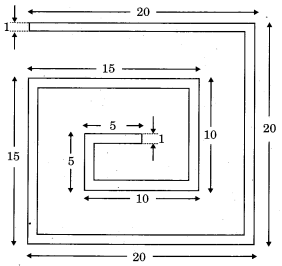
Area of a Triangle
The area of a triangle can be calculated using the formula :
Area = [latex]\frac{1}{2}[/latex] × Base × Height
Here, the base is one side of the triangle, and the height is the perpendicular distance from the base, to the opposite vertex.
For example, if a triangle has a base of 4 cm and a height of 3 cm, the area would be :
Area = [latex]\frac{1}{2}[/latex] × 4 cm × 3 cm = 6 cm²
Some Applications of the Area Formula
In a triangle, if you draw a line from one vertex to the midpoint of the opposite side, this line divides the triangle into two smaller triangles of equal area. This is a useful property in geometry, as it helps in various constructions and proofs.
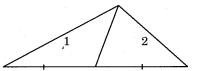
Triangles 1 and 2 have equal areas as they have the same measures for height and base
Triangles Between Parallel Lines with a Common Base
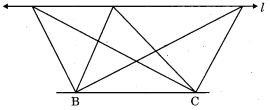
Consider a line (l) that is parallel to the base (BC) of a triangle. If we draw different triangles that have (BC) as their base and their third vertex lying anywhere on line (l):
Area of Any Polygon
Dissection : Dissection is a mathematical technique where a shape is cut into smaller pieces that can be rearranged to form a different shape with the same area.
This method is often used to transform one geometric figure into another while preserving the area..
For example, you can dissect a rectangle into triangles or other polygons and rearrange them to form a triangle with the same area.
Area of a Parallelogram
The area of a parallelogram can be calculated using the formula :
Area = Base × Height
Here, the base is one side of the parallelogram, and the height is the perpendicular distance from the base to the opposite side.
This formula is derived from the concept of dissection, where a parallelogram can be trans¬formed into a rectangle with the same area.
Area of a Rhombus : The area of a rhombus can be calculated using the formula :
Area = [latex]\frac{1}{2}[/latex] × d1 × d2
where (d1 ) and (d2) are the lengths of the diagonals of the rhombus. This formula works because the diagonals of a rhombus bisect each other at right angles, effectively dividing the rhombus into four right triangles. The area of the rhombus is thus equal to the sum of the areas of these triangles.
Area of a Trapezium: The area of a trapezium (or trapezoid) can be calculated using the formula :
Area = [latex]\frac{1}{2}[/latex] × Height × (Base1 + Base2)
In this formula, base1 and base2 are the lengths of the two parallel sides, and the height is the perpendicular distance between these bases.
This formula is derived from the idea that a trapezium can be dissected into a rectangle and two triangles, allowing us to calculate the area effectively.