Constructions and Tilings Class 7 MCQ
hardConstructions and Tilings Class 7 MCQ
Constructions and Tilings Class 7 MCQ
Question 1.
The steps to construct a perpendicular to a line w through a point which does not lie on the line w are shown below.
Step 1 : Mark point K outside the line w.
Step 2 : Place a ruler along the edge opposite to the right angle of the set-square.
Step 3 : Place a set-square on w such that one arm of its right angle aligns along w.
Step 4 : Hold the ruler fixed. Slide the set- square along the ruler till the point K touches the other arm of the set-square.
Step 5 : Join KL along the edge through K, meeting w at L.
Which two steps should be swapped so that the construction becomes possible?
(a) Step 2 and Step 4
(b) Step 3 and Step 4
(c) Step 2 and Step 3
(d) Step 3 and step 5
Solution:
(c) Step 2 and Step 3
Question 2.
The correct steps to construct a perpendicular to a line through a point not on it are as shown.
Step 1:
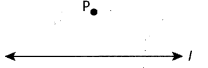
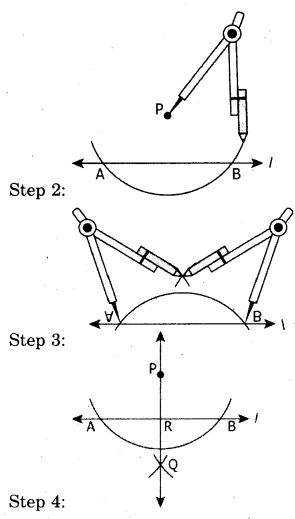
Which of these conditions is sufficient to justify the construction?
(a) [latex]\overline{\mathrm{PA}}[/latex] = [latex]\overline{\mathrm{PB}}[/latex]
(b) [latex]\overline{\mathrm{PA}}[/latex] = [latex]\overline{\mathrm{PB}}[/latex] = [latex]\overline{\mathrm{BQ}}[/latex]
(c) [latex]\overline{\mathrm{PA}}[/latex] = [latex]\overline{\mathrm{PB}}[/latex] = [latex]\overline{\mathrm{BQ}}[/latex] = [latex]\overline{\mathrm{AQ}}[/latex]
(d) [latex]\overline{\mathrm{PA}}[/latex] = [latex]\overline{\mathrm{PB}}[/latex] = [latex]\overline{\mathrm{BQ}}[/latex] = [latex]\overline{\mathrm{AQ}}[/latex] = [latex]\overline{\mathrm{PR}}[/latex]
Solution:
(c) [latex]\overline{\mathrm{PA}}[/latex] = [latex]\overline{\mathrm{PB}}[/latex] = [latex]\overline{\mathrm{BQ}}[/latex] = [latex]\overline{\mathrm{AQ}}[/latex]
Question 3.
A teacher asks his students to write the step-in order to draw a line parallel to PQ, passing through R.
The responses of two of students are as follows.
Statement 1 : Draw a line RU such that ∠PRT + ∠RPQ = 180°.
Statement 2 : Draw a line RU such that ∠PRU + ∠RPQ = 180°.
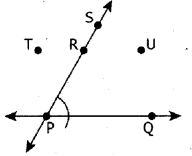
Who among them is/are correct?
(a) Only Student 1
(b) Only Student 2
(c) Both Student 1 and Student 2
(d) Neither Student nor Student 2
Solution:
(b) Only Student 2
Case Study
Question 1.
Angle Equal to a Given Angle
A student was given a task of constructing an angle equal to a given angle XAY. She goes through the following steps for the construction.
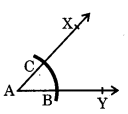
Step 1 : Draw a line Z and mark a point P on it.
Step 2 : Place the compasses at A and draw an arc to cut the rays AX and AY at B and C respectively.
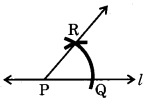
Step 3 : With centre P and same radius as in step 2, draw an arc to intersect Z at Q.
Step 4 : Now with Q as centre and same radius as in step 3, draw an arc to intersect the arc of step 3 at R.
Step 5: Join P and R to form ∠RPQ = ∠XAY.
(a) A mistake has been done by the student at one of the steps. Identify that step :
(i) Step 2
(ii) Step 3
(iii) Step 4
(iv) Step 5
(b) What should be the correction in that step ?
(c) With the mistaken step, what angle has been formed?
(d) Can you obtain an angle of 30° from this angle 2, using ruler and compasses.
(e) Can you obtain an angle of 20°, using ruler and compasses ?
Solution:
(a) (iii)
(b) Radius of arc should be BC
(c) 60°
(d) Yes
(e) No.
Question 2.
Bisecting an Angle
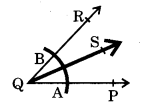
(a) Anurag was given a task of bisecting the given angle PQR. He goes through the following steps :
Step 1 : With Q as centre and any radius, draw an arc to intersect arms QP and QR at A and B respectively.
Step 2 : With A as centre and any radius, draw an arc.
Step 3 : With B as centre and the same radius as in step 2, draw an arc to intersect the previous arc at S.
Step 4 : On joining QS, QS will be the required bisector of ∠PQR.
There is a mistake in the construction at one step.
Can you identify that step?
(i) Step 1
(ii) Step 2
(iii) Step 3
(iv) Step 4
(b) What is the mistake ?
(c) What will happen due to this mistake?
(d) Can you bisect a reflex angle using this method?
(e) If answer to (d) above is yes, what type of each angle will be ?
Solution:
(a) (ii)
(b) Radius of the arc should be more than AB
(c) Arcs of step 2 and step 3 will not intersect
(d) Yes
(e) Obtuse angle.
Question 3.
Constructing a Line Parallel to a Given Line
(a) For constructing a line parallel to a given line l, through a point P not lying on it, a student goes through the following steps :
Step 1 : Take any point Q on l and join P and Q.
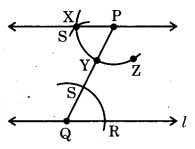
Step 2 : With Q as centre and a suitable radius, draw an arc to intersect l at R and QP at S.
Step 3 : Now, with P as centre and the same radius that of step 2, draw an arc XZ intersecting QP at Y.
Step 4 : Now, with Y as centre and the same radius that of step 2, draw an arc to intersect the arc of step 3 at S.
Step 5 : Join P and S to draw a line PS. Then, PS is the line parallel to line l.
Here, the student has committed a mistake at one step. This step is :
(i) Step 2
(ii) Step 3
(iii) Step 4
(iv) Step 5
(b) Correct the mistake.
(c) How many parallel lines can be drawn to a given line l?
(d) How many parallel lines can be drawn to a given line parallel to the given line l through point P ?
(e) Can you name the axiom or postulate related to it?
Solution:
(a) (iii)
(b) At step 4, radius of the arc should be equal to RS.
(c) infinitely many
(d) one and only one
(e) Playfair Axiom or Euclid’s Fifth Postulate