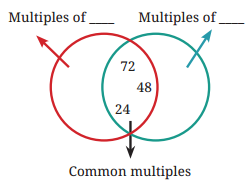
In the diagram (given in textbook), Guna has erased all the numbers except the common multiples. Class 6
mediumIn the diagram (given in textbook), Guna has erased all the numbers except the common multiples. Class 6
Question 1.
In the diagram (given in textbook), Guna has erased all the numbers except the common multiples. Find out what those numbers could be and fill in the missing numbers in the empty regions. Class 6
Solution:
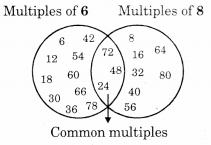
[Note: With common multiples 24, 48 and 72; the answer to this question may also be multiples of 12 and multiples of 8. In that case, numbers in the first circle will be 12, 36, 60, 84.]
Question 2.
Find the smallest number that is a multiple of all the numbers from 1 to 10 except for 7. Class 6
Solution:
Multiples of 1 are 1, 2, 3, 4, 5, 6, 7, ...; multiples of 2 are 2, 4, 6, 8, 10, ...; multiples of 3 are 3, 6, 9, 12, 15, 18, ...; multiples of 4 are 4, 8, 12, 16, ...; multiples of 5 are 5, 10, 15, 20, ...; multiples of 6 are 6, 12, 18, ...; multiples of 7 are 7, 14, 21, 28, ...; multiples of 8 are 8, 16, 24, 32, ...; multiples of 9 are 9, 18, 27, 36, ... and multiples of 10 are 10, 20, 30, 40, 50, ...
Now, clearly the requred number must be some multiple of 10. These are 10, 20, 30, 40, 50, ... Also as 10 and 9 as no common factor, so the required number must be a multiple of 10 × 9 = 90.
Now, multiples of 90 are 90, 180, 270, 360, 450 and so on. Out of these, we have to choose a number which is also a multiple of 8, because all other numbers except 7, 4 and 8 are factors of 90.
Now, multiple of 8 greater than 90 are 96, 104, 112, 120, 128, 136, 144, 152, 160, 168, 176, 184, 192, 200, 208, 216, 224, 232, 240, 248, 256, 264
272, 280, 288,..., 352, 360, 368, ...
So, smallest such number is 360.