Large Numbers Around Us Class 7 Notes
mediumLarge Numbers Around Us Class 7 Notes
Large Numbers Around Us Class 7 Notes
1. Place Value : Place value defines the value of each digit in a number based on its position. Each position, or “place,” in a number has a unique value that helps to determine the overall number.
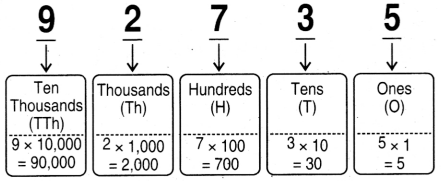
As numbers get bigger, it becomes difficult to read and understand them unless they are written properly with commas. To help us, two main systems are used around the world :
2. Indian system : In this, commas are placed to group the digits in a 3-2-2-2... pattern from right to left (thousands, lakhs, crores, etc.).
3. American system : In this the digits are grouped uniformly in a 3-3-3-3... pattern from right to left (thousands, millions, billions, etc.).
4. Multiplication : A mathematical operation where a number is added to itself a certain number of times. For example, 1250 × 380 means adding 1250 together 380 times.
5. Quotient: The result of dividing one number by another. For example, if you divide 1,000 by 10, the quotient is 100.
6. Kirtanas : Devotional songs composed by Purandaradasa, which are significant in the context of Indian classical music.
7. Population : The total number of people living in a specific area, such as a city or town. Understanding population figures helps in grasping the size of communities.
8. Large Numbers : Numbers that are significantly greater than what we typically encounter in daily life. For example, distances in kilometres, populations, and financial figures often involve large numbers.
9. Button Presses (Calculator Analogy) : A method to visualize how we can build numbers using a minimal number of operations, which helps in understanding the efficiency of calculations.
A Lakh Varieties!
Understanding One Lakh : One lakh is written as 1,00,000 in the Indian numeration system.
- It is the smallest 6-digit number.
- In everyday life, a lakh is often used to describe large quantities, like population or money.
- Real-world example : A city might have a population of several lakhs.
Amazing Fact: The term ‘lakh’ is used in India, Bangladesh, Nepal, and Pakistan, but not commonly used in Western countries.
There are 365 days in a year ignoring leap year day.
If someone lives for 100 years, then total number of days are : 100 × 365 = 36,500 days.
Patterns in Large Numbers
- The largest 3-digit number is 999, and the smallest 4-digit number is 1000.
- The largest 4-digit number is 9999, and the smallest 5-digit number is 10000.
Writing Large Numbers in Words When writing large numbers in words, follow these steps :
- Group the Digits : Start from the right and group the digits into sets of two and three as per the Indian system.
- Identify Each Group : Name each group according to its place value (thousands, lakhs, crores).
- Combine the Names : Write the names of each group together, ensuring to include “and” where necessary.
Example
Let’s take the number 5,04,085 :
- Grouping:
- 5 (lakh) • 04 (thousand) • 085 (units)
- Identifying Each Group :
- 5 is in the lakh group.
- 04 is in the thousand group.
- 085 is in the units group.
- Writing in Words :
- This number is written as “five lakh four thousand eighty-five.”
Exact and Approximate Values
Rounding Up : Rounding up occurs when you increase a number to the nearest specified value.
Rounding Down: Rounding down occurs when you decrease a number to the nearest specified value
Nearest Neighbours
Steps to Find Nearest Neighbours
- Identify the Number: Start with the large number you want to round. For example, let’s take the number 6,72,85,183.
- Determine the Place Value : Identify the place value you want to round to, such as thousand, lakh, or crore.
Nearest Thousand : 6,72,85,183 rounds to 6,72,85,000 (last three digits are 183, which is less than 500).
Nearest Ten Thousand ; 6,72,85,183 rounds to 6,72,90,000 (last four digits are 5183, which is more than 5000).
Nearest Lakh : 6,72.85,183 rounds to 6,73,00, 000 (last five digits are 85183, which is more than 50000).
Nearest Ten Lakh : 6,72,85,183 rounds to 6,70,00,000 (last six digits are 285183, which is less than 500000).
Nearest Crore : 6,72,85,183 rounds, to 7,0, 00,000 (last seven digits are 7285183, which is more than 5000000).