Lines and Angles Class 6 Fill in the blanks, True or False, Matching Type
easyLines and Angles Class 6 Fill in the blanks
Lines and Angles Class 6 Fill in the blanks
Fill in the blanks.
Question 1.
Only one line can pass through ____________ given points.
Answer:
Two
Question 2.
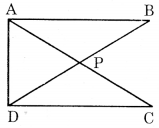
In the given figure, the number of obtuse angles is ____________
Answer:
Two
Question 3.
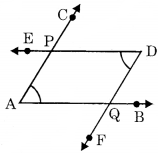
The number of common points in the two angles A and D of the given figure is ____________ and their names are ____________
Answer:
Two, P and Q
Question 4.
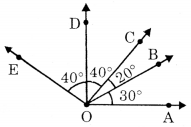
In the given figure, ∠AOD is a/an ____________ angle and ∠BOE is a/an ____________ angle.
Answer:
Right, Obtuse
Question 5.
An angle greater than 180° and less than 360° is called a/an ____________ angle.
Answer:
Reflex
Lines and Angles Class 6 True or False
Question 1.
The measure of an acute angle is equal to 0°.
Answer:
False
Question 2.
The measure of an obtuse angle lies between 90° and 180°.
Answer:
True
Question 3.
The measure of a reflex angle lies between 180° and 360°.
Answer:
True
Question 4.
The horizontal line and a vertical line are always perpendicular to each other.
Answer:
True
Question 5.
If the arms of an angle on the paper are increased, the angle increases.
Answer:
False
Lines and Angles Class 6 Match the Following
| Column 1 | Column 2 |
| (a) Right angle | (i) Less than 1/4 of a revolution. |
| (b) Acute angle | (ii) More than half of a revolution but less than one revolution. |
| (c) Straight angle | (iii) 1/4 of a revolution. |
| (d) Obtuse angle | (iv) 1/2 of a revolution. |
| (e) Reflex angle | (v) Between 1/4 and 1/2 of a revolution. |
Answer:
| Column 1 | Column 2 |
| (a) Right angle | (iii) 1/4 of a revolution. |
| (b) Acute angle | (i) Less than 1/4 of a revolution. |
| (c) Straight angle | (iv) 1/2 of a revolution. |
| (d) Obtuse angle | (v) Between 1/4 and 1/2 of a revolution. |
| (e) Reflex angle | (ii) More than half of a revolution but less than one revolution. |