Now mark any four points on your paper so that no three of them are on one line
hardNow mark any four points on your paper so that no three of them are on one line Class 6
Question 1.
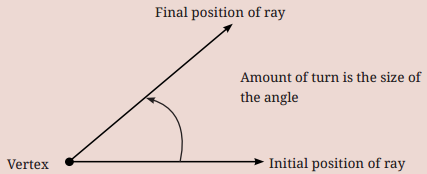
Now mark any four points on your paper so that no three of them are on one line. Label them A, B, C, D. Draw all possible lines going through pairs of these points. How many lines do you get? Name them. How many angles can you name using A, B, C, D? Write them all down, and mark each of them with a curve as in Fig. 2.9. Class 6
Solution:
The figure is drawn as shown:
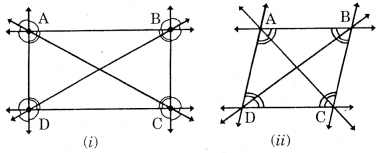
Through pairs of these points, we can draw six lines as shown in the figure.
These are named as [latex]\overleftrightarrow{\mathrm{AB}}, \overleftrightarrow{\mathrm{BC}}, \overleftrightarrow{\mathrm{CD}}, \overleftrightarrow{\mathrm{DA}}, \overleftrightarrow{\mathrm{AC}}[/latex] and [latex]\overleftrightarrow{\mathrm{BD}}[/latex].
At each of the points A, B, C, and D, six angles have been marked in the figure.
Thus, there are 24 angles in all.
In fact, there can be many more angles by taking different rays in pairs, but it is difficult to depict them in the figure at this stage.
Using A, B, C, and D, we can name the following angles:
∠DAB, ∠DAC, ∠CAB (i.e., three angles at A);
∠ABC, ∠ABD, ∠DBC (i.e., three angles at B);
∠BCD, ∠BCA, ∠ACD (i.e., three angles at C);
∠CDA, ∠CDB, ∠ADB (i.e., three angles at D).
So, in all 12 angles can be named using A, B, C, and D [See Fig. (ii)].