Operations with Integers Class 7 Notes
hardOperations with Integers Class 7 Notes
Operations with Integers Class 7 Notes
1. Integers
Definition : Whole numbers including positive, negative, and zero. Representation : (Z = -3, -2, -1, 0, 1, 2, 3,...})
2. Addition of Integers Rules:
Positive + Positive = Positive
Example : (5 + 3 = 8)
Negative + Negative = Negative
Example : (- 4 + (- 6) = - 10)
Positive + Negative : Subtract smaller from larger, take sign of larger.
Example : (7 + (- 2) = 5)
3. Subtraction of Integers
Concept: Subtracting an integer is the same as adding its additive inverse.
Formula :(a- b = a + (-b))
Examples :
(7 - 3 = 7 + (-3) = 4)
(-5 - 2 = -5 + (-2) = -7)
4. Carrom Coin Analogy
Visualization of integers using a carrom board?
Positive Movement: Rightward strikes represented as positive integers.
Negative Movement: Leftward strikes represented as negative integers.
Final Position Formula :
For two rightward strikes : (P = a + b)
For one rightward and one leftward strike :
(P = a - b)
Example :
First strike : (a = 5) (right)
Second strike : (b = 2) (left)
Final position : (P = 5 - 2 = 3)
5. Multiplication of Integers Rules :
Positive × Positive = Positive
Example : (3 × 4 = 12)
Negative × Negative = Positive
Example : ((- 3) × (- 4) = 12)
Positive × Negative = Negative
Example: (3 × (-4) = -12)
Negative × Positive = Negative
Example : ((-3) × 4 = - 12)
6. Properties of Multiplication
Commutative Property :
(a × b = b × a)
Associative Property :
(a × (b × c) = (a × b) × c)
Distributive Property :
(a × (b + c) = (a × b) + (a × c))
7. Brahmagupta's Rules for Multiplication and Division
Brahmasphutasiddhanta.
Rules :
Product/Quotient of two fortunes (positive) = Fortune
Product/Quotient of two debts (negative) = Fortune
Product/Quotient of a debt and a fortune = Debt
8. Magic Grid of Integers
A fun method to practice multiplication. Steps :
- Set up a grid with integers.
- Circle a number and strike out its row and column.
- Repeat until no unstruck numbers remain.
- Multiply the circled numbers to find the product.
Division of Integers Rules:
Positive Positive = Positive Example : (12 ÷ 3 = 4 )
Negative + Negative = Positive Example : ((-12) ÷ (-3) = 4)
Positive + Negative = Negative Example : (12 ÷ (-3) = - 4)
Negative + Positive = Negative Example : ((-12) ÷ 3 = - 4)
CHAPTER AT A GLANCE
1. Integers : Integers are whole numbers that can be positive, negative, or zero. For example, -3, 0, and 5 are all integers.
2. Positive Integers : These are the integers greater than zero. For example, 1, 2, 3, etc.
3. Negative Integers : These are the integers less than zero. For example, -1, -2, -3, etc.
4. Zero : Zero is a special integer that is neither positive nor negative. It acts as a neutral number in addition and subtraction.
5. Addition of Integers : When you add two integers, you combine their values. If both integers are positive, the result is positive. If both are negative, the result is negative. If one is positive and the other is negative, you subtract their absolute values and take the sign of the integer with the larger absolute value.
6. Subtraction of Integers : Subtracting an integer is the same as adding its opposite (or additive inverse).
7. Multiplication of Integers : When multiplying integers, the following rules apply :
- Positive × Positive = Positive
- Negative × Negative = Positive
- Positive × Negative = Negative
- Negative × Positive = Negative
8. Division of Integers : The rules for division are similar to multiplication :
- Positive ÷ Positive = Positive
- Negative ÷ Negative = Positive
- Positive ÷ Negative = Negative
- Negative ÷ Positive = Negative
9. Additive Inverse : The additive inverse of a number is what you add to that number to get zero. For example, the additive inverse of 5 is -5, because (5 + (- 5) = 0).
10. Commutative Property : This property states that the order in which you add or multiply numbers does not change the result. For example, (a + b = b + a) and (a × b = b × a).
11. Associative Property : This property states
that when adding or multiplying three or more numbers, the way in which the numbers are grouped does not change the result. For example, ((a + b) + c = a + (b + c)) and ((a × b) × c = a × (b × c)).
12. Distributive Property: This property states that multiplying a number by a sum is the same as multiplying each addend separately and then adding the results. For example, (a × (b + c) = a × b + a × c).
13. Number Line : A number line is a straight line that represents numbers as points.
Positive integers are to the right of zero, and negative integers are to the left.
A Quick Recap of Integers
Integers are a set of numbers that include all whole numbers, both positive and negative, as well as zero. The set of integers can be represented as Z = {..., -3, -2, -1, 0, 1, 2, 3,...}
1. Addition of Integers:
- When adding two positive integers, the result is positive.
- When adding two negative integers, the result is negative.
- When adding a positive integer and a negative integer, subtract the smaller integer from the larger integer and take the sign of the integer with the larger value.
Example:
- 5 + 3 = 8 (both positive)
- - 4 + (-6) = -10 (both negative)
- 7 + (- 2) = 5 (positive and negative)
2. Subtraction of Integers:
- Subtracting an integer is the same as adding its additive inverse.
- For example, (a-b = a + (-b)).
Example:
- 7 - 3 = 7 + (-3) = 4
- -5 - 2 = - 5 + (-2) = -7
Carrom Coin Integers
Integers can be visualized using a Carrom Coin analogy, where the positive integers can be thought of as coins placed on one side of the board, while negative integers represent coins on the opposite side. Zero acts as the neutral point on the board, When a carrom coin is struck, it moves a certain number of units in a specific direction. For our example, let’s assume the initial position of the coin is at point 0 on a number line.
- First Strike: If the first strike moves the coin by (a) units to the right, we can represent this movement as a positive integer (a).
- Second Strike : If the second strike moves the coin by (b ) units to the right, we represent this movement as another positive integer (b).
Final Position of the Coin
To find the final position (P) of the coin after both strikes, we can use the formula :
P = a + b
where,
- (P) is the final position of the coin,
- (a) is the distance moved by the first strike,
- (b) is the distance moved by the second strike.
Example:
Let’s consider a specific example :
- First Strike : The coin is struck and moves 4 units 16 the right. Thus, (a = 4).
- Second Strike: The coin is struck again and moves 3 units to the right. Thus, (b = 3).
Using our formula, we can calculate the final position:
P = 4 + 3 = 7P = 4 + 3 = 7 So, after both strikes, the coin is at position 7 on the number line.
Incorporating Negative Integers
Now, let’s consider a scenario where the coin can also be struck in the opposite direction. If a strike moves the coin to the left, we can represent this movement as a negative integer.
- First Strike to the Right: (+ a)
- Second Strike to the Left: (- b)
The final position in this case would be :
P = a - b
Example with Negative Movement
Suppose:
- The first strike moves the coin 5 units to the right ((a = 5)).
- The second strike moves the coin 2 units to the left ((b = 2)).
Calculating the final position :
P = 5 - 2 = 3
Thus, the coin ends up at position 3.
Multiplication of Integers
When multiplying integers, it is essential to understand the rules governing the signs of the numbers involved. Here are the key points :
1. Positive × Positive = Positive :
Example : 3 × 4 = 12
2. Negative × Negative = Positive :
Example : (-3) × (-4) = 12 .
3. Positive × Negative = Negative : .
Example : 3 × (-4) = -12
4. Negative × Positive = Negative :
Example : (-3) × 4 = -12
Patterns in Integer Multiplication
Commutative Property: This property states that the order of multiplication does not affect the product. For any two integers a and b :
a × b = b × a
Multiplicand and Multiplier : In the expression a × b, a is called the multiplicand and b is the multiplier.
To remember:
- The magnitude of the product does not change with the change in the signs of the multiplier and the multiplicand.
- When both the multiplier and the multiplicand are positive, the product is positive.
- When both the multiplier and the multiplicand are negative, the product is positive.
- When one of the multiplier or the multiplicand is positive and the other is negative, their product is negative.
Brahmagupta’s Rules
Brahmagupta, an ancient Indian mathematician, articulated these rules in his work Brahmasphuta- siddhanta around 628 CE. He used the terms “fortune” (dhana) to represent positive numbers and “debt” (rina) to represent negative numbers. His rules can be summarized as follows :
- The product or quotient of two fortunes is a fortune.
- The product or quotient of two debts is a fortune.
- The product or quotient of a debt and a fortune is a debt.
- The product or quotient of a fortune and a debt is a debt.
Magic Grid of Integers
The Magic Grid of Integers is a fun and engaging way to practice operations with integers, particularly multiplication. The grid consists of a set of integers arranged in rows and columns. The objective is to select numbers, strike out their respective rows and columns, and ultimately multiply the selected (circled) numbers together to find a product.
Steps to Solve the Magic Grid :
Here’s a detailed breakdown of the steps involved in using the Magic Grid of Integers :
1. Set Up the Grid : Start with a grid filled with integers. For example :
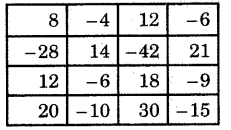
2. Circle a Number: Choose any number from the grid and circle it. This number will be part of your final product.
3. Strike Out the Row and Column : After circling a number, strike out (cross out) the entire row and the entire column that contains the circled number. This means that you will no longer consider any of the numbers in that row or column for further selections.
4. Repeat the Process : Continue circling numbers and striking out their respective rows and columns until there are no unstruck numbers left in the grid. Each time you circle a number, remember to strike out its row and column.
5. Multiply the Circled Numbers : Once you have circled all your numbers and struck out the rest, multiply all the circled numbers together to find the final product.
Expressions Using Integers
Associative Property : This property states that when multiplying three or more integers, the way in which the numbers are grouped does not change the product. For any three integers (a), (b), and (c):
a × (b × c) = (a × b) × c
Example:
(2 × (3 × 4) = 2 × 12 = 24 and,
(2 × 3) × 4 = 6 × 4 = 24)
Distributive Property : This property shows how multiplication distributes over addition. For any three integers a, b, and c :
a + (b × c) = (a × b) + (a × c)
Example:
2 × (3 + 4) = 2 × 7 = 14 and (2 × 3) + (2 × 4) = 6 + 8 = 14
Division of Integers
When dividing integers, the rules for the signs are similar to multiplication :
For any two positive integers a and b, where b ≠ 0, we can say that
1. Positive ÷ Positive = Positive :
a ÷ b
Example : 12 ÷ 3 = 4
2. Negative ÷ Negative = Positive :
-a ÷ -b = a ÷ b
Example : (-12) ÷ (-3) = 4
3. Positive ÷ Negative = Negative :
a ÷ -b = -(a ÷ b) .
Example : (12 ÷ (- 3) = -4)
4. Negative ÷Positive = Negative :
-a ÷ b = -(a ÷ b)
Example : ((-12) ÷ 3 = -4)
In general, for any two positive integers (a) and (b) (where (b \neq 0)), we can express the division of integers as follows :
- (a ÷ (- b) = - (a ÷ b))
- ((-a) ÷ b = - (a ÷ b))
- ((-a) ÷ (- b) = a ÷ b)