Parallel and Intersecting Lines Class 7 Short Question Answer
hardParallel and Intersecting Lines Class 7 Short Question Answer
Parallel and Intersecting Lines Class 7 Short Question Answer
Question 1.
Two angles are making a linear pair. If one of them is one-third of the other, then find the angles.
Solution:
Let one angle be 3x. So, the other angle is x.
So, 3x + x = 180° or 4x = 180° or x = [latex]\frac{180^{\circ}}{4}[/latex] = 45°
So, one angle is 45° and the other angle is 3 x 45° = 135°.
Question 2.
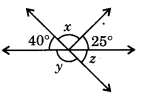
In the given figure, find the values of angles x, y and z.
Solution:
x + 40° + 25° = 180°.
So, x + 65° = 180°.
Hence, x = 180°- 65° = 115°.
Also,y + 40° = 180°.
So,y = 180° - 40° = 140°.
Again, y + z = 180°. So, 140° + z = 180°.
That is, z = 180° - 140° = 40°.
Question 3.
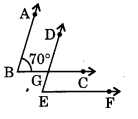
In the given figure, AB is parallel to DE and BC is parallel to EF. Find :
(i) ∠DGC
(ii) ∠DEF.
Solution:
(i) Since AB is parallel to ED and BC is a transversal, so, ∠DGC = ∠ABC (Corresponding angles)
Hence, ∠DGC = 70°.
(ii) Since BC is parallel to EF and DE is a transversal, so, ∠DEF = ∠DGC (Corresponding angles)
Hence, ∠DEF = 70°.
Question 4.
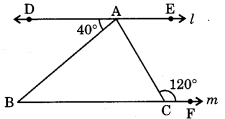
In the given figure, if lines l and m are parallel, then find ∠BAC.
Solution:
∠EAC + ∠ACF = 180°
(Interior angles on the same side of the transversal)
So, ∠EAC + 120° = 180°
or ∠EAC = 180° - 120° = 60° ...(i)
Now, ∠DAB + ∠BAC + ∠EAC = 180°
So, 40° + ∠BAC + 60° = 180°
or ∠BAC = 180° - 40° - 60° = 80°.
Question 5.
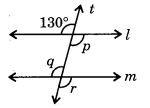
In the given figure, if l is parallel to m, then find the value of p + q + r.
Solution:
p = 130° (Vertically opposite angles)
q = p = 130° (Alternate angles)
r = q = 130° (Vertically opposite angles)
So, p + q + r = 130° + 130° + 130° = 390°.