Patterns in Mathematics Class 6 MCQ
easyPatterns in Mathematics Class 6 MCQ
Patterns in Mathematics Class 6 MCQ
Question 1.
What is the next number in the number sequence:
1, 3, 6, 10, 15, 21, 28, 36, ...
(a) 38
(b) 41
(c) 42
(d) 45
Answer:
(d) 45
Question 2.
Picture

represents the sequence of
(а) triangular numbers
(b) odd numbers
(c) powers of 3
(d) even numbers
Answer:
(b) odd numbers
Question 3.
The next number in the sequence of 1, 4, 9, 16, 25, 36, ... is
(a) 40
(b) 48
(c) 49
(d) 64
Answer:
(c) 49
Question 4.
The sequence 1, 7, 19, 37, ... is the sequence of
(a) odd numbers
(b) hexagonal numbers
(c) triangular numbers
(d) cube numbers
Answer:
(b) hexagonal numbers
Question 5.
The next number in the sequence 1, 2, 3, 5, 8, 13, 21,... is
(a) 30
(b) 31
(c) 33
(d) 34
Answer:
(d) 34
Question 6.
The sequence 1, 1 + 3, 1 + 3 + 5, 1 + 3 + 5 + 7, ... represents the sequence of
(а) odd numbers
(b) triangular numbers
(c) square numbers
(d) cube numbers
Answer:
(c) square numbers
Question 7.
The value of 1 + 2 + 3 + 4 + 5 + 6 + 7 + 8 + 9 + 8 + 7 + 6 + 5 + 4 + 3 + 2 + 1 is
(a) 64
(b) 81
(c) 99
(d) 100
Answer:
(b) 81
Question 8.
By adding all the sequences up and down, we obtain the sequence of
(a) triangular numbers
(b) odd numbers
(c) counting numbers
(d) square numbers
Answer:
(b) odd numbers
Question 9.
The sequence 1 + 1, 1 + 2 + 1, 1 + 2 + 4 + 1, 1 + 2 + 4 + 8 + 1, ... is the sequence of
(a) even numbers
(b) powers of 2
(c) square numbers
(d) powers of 4
Answer:
(b) powers of 2
Question 10.
When we multiply triangular numbers by 6 and add 1, then we obtain the sequence of
(a) square numbers
(b) cube numbers
(c) hexagonal numbers
(d) powers of 3
Answer:
(c) hexagonal numbers
Case Study
The Class VI teacher asks a student to come to the blackboard and write any sequence of numbers. The student wrote the following sequence:
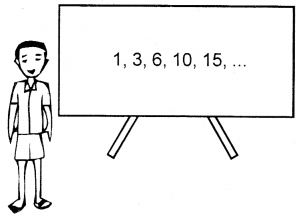
Question 1.
This sequence is known as the sequence of
(a) counting numbers
(b) odd numbers
(c) hexagonal numbers
(d) triangular numbers
Answer:
(d) triangular numbers
Question 2.
The next two numbers of this sequence are:
(a) 19, 24
(b) 20, 26
(c) 21, 27
(d) 21, 28
Answer:
(d) 21, 28
Question 3.
What sequence will be obtained by adding two consecutive terms of this sequence?
(a) sequence of triangular numbers
(b) sequence of square numbers
(c) sequence of odd numbers
(d) sequence of powers of 2
Answer:
(b) sequence of square numbers
Question 4.
Which number in this sequence is also a number in the sequence of square numbers?
(a) 25
(b) 36
(c) 49
(d) 64
Answer:
(b) 36
Question 5.
The 9th number of this sequence will be
(a) 36
(b) 38
(c) 42
(d) 45
Answer:
(d) 45