Prime Time Class 6 MCQ
easyPrime Time Class 6 MCQ
Prime Time Class 6 MCQ
Question 1.
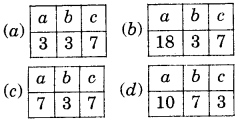
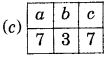
Jagat arranges 21 marbles into rows such that each row has an equal number of marbles. If there are 3 rows, each having (a)_ marbles indicating that (b)_ and (c)_ are the factors of 21. Which of these options correctly identifies a, b, and c?
Answer:
Question 2.
In a sitting arrangement, some people are made to sit in 9 rows such that each row has 4 people. If the same number of people are rearranged in m rows with n people in each row, which of these cannot be the value of m and n?
(a) 12 and 3
(b) 8 and 5
(c) 18 and 2
(d) 6 and 6
Answer:
(b) 8 and 5
Question 3.
Which of these is a factor of 96?
(a) 43
(b) 14
(c) 16
(d) 36
Answer:
(c) 16
Question 4.
The factors of a number 667 are two consecutive prime numbers p and q such that p > q. What is/are the factor(s) of the number (p - q)?
(a) 2 and 3
(b) 2 and 13
(c) 7
(d) 52
Answer:
(a) 2 and 3
Question 5.
Which of these can be concluded about the number 713?
(а) As it has no factor other than 1 and itself, it is a prime number.
(b) As it has two factors, 23 and 31, other than 1 and itself, it is a prime number.
(c) As it has two factors, 23 and 31, other than 1 and itself, it is a composite number.
(d) As it has no factor other than 1 and itself, it is a composite number.
Answer:
(c) As it has two factors, 23 and 31, other than 1 and itself, it is a composite number.
Question 6.
What are the factors of 1147? Is it a prime number or a composite number?
(а) 1, 1147; composite
(b) 1, 1147; prime
(c) 1, 31, 37, 1147; composite
(d) 1, 31, 37, 1147; prime
Answer:
(c) 1, 31, 37, 1147; composite
Question 7.
Which is the first common multiple of 48 and 72?
(a) 96
(b) 112
(c) 128
(d) 144
Answer:
(d) 144
Question 8.
Which of the following is not a common factor of 144 and 96?
(a) 12
(b) 24
(c) 18
(d) 16
Answer:
(c) 18
Question 9.
Consider the two conditions about the numbers m and n.
Condition 1: Both are two-digit numbers.
Condition 2: One is odd, and the other is even.
If m × n = 180, then what is the first common multiple of m and n.
(a) 36
(b) 60
(c) 90
(d) 180
Answer:
(b) 60
Question 10.
How many twin primes are there between the numbers 40 and 100?
(a) 4
(b) 3
(c) 2
(d) 1
Answer:
(b) 3
Question 11.
Which of the following numbers is divisible by 4?
(a) 4402
(b) 3486
(c) 2914
(d) 3916
Answer:
(d) 3916
Question 12.
Which of the following is the prime factorisation of 72?
(a) 2 × 4 × 3 × 3
(b) 8 × 9
(c) 2 × 3 × 2 × 3 × 2
(d) 2 × 2 × 2 × 9
Answer:
(c) 2 × 3 × 2 × 3 × 2
Question 13.
Which of the following pairs of numbers are not co-prime?
(a) 8 and 9
(b) 16 and 25
(c) 7 and 17
(d) 51 and 57
Answer:
(d) 51 and 57
Question 14.
The greatest common factor of the numbers 30 and 75 is
(a) 5
(b) 12
(c) 15
(d) 25
Answer:
(c) 15
Question 15.
How many numbers between 530 and 540 are divisible by 4?
(a) 3
(b) 2
(c) 1
(d) 0
Answer:
(b) 2
Case Study
I. Number Cards
Question 1.
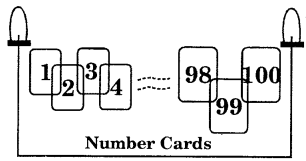
A student draws two number cards from a bag containing number cards from 1 to 100. One of the numbers drawn is 8 more than the least two-digit number, and the other is three times the least two-digit number. Two common factors of these numbers are:
(a) 9 and 6
(b) 6 and 2
(c) 6 and 5
(d) 3 and 9
Answer:
(b) 6 and 2
Question 2.
The greatest common factor of these two numbers is
(a) 3
(b) 6
(c) 5
(d) 9
Answer:
(b) 6
Question 3.
Prime factorisation of the first number is
(a) 2 × 3 × 5
(b) 2 × 2 × 3
(c) 2 × 3 × 3
(d) 2 × 2 × 3 × 3
Answer:
(c) 2 × 3 × 3
Question 4.
The first common multiple of these two numbers is
(a) 36
(b) 45
(c) 72
(d) 90
Answer:
(d) 90
Question 5.
The sum of the greatest common factors and the first common multiple of these two numbers is
(a) 42
(b) 54
(c) 81
(d) 96
Answer:
(d) 96
II. Numbers on the blackboard:
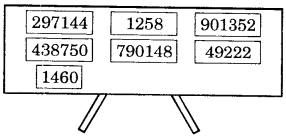
Some numbers are written on the blackboard.
Question 1.
Which of the following numbers is divisible by 8?
(a) 1258
(b) 790148
(c) 49222
(d) 901352
Answer:
(d) 901352
Question 2.
Which of the following numbers is divisible by 4?
(a) 1258
(b) 790148
(c) 49222
(d) 438750
Answer:
(b) 790148
Question 3.
Which of the following numbers is divisible by 5?
(a) 297144
(b) 790148
(c) 438750
(d) 901352
Answer:
(c) 438750
Question 4.
Which of the following numbers is divisible by 2 but not by 4?
(a) 297144
(b) 1258
(c) 901352
(d) 790148
Answer:
(b) 1258
Question 5.
Which of the following numbers is divisible by both 4 and 5?
(a) 901352
(b) 438750
(c) 790148
(d) 1460
Answer:
(d) 1460