Quadrilaterals Class 8 MCQ
easyQuadrilaterals Class 8 MCQ
Quadrilaterals Class 8 MCQ
Question 1.
Consider a quadrilateral PQRS shown.
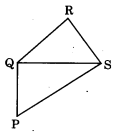
Which expression represents the sum of the measures of all the angles of the quadrilateral PQRS?
(a) 2 × 90°
(b) 2 + 180°
(c) 2 × 180°
(d) 2 + 90°
Solution:
(c) 2 × 180°
Question 2.
Consider the quadrilateral ABCD below.
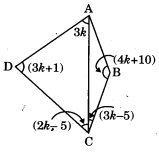
What is the measure of ∠DAB of the quadrilateral ABCD?
(a) 14°
(b) 69°
(c) 83°
(d) 113°
Solution:
(c) 83°
Question 3.
Two students are determining in which quadrilateral the measure of all interior angles can be calculated, given the measure of one interior angle.
Their response is as shown :
Student A : The quadrilateral will be kite.
Student B : The quadrilateral will be an isosceles trapezium.
Whose response is correct?
(a) Only Student A
(b) Only Student B
(c) Both the students
(d) Neither student A nor B
Solution:
(b) Only Student B
Question 4.
Gagan draws a quadrilateral with diagonals perpendicular to each other at a point O.
What additional information is required to conclude that the quadrilateral drawn is a rhombus?
(a) Point 0 must be the mid-point of both the diagonals.
(b) Point O must be the mid-point of the longer diagonal.
(c) Point O divides both the diagonals in the ratio 1:2.
(d) Point 0 must be the mid-point of the shorter diagonal.
Solution:
(a) Point 0 must be the mid-point of both the diagonals.
Question 5.
Anamika constructs a quadrilateral ABCD where BC = 18 cm, AD = 22 cm, CD = 20 cm, diagonal AC = 22 cm and diagonal BD = 28 cup
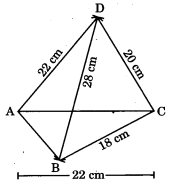
Which of the following options justifies that her construction is correct?
(a) AC = AD
(b) BC + AD + CD > AC + BD
(c) In triangle BCD; BC + CD ≠ BD, CD + BD ≠ BC, BD + BC ≠ CD and in triangle ACD; AC + AD ≠ CD, AC + CD ≠ AD, CD + AD ≠ AC
(d) In triangle BCD; BC + CD > BD, CD + BD > BC, BD + BC > CD and in triangle ACD; AC + AD > CD, AC + CD > AD, CD + AD > AC
Solution:
(d) In triangle BCD; BC + CD > BD, CD + BD > BC, BD + BC > CD and in triangle ACD; AC + AD > CD, AC + CD > AD, CD + AD > AC
Question 6.
Question Text : A teacher asked her students to construct a quadrilateral ABCD with AB = 12 cm, BC = 9 cm, ∠A = 60°, ∠B = 105° and ∠C = 105°. A student performed the following steps of construction.
Step 1 : Draw AB = 12 cm.
Step 2 : Taking B as the vertex, draw ∠ABE = 105°.
Step 3 : Taking A as. the centre and radius equal to 9 cm, draw an arc intersecting BE at C.
Step 4: Taking A as the vertex, draw ∠BAF = 60°.
Step 5: Taking C as the vertex, draw ∠BCG = 105°.
The student made an error while constructing the quadrilateral. In which step did the student make the first error?
(a) Step 2
(b) Step 3
(c) Step 4
(d) Step 5
Solution:
(b) Step 3
Case Study
Question 1.
Thinking of a Quadrilateral Sunita is thinking of a quadrilateral, having the following properties :

Both pairs of opposite sides parallel.
Diagonals bisecting each other at right angles.
(a) This shape is best described in the form of a
(i) trapezium
(ii) kite
(iii) rectangle
(iv) rhombus
Fill in the blanks :
(b) All the sides of this shape are )__________ . (equal/not equal)
(c) Diagonals of this shape are ____________ . (equal/not equal)
(d) All angles of this shape are __________ .(equal/not equal)
(e) Each of the diagonals of this shape its opposite angles ____________ (bisects/not bisects)
Solution:
(a) (iv)
(b) equal
(c) not equal
(d) not equal
(e) bisects.
Question 2.
A student was asked to construct a quadrilateral PQRS with PQ = 4.5 cm, QR = 5.5 cm, RS = 4 cm, PS = 6 cm and PR = 7 cm. He goes through the following steps for the construction.
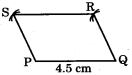
Step 1: Draw a line-segment PQ = 4.5 cm.
Step 2: With P as centre and 6 cm as radius, draw an arc.
Step 3 : With Q as centre and 5.5 cm radius, draw an arc to intersect the arc of step 2 at R.
Step 4 : With R as centre and radius 4 cm, draw an arc.
Step 5 : With P as centre and radius 7 cm, draw an arc to intersect the arc of step 4 at S.
Step 6 : Join P, Q, R and S in order to obtain the quadrilateral PQRS.
(a) Some mistakes have been committed in the construction. Mistakes to be corrected are:
(i) Interchange the radii of steps 2 and 4.
(ii) Interchange the radii of steps 2 and 5.
(iii) Interchange the radii of steps 3 and 4.
(iv) Interchange the radii of steps 3 and 5.
(b) Will it be possible to construct the quadrilateral, if QR = 2.5 cm ?
(c) Will it be possible to construct the quadrilateral, if PS = 5 cm ?
(d) Will it be possible to construct the quadrilateral, if RS = 2 cm ?
(e) Will it be possible to construct the quadrilateral, if PR =11 cm ?
Solution:
(a) (ii)
(b) No
(c) Yes
(d) Yes
(e) No