The hypotenuse of an isosceles right triangle is 10. What are its other two sidelengths? Class 8
easyThe hypotenuse of an isosceles right triangle is 10. What are its other two sidelengths? Class 8
Question 1.
The hypotenuse of an isosceles right triangle is 10. What are its other two sidelengths? [Hint: Find the area of the square composed of two such right triangles.] Class 8
Solution:
Let its each equal side be a.
So, [latex]\sqrt{a^2+a^2}[/latex] = 100 ⇒ 2a² = 100
or a² = 50, i.e., a = [latex]\sqrt{50}[/latex] = [latex]5 \sqrt{2}[/latex]
So, other two sidelengths are [latex]5 \sqrt{2}[/latex] each.
Question 2.
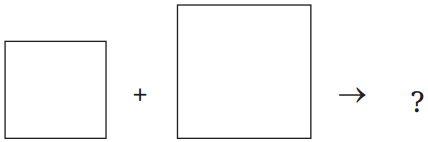
What if we wish to combine two squares of ‘different’ sizes to make a large square whose area is the sum of the two smaller squares? Class 8
Solution:
We construct a right triangle whose two sides, other than the hypotenuse, are equal to the sides of two different squares as shown :
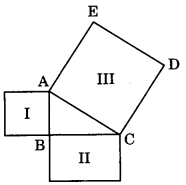
Now, construct a square on the hypotenuse AC.
Now, area of this square III will be equal to the sum of the areas of the two squares I and II, by Baudhayana-Pythagoras theorem.