Activity 13.2 Let us find out (Pages 213) Collect information about the temperature and size of the planets Class 8
hardActivity 13.2 Let us find out (Pages 213) Class 8
Activity 13.2 Let us find out (Pages 213) Class 8
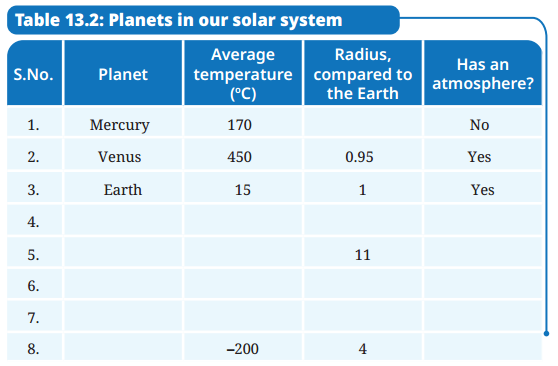
Collect information about the temperature and size of the planets in the solar system, and check if they have an atmosphere.
You may collect this information from books in your school library, trusted websites, or discuss it with your teachers.
Fill out the missing information in the Table.
Table 13.2 Planets in our solar system
Answer:
Table 13.2 Planets in our solar system
| S. No | Planet | Average temperature (°C) | Radius, compared to the Earth | Has an Atmosphere? |
| 1. | Mercury | 170 | ______________ | No |
| 2. | Venus | 450 | .0.95 | Yes |
| 3. | Earth | 15 | 1 | Yes |
| 4. | Mars | -60 | 0..5 | Yes |
| 5. | Jupiter | -110 | 11 | Yes |
| 6. | Saturn | -140 | 9.5 | Yes |
| 7. | Uranus | -195 | 4 | Yes |
| 8. | Neptune | -200 | 4 | Yes |
1. Is the temperature or distance from the sun the only factor that makes the Earth habitable? Class 8
Answer:
Not at all, temperature and distance from the Sun are important, but they're just part of a much bigger picture. Earth's habitability is the result of a delicate balance of interconnected factors like atmosphere composition, the ozone layer (protective atmosphere), presence of liquid water which is essential for all known life forms, magnetic field (gravity), gravitational interactions.
2. What would happen if the size of the Earth were too small or too big? Class 8
Answer:
If Earth were too small:
- It might lose its atmosphere, making it hard to breathe.
- Gravity would be weaker - water and air could escape into space.
- No magnetic field-harmful solar radiation could reach the surface.
If Earth were too big:
- Gravity would be much stronger-walking and breathing could be more difficult.
- A thicker atmosphere might trap too much heat.
- High pressure could crush living cells or prevent life from forming.
So, Earth's size is just right to hold air, water, and support life comfortably.
3. Does the magnetic field of the Earth have any role in sustaining life on Earth? Class 8
Answer:
Yes, Earth's magnetic field plays a key role in sustaining life.
It protects us from harmful solar winds and cosmic radiation by deflecting charged particles away from the planet. Without it, our atmosphere could slowly be stripped away, and life would be exposed to dangerous radiation. So, it acts like a shield and keeping Earth safe and liveable.
4. How is life supported and sustained on Earth? Class 8
Answer:
Life is supported and sustained on Earth by a mix of natural systems working together:
- Right distance from the Sun gives us suitable temperature.
- Water is available in liquid form essential for all living things.
- Atmosphere provides oxygen to breathe and protects us from harmful rays.
- Magnetic field shields Earth from dangerous solar particles.
- Soil and nutrients help plants grow, which support animals and humans.
- Natural cycles like water cycle and oxygen carbon dioxide cycle keep things balanced.
- All these features make Earth a safe and comfortable home for life.
5. How do bamboo and sugarcane grow into new plants? I have never seen their seeds. Class 8
Answer:
Bamboo and sugarcane usually grow into new plants without seeds.
They use a method called vegetative reproduction. New plants grow from parts like:
- Bamboo: Grows from underground stems called rhizomes.
- Sugarcane: Grows from pieces of its stem - each piece with a bud can grow into a new plant.