Activity 3.2 Let us observe (Page 25) In a torch, we generally use more than one cell. Class 7
hardActivity 3.2 Let us observe (Page 25) Class 7
In a torch, we generally use more than one cell. Are those placed in any particular order? Class 7
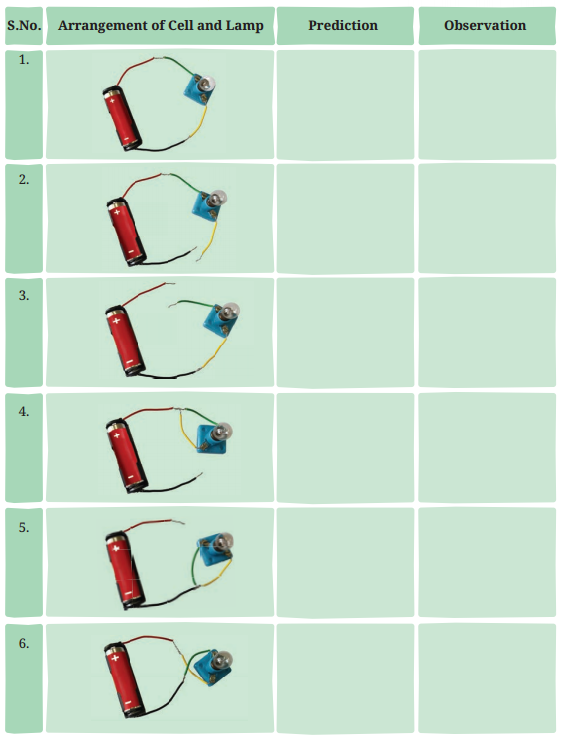
Answer:
Yes. The cells are placed on after another in a line. The positive terminal of one cell is connected to the negative terminal of the next cell.
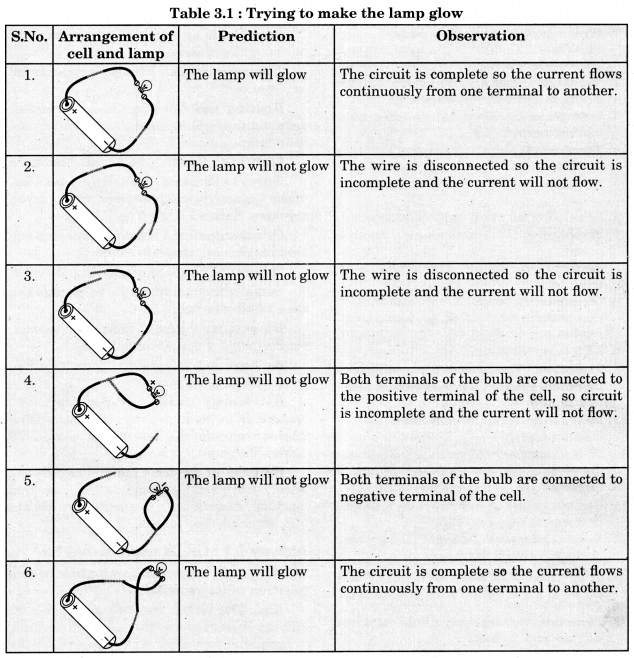
Question 1.
How does a switch turn 'on' or 'off' the torchlight? Class 7
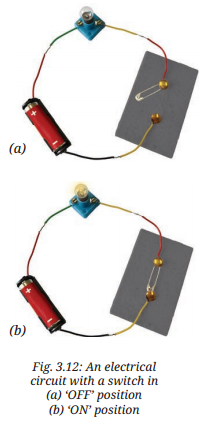
Answer:
The switch controls the flow of electricity in the circuit. When the switch is 'ON', it closes the circuit, allowing electricity to flow through the lamp and make it glow. When the switch is 'OFF', it opens the circuit, stopping the flow of electricity, and the lamp goes off.
Question 2.
Can we represent the circuits in a simpler manner? Class 7
Answer:
Yes, the circuit can be represented by symbols, for example, a battery is represented by a pair of short and long parallel lines, a lamp is represented by a circuit with an ' X ' inside it and a switch in 'off' position by a slanting line over a short horizontal line  and a horizontal line
  in 'on' position.
Question 3.
Why did we use metal wires for making electric circuits? Can we not use some other materials for wires? Class 7
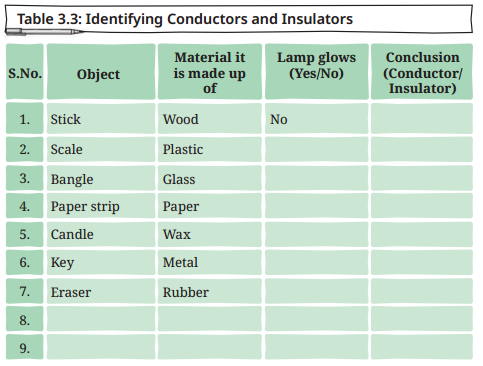
Answer:
We use metal wires in electric circuits because metals like copper and aluminium are good conductors and let electricity flow through them easily. Most other materials, like rubber, plastic or wood, don't conduct electricity well, so they wouldn't be used for making electric circuit.
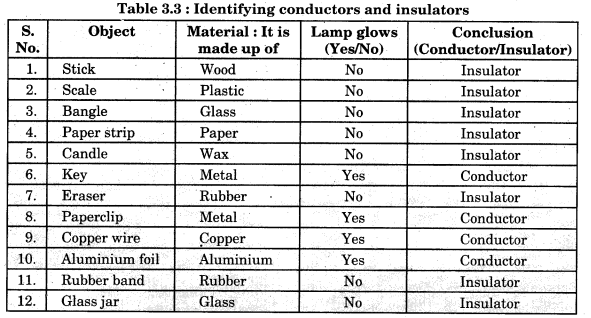
Observation and conclusion: This activity shows the difference between conductors and insulators. Conductors allow electricity to flow through them, making the lamp glow. On the other hand, insulators do not allow the current to pass through them, so the lamp does not glow.
Question 4.
Why wires are covered with insulated materials? Class 7
Answer:
Wires are covered with insulated materials like plastic, rubber and ceramics to prevent electric current flow outside. It prevent us from electric shocks and short circuits. These insulators are bad conductor of heat and not heated due to flowing electric current and do not burn easily.