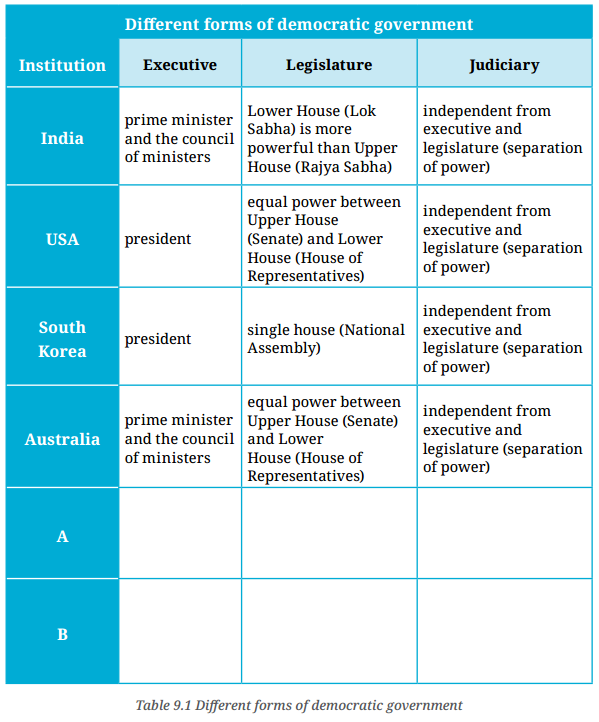
Fill the blank columns under Country A and Country B in table 9.1 given on the previous page (see textbook, page 195) Class 7
hard
R
RBSEGuide
Expert Answer
Fill the blank columns under Country A and Country B in table 9.1 given on the previous page (see textbook, page 195) Class 7
Question 1.
Fill the blank columns under Country A and Country B in table 9.1 given on the previous page (see textbook, page 195) by taking two different countries of your choice. Class 7
Answer:
| Country | Executive | Legislature | Judiciary |
| Canada | Prime Minister and the Cabinet | Parliament (Commons (Lower House) and Senate (Upper House) | Independent from executive and legislative (separation of power) |
| Germany | Chancellor and the Federal Cabinet | Bundestag (Lower House) and Bundesrat (Upper House) | Independent from executive and legislative (separation of power) |
Question 2.
Analyse the table and discuss amongst yourselves the similarities and differences in all the examples. Class 7
Answer:
Similarities:
- All these countries have a clear separation between the executive, legislature, and judiciary. This means that each branch operates independently and does not interfere with the others.
- Each country has an independent judiciary.
- All these nations have a form of representative democracy, where elected officials represent the people's interests.
Differences:
- In some countries like India and Australia, the executive (Prime Minister) is part of the legislature, while in the USA and South Korea, the President operates independently from the legislature.
- The number of houses in the legislature varies. For example, the USA and Australia have two houses (Upper and Lower), while South Korea has a single house.
- In India, Lower House is more powerful than Upper House.
- In USA and Australia, both houses have equal power.