On blank maps: Label India's neighbours. Draw arrows showing cultural flows (e.g., food, festivals, languages) Class 7
hardOn blank maps: Label India's neighbours. Draw arrows showing cultural flows (e.g., food, festivals, languages) Class 7
On blank maps: Label India's neighbours.
Draw arrows showing cultural flows (e.g., food, festivals, languages) between India and her neighbours.
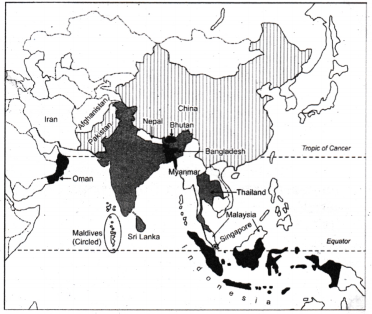
Answer:
Note: Using the above map student can draw arrows.
⟶ Imagine and redraw new "borders of friendship" that connect neighbours through rivers, trade routes, or cultural zones.
Note: Using the above map student can draw arrows.
⟶ Collect pictures of the flags of the countries listed in this chapter and write your observations.
Answer:
Observation of each flag is given below, student collect flags yourself.
(1) India: The saffron represents courage, white symbolises peace and truth, and green stands for faith and chivalry. The Ashoka Chakra signifies the eternal wheel of law.
(2) Pakistan: The green symbolises the Muslim majority, while the white represents religious minorities. The crescent and star are traditional symbols of Islam.
(3) Afghanistan: The black symbolises the past, red represents the blood of those who fought for independence, and green signifies hope for the future.
(4) China (Tibet): A red field symbolising revolution and the Communist Party, with five gold stars representing the unity of the Chinese people (workers, peasants, urban middle class, rural middle class) led by the Party (the large star).
(5) Nepal: The triangles symbolise the Himalayas and the two major religions, Hinduism and Buddhism. The moon represents peace, while the sun symbolises the hope for longevity.
(6) Bhutan: The dragon represents the purity of the Bhutanese people, yellow symbolises the king and secular authority, and orange represents Buddhism.
(7) Bangladesh: The green symbolises the lushness of the land, while the red represents the blood of those who fought for independence.
(8) Myanmar: Yellow represents solidarity, green symbolises peace, and red stands for courage and determination.
(9) Sri Lanka: The lion represents the Sinhalese majority, while the green and orange stripes represent the Muslim and Tamil minorities, respectively.
(10) Maldives: The red symbolises the blood of those who fought for independence, green represents peace and prosperity, and the crescent stands for Islam.
(11) Iran: The green symbolises Islam, white represents peace, and red stands for courage. The emblem represents the Islamic Republic.
(12) Oman: The white symbolises peace, the green represents the land, and the red stands for the blood of those who fought for independence.
(13) Thailand: The red represents the land and people, white symbolises religion, and blue signifies the monarchy.
(14) Malaysia: The stripes represent the equal status of the 13 member states and the federal government, while the crescent signifies Islam and the star represents unity.
(15) Singapore: The red symbolises universal brotherhood, while the white represents purity. The crescent represents a young nation on the rise, and the five stars symbolise democracy, peace, progress, justice, and equality.
(16) Indonesia: The red symbolises courage, while the white represents purity and peace. This simple yet powerful design reflects the spirit of the Indonesian people.