Constructions and Tilings Class 7 Notes
hardConstructions and Tilings Class 7 Notes
Constructions and Tilings Class 7 Notes
1. Bisection
Definition : The process of dividing a line segment or geometrical object into two identical parts.
Key Concept: The point that divides the object into equal lengths is called the midpoint. Example : For a line segment XY, if O is the midpoint, then XO = OY.
2. Perpendicular Bisector Definition : A line that divides a line segment into two equal parts at a right angle 90°.
Every point on the perpendicular bisector is equidistant from the endpoints of the segment. It intersects the line segment at its midpoint.
3. Angle Bisection
Definition : The process of dividing an angle into two equal parts.
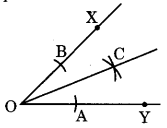
Example: If (∠XOY = 60°), then (OC) will create two angles of (30°) each.
4. Sulba-Sutras
Ancient Indian texts that provide geometric construction methods, particularly for constructing fire altars.
Part of the Vedic literature, considered one of the six Vedangas.
Key Points: Dates back to the Vedic period; among the earliest mathematical texts.
Purpose: Focus on precise geometric shapes for rituals.
Techniques : Use of a rope for constructions instead of a traditional compass.
Geometric Principles: Procedures for constructing perpendicular lines and bisectors.
Practical Applications: Ensured geometrically exact constructions.
5. Repeating Units and Angles in Tiling
Repeating units are shapes that can be repeated to cover a surface without gaps or overlaps.
Repeating angles can create patterns in tiling.
6. Tiling
The process of covering a surface with geometric shapes (tiles) without gaps or overlaps.
Types of Tiles : Can include squares, rectangles, and other polygons.
Conditions for (m × n) Grid Tileability :
Both (m) and (n) are even : Yes, can be tiled with (2 × 1) tiles.
One is even, one is odd : Yes, can be tiled since the total area is even.
Both (m) and (n) are odd : No, cannot be tiled as the total area is odd.
Example : A (4 x 6) grid can be tiled with (2 × 1) tiles, while a (3 × 3) grid cannot.
7. Arch Designs Types of Arches :
Trefoil Arch : Three lobes, used in Gothic architecture.
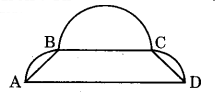
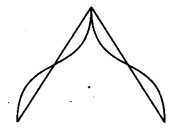
Pointed Arch : Constructed using two arcs that meet at a point above the base.
8. Regular Hexagons
Definition : A regular hexagon has six , equal sides and angles.
Relationship with Equilateral Triangles : Connecting opposite vertices creates equilateral triangles.
Angle Sum : Angles around a point must add up to 360°.
CHAPTER AT A GLANCE
- Geometric Construction : This is the process of drawing shapes, angles, and figures using only a compass and a ruler without any measurements.
- Arc : A part of the circumference of a circle. When constructing shapes, arcs are often used to create curves.
- Congruent : Two shapes are congruent if they are the same size and shape. This means all corresponding sides and angles are equal.
- Angle : Formed by two rays (sides of the angle) that share a common endpoint (the vertex). Angles are measured in degrees.
- Transversal : A line that crosses two or more other lines. When a transversal crosses parallel lines, it creates corresponding angles that are equal.
- Parallel Lines : Lines that run in the same direction and are always at the same distance apart. They never meet.
- Equilateral Triangle : A triangle where all three sides are of equal length, and all angles are 60 degrees.
- Hexagon : A six-sided polygon. A regular hexagon has all sides and angles equal.
Define Bisection
Bisection is the process of dividing a line segment or any geometrical object into two identical parts. The point that divides the object into two equal lengths is called the midpoint.
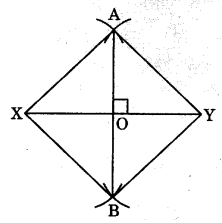
For example, if you have a line segment XY, the point O that divides XY into two equal lengths XO and OY is called the midpoint, and we say that O bisects XY.
Define Perpendicular Bisector
A perpendicular bisector is a line that divides a line segment into two equal parts at a right angle (90°). This means that every point on the perpendicular bisector is equidistant from the endpoints of the segment.
This means that a line segment XY given above, the perpendicular bisector will intersect XY at its midpoint O and form right angles with it.
Steps for Construction of Perpendicular Bisector
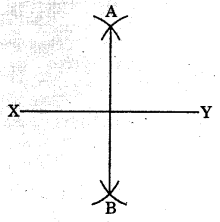
To construct the perpendicular bisector of a line segment XY:
- Draw the Line Segment: Start by drawing a line segment XY.
- Set Compass Width: Open your compass to a width greater than half the length of XY.
- Draw Arcs : With the compass point on X, draw an arc 44above and below the line. Without changing the compass width, repeat this step with the compass point on Y.
- Mark Intersection Points: Label the points where the arcs intersect as A and B.
- Draw the Perpendicular Bisector: Use a ruler to draw a line through points A and B. This line is the perpendicular bisector of XY.
Steps for Construction of a 90° Angie at a Given Point
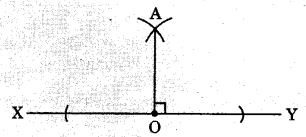
To construct a 90° angle at a point O on a line: .
- Draw the Line : Draw a straight line and mark a point O on it.
- Draw Arcs : Using a compass, mark two points X and Y at equal distances from 0.
- Construct Perpendicular Bisector: Follow the steps for constructing the perpendicular bisector of XY (as given above). This bisector will pass through O and form a 90° angle with the line.
Construction Methods in Sulba-Sutras
The 6ulba-Sutras are ancient Indian texts that provide methods for geometric constructions, particularly for constructing fire altars.
The Sulba-Sutras are ancient Indian texts that provide detailed geometric methods for constructing various shapes and lines, particularly for religious rituals like building fire altars. These texts are part of the Vedic literature and are considered one of the six Vedangas, which are auxiliary disciplines associated with the Vedas.
- The Sulba-Sutras date back to the Vedic period in India and are among the earliest known mathematical texts.
- Purpose : They primarily focus on the construction of fire altars for rituals, which required precise geometric shapes.
- Construction Techniques : The methods described utilize a unique tool—a rope— rather than a traditional compass. This rope can be used to draw circles, arcs, and straight lines.
- Geometric Principles : The texts contain procedures for constructing perpendicular lines and bisectors, which are essential for accurate geometric designs.
- Practical Applications : The techniques are not just theoretical; they were used in practical applications, ensuring that constructions were geometrically exact.
Steps for Angle Bisection
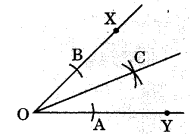
- Consider an angle ∠XOY.
- Mark points A and B such that OA = OB.
- Choosing any sufficiently long radius, cutarcs from A and B, keeping the radiussame. Mark the point of intersection as C.
- OC bisects ∠AOB.
Repeating Units and Repeating Angles
In tiling and geometric designs, repeating units refer to shapes that can be repeated to cover a surface without gaps or overlaps.
Repeating angles are angles that can be used in a similar way to create patterns.
Steps of Construction to Copy an Angle
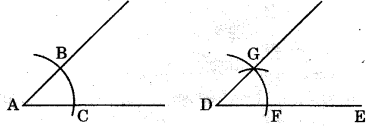
To copy an angle ∠ABC :
- Draw the Original Angle : Start with ∠ABC.
- Draw a Line : Draw a line DE where you want to copy the angle.
- Transfer the Arc: Use a compass to measure the distance AB and draw an arc from point D.
- Mark the Intersection : Label the inter¬section of the arc with line DE as F.
- Repeat for the Other Ray : Measure BC and draw another arc from F to find point G.
- Draw the Angle : Draw line FG. ∠DFG is a copy of ∠ABC.
Arch Designs
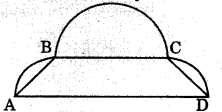
• Trefoil Arch: A trefoil arch has three lobes and is often used in Gothic architecture. To construct it, you can use circles and arcs to create the lobes symmetrically.
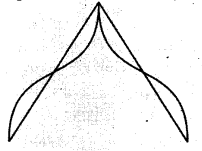
• Pointed Arch : A pointed arch can be constructed by drawing two arcs that meet at a point above the base, creating a sharp peak.
Regular Hexagon
A regular hexagon has six equal sides and angles.
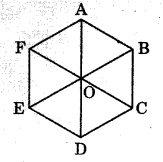
Regular Hexagon and Equilateral Triangles: When you connect apposite vertices of a regular hexagon, you create equilateral triangles. This is because all sides are equal, and the angles at each vertex are 120°.
All Angles around the Centre Should Add Up to 360°
The angles around a point (or center) mnst add up to 360° because :
- A full rotation around a point is 360°.
- Each angle contributes to this total, ensuring that they completely cover the space around the point without any gaps or overlaps.
Construction of a 60° angle
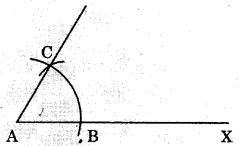
Step 1: Construct an arc with centre A and any radius.
Step 2 : With the same radius, cut another arc from B that meets the first arc. Let C be the point at which the arcs meet.
Tiling
Tiling is the process of covering a surface or a plane with one' or more geometric shapes, called tiles, without any overlaps or gaps. Tiles can be of various shapes and sizes, but in this chapter, we will primarily focus on rectangular tiles, specifically 2x1 tiles.
Conditions for m × n Grid Tileability
Both mm and nn are even :
- Tileability : Yes, the grid can be tiled with 2 × 1 tiles.
- Strategy : One effective strategy is to cover each column with vertical tiles. Since both m and n are even, each column can be filled completely with vertical tiles, ensuring that all squares are covered without any gaps or overlaps.
One of m or n is even, and the other is odd:
- Tileability : Yes, the grid can be tiled with 2 × 1 tiles.
- Reason : In this case, the total number of unit squares in the grid is m × n which is even. If one dimension is odd and the other is even, the product will be even. Since each 2x1 tile covers 2 squares, it is possible to cover an even number of squares completely with these tiles.
Both m and n are odd :
- Tileability: No, the grid cannot be tiled with 2 × 1 tiles.
- Reason: In this case, the total number of unit squares in the grid is m × n which is odd. If both the dimension are odd, the product will be odd. Since each 2 × 1 tile covers 2 squares, it is impossible to cover an odd number of squares completely with these tiles.