(i) Using the dots of a grid as the vertices, can you create a square that has an area of (a) 2 sq. units, (b) 3 sq. units Class 8
easy(i) Using the dots of a grid as the vertices, can you create a square that has an area of (a) 2 sq. units, (b) 3 sq. units Class 8
Question 1.
(i) Using the dots of a grid as the vertices, can you create a square that has an area of (a) 2 sq. units, (b) 3 sq. units, (c) 4 sq.units, and (d) 5 sq. unit?
(ii) Suppose the grid extends indefinitely. What are the possible integer-valued areas of squares you can create in this manner? Class 8
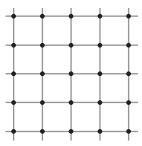
Solution:
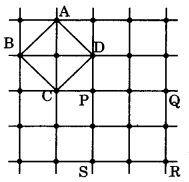
(a) Yes, in the grid area of ABCD is 2 sq. units.
(b) On the grid, it is not possible
(c) Yes, in the grid, area of PQRS = 4 sq. units.
(d) Yes, in the grid, it is not possible
(ii) Possible areas that can be created on the grid are 2 square units, 4 square units, 8 square units, 16 square units, 9 square units, 18 square units, 25 square units, 50 square units, etc.
Question 2.
Find the area of an equilateral triangle with sidelength 6 units. Class 8
[Hint : Show that an altitude bisects the opposite side. Use this to find the height.]
Solution:
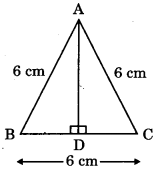
Draw AD ⊥ BC.
So, ∆ABD ≅ ∆ACD (By RHS)
Hence, BD = DC = 3 cm
So, AD² = [latex]\sqrt{6^2-3^2}[/latex] = [latex]\sqrt{27}[/latex]
= [latex]3 \sqrt{3}[/latex] units
So, required area
= [latex]\frac{1}{2}[/latex] BC × AD
= [latex]\frac{1}{2}[/latex] × 6 × [latex]3 \sqrt{3}[/latex]
= [latex]9 \sqrt{3}[/latex] sq. units