In this figure, if the sidelength of the square is doubled, what is the increase in the areas of the regions 1, 2 and 3? Give reasons. Class 8
easyIn this figure, if the sidelength of the square is doubled, what is the increase in the areas of the regions 1, 2 and 3? Give reasons. Class 8
Question 1.
In this figure, if the sidelength of the square is doubled, what is the increase in the areas of the regions 1, 2 and 3? Give reasons. Class 8
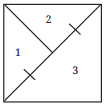
Solution:
Let sidelengths of the square be a units.
So, BD² = a² + a² = 2a²
or BD = [latex]a \sqrt{2}[/latex] units.
So, AO = [latex]\frac{a \sqrt{2}}{2}[/latex]
If AD become 2a, then
BD² = 4a² + 4a² = 8a²
or BD = [latex]2 \sqrt{2}[/latex] a²
So, BD = [latex]\frac{2 \sqrt{2} a}{2}[/latex] = [latex]\sqrt{2} a[/latex]
Now, area of 1 = [latex]\frac{1}{2}[/latex] DO × AO
= [latex]\frac{1}{2}[/latex] × [latex]\frac{a \sqrt{2}}{2}[/latex] × [latex]\frac{a \sqrt{2}}{2}[/latex]
= [latex]\frac{1}{8}[/latex]2a² sq. units
= [latex]\frac{1}{4}[/latex]a² sq. units
and area of new region 1
= [latex]\frac{1}{2}[/latex]DO × AO
= [latex]\frac{1}{2}[/latex] × [latex]\sqrt{2} a[/latex] × [latex]\sqrt{2} a[/latex]
= [latex]\frac{1}{2}[/latex] × 2a² = a² sq. units
= 4 × [latex]\frac{1}{4}[/latex]a² sq. units
which is 4 times the previous region 1.
Similarly, area of each of the regions 2 and 3 also becomes 4 times of the previous area.