Lines and Angles Class 6 Notes
easyLines and Angles Class 6 Notes
Lines and Angles Class 6 Notes
1. Point: A precise location in space represented by a dot. It has no length, breadth, or height and is oftep denoted by a capital letter (e.g., Point A).
2. Line Segment: A part of a line that has two end-points. It is the shortest path connecting two points, denoted as [latex]\overline{\mathrm{AB}}[/latex] or [latex]\overline{\mathrm{BA}}[/latex], where A and B are the end-points.
3. Line: An infinite collection of points extending in both directions without end. It is often represented by two points on the line (e.g., line AB) or by a lowercase letter (e.g., line 1).
4. Ray: A part of a line that starts at a point and extends infinitely in one direction. It is denoted by its end-point and another point on the ray (e.g., ray AB starts at A and passes through B).
5. Angle: Formed by two rays (the arms) that share a common end-point (the vertex). Angles are measured in degrees.
6. Acute Angle: An angle that measures less than 90 degrees and greater than 0 degrees. It represents a small turning.
7. Right Angle: An angle that measures exactly 90 degrees. It is often represented by a square at the vertex.
8. Obtuse Angle: An angle that measures more than 90 degrees but less than 180 degrees. It represents a larger turning.
9. Straight Angle: An angle that measures exactly 180 degrees, forming a straight line.
10. Perpendicular Lines: Lines that intersect at a right angle (90 degrees).
11. Angle Bisector: It is a line or ray that divides an angle into two equal parts
12. Triangle: A polygon with three sides and three angles. The sum of the interior angles of a triangle is always 180 degrees.
13. Polygon : A closed figure formed by a finite number of line segments (sides) connected end to end.
14. Convex Polygon: A polygon where all interior angles are less than 180 degrees, and no sides are curved inward.
15. Concave Polygon : A polygon that has at least one interior angle greater than 180 degrees, causing a ‘cave’ effect.
Point
A point is a precise location in space, represented by a dot. It has no dimensions (length, breadth, or height).
Real-World Example: The tip of a pencil on a piece of paper can represent a point. In navigation, a specific location on a map (like a city or landmark) can also be considered a point.
Line Segment
A line segment is a part of a line that has two end-points. It is the shortest distance between two points.
It is denoted by either [latex]\overline{\mathrm{AB}}[/latex] or [latex]\overline{\mathrm{BA}}[/latex].
Real-World Example: The distance between two cities on a map can be represented as a line segment. If you draw a straight line between New York and Los Angeles, that line represents the line segment connecting the two cities.
Line
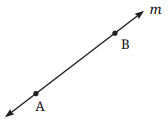
A line is a straight path that goes on forever in both directions. It has no end-points.
For example, if we have two points A and B, we can write the line that passes through these points as AB or BA. The line is denoted with a line symbol over the letters, like this :
[latex]\overleftrightarrow{\mathrm{AB}}[/latex]
Infinite Length: A line has no beginning or end.
Named by Points: A line can be named by any two points on it.
Ray
A ray is a part of a line that starts at one point and goes on forever in one direction. You can think of a ray as a flashlight beam that starts at the flashlight and shines out into the darkness without stopping.
For example, if we have a starting point A and another point P on the ray, we can write the ray as [latex]\overrightarrow{\mathrm{AP}}[/latex]. The ray starts at A and goes through P, extending infinitely in the direction ofP.
Starting Point : A ray has one end-point, called the starting point.
Infinite Length in One Direction : A ray goes on forever in one direction but has a definite starting point.
Angle
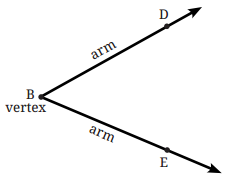
An angle is formed when two rays meet at a common starting point. You can think of an angle as the space between two lines or rays that come together. The point where the rays meet is called the vertex of the angle, and the rays are called the arms of the angle.
Vertex: The point where the two rays meet.
Arms: The two rays that form the angle.
Measurement: Angles are measured in degrees (°), which tells us how wide the angle is.
How Do We Name an Angle ?
To name an angle, we usually use three points: One on each arm and the vertex in the middle. For example, if we have rays BD and BE meeting at point B, we can name the angle as Angle DBE or Angle EBD. We can also use the symbol ‘∠’ to represent it, like this: ∠DBE. Example with figure :
Let’s say we have two rays, BD and BE, that meet at point B. We can draw the angle formed by these rays.
Comparing Angles
Angles can be compared using super-imposition and using protractor.
Comparing Angles with Superimposition What is Superimposition ? Superimposition is a method where you place one angle directly on top of another angle to see which one is larger or if they are equal. This is like stacking two pieces of paper on top of each other to see if they match perfectly.
How to Compare Angles Using Super-imposition :
Align the Vertices: Place the vertices of both angles on top of each other.
Match the Arms: Make sure the arms of both angles are aligned.
Observe: See which angle is bigger, smaller or same.
Real-World Example: Think about two pizza slices. If you want to compare the angles of the slices, you can place one slice on top of the other. If they match perfectly, they are equal. If one slice is larger angle corresponding to that slice is larger.
Comparing Angles Without Super-imposition When we compare angles without super-imposition, we look at the angles separately and use measurements or visual looking at, to determine which is larger or smaller.
How to Compare Angles Without Super-imposition:
Use a Protractor: Measure each angle in degrees using a protractor.
Visual Comparison: Look at the angles and see which one appears wider or shorter.
Special Types of Angles
1. Acute Angle: An angle that measures less than 90 degrees but greater than 0 degrees.
Real-World Example: The angle formed by the hands of a clock at 10 : 00 is an acute angle. The angle between the blades of a pair of scissors when slightly opened is also acute.
2. Right Angle: An angle that measures exactly 90 degrees.
Real-World Example: The corners of a square or rectangle are right angles. A piece of paper has right angles at its corners.
3. Obtuse Angle: An angle that measures more than 90 degrees but less than 180 degrees.
Real-World Example: The angle formed by the hands of a clock at 10 : 15 is an obtuse angle. The angle between the arms of a chair can also be obtuse.
4. Straight Angle: An angle that measures exactly 180 degrees.
Real-World Example: A straight line, such as the edge of a ruler, forms a straight angle. The angle formed by the hands of a clock at 6 : 00 is also a straight angle.
5. Reflex Angle: An angle that is more than 180° but less than 360°.
Measuring Angles
What is a Protractor ?
A protrator is a semi-circular or circular tool that helps us measure angles in degrees (°). It usually has markings from 0° to 180° (for a semi-circular protractor) or 0° to 360° (for a full circular protractor).
How to use a Protractor:
Place the Protractor: Position the protractor so that the centre hole (the small hole) is over the vertex (the point where the two arms of the angle meet).
Align One Arm: Make sure one arm of the angle lines up with the 0° line on the protractor.
Read the Measurement: Look at where the other arm of the angle points on the protractor. This number is the measure of the
angle in degrees.
Why is Measuring Angles Important?
Construction: Builders need to measure angles to make sure walls and roofs are straight and fit together properly.
Art and Design: Artists and designers use angles to create shapes and patterns in their work.
Sports: In sports like basketball, players need to understand angles to make successful shots.
Real-World Example: Imagine you are looking at a door. When the door is open, it forms an angle with the wall. You can measure this angle using protractor.