Proportional Reasoning 2 Class 8 Notes
easyProportional Reasoning 2 Class 8 Notes
Proportional Reasoning 2 Class 8 Notes
Proportionality
Proportionality refers to a relationship between two ratios or fractions that are equivalent. If two ratios are proportional, we can express this relationship mathematically as:
a : b = c : d
This can also be written in the form of a cross-multiplication :
a × d = b × c
This means that the product of the means (the inner terms) is equal to the product of the extremes (the outer terms).
Representative Fraction
A representative fraction (RF) is a way to express the scale of a map or drawing. It is the ratio of a distance on the map to the corresponding distance on the ground. It is usually expressed as a fraction or ratio.
Ratios with More than 2 Terms
When dealing with ratios that have more than two terms, we can express the relationship between them similarly to two-term ratios. If we have two ratios with multiple terms, such as:
a : b : c : d :: p : q : r : s
Then, the proportional relationship can be
expressed as:
a × p = b × q = c × r = d × s
Dividing a Whole in a Given Ratio
When dividing a whole into parts according to given ratio, we can use the following formula: When we divide a quantity (x) in the ratio (a : b : c : .......), the terms in the ratio are calculated as follows:
For the first term = First part = x × [latex]\frac{a}{(a+b+c+\ldots)}[/latex]
For the second term = Second part
= x × [latex]\frac{b}{(a+b+c+\ldots)}[/latex]
For the third term = Third part c
= x × [latex]\frac{c}{(a+b+c+\ldots)}[/latex]
and so on.
The Pie Chart and Finding Angles
A pie chart visually represents proportions of a whole. To construct a pie chart, we need to find the angles corresponding to each category based on their proportions.
Steps to Construct a Pie Chart:
- Calculate the total number of parts.
- For each category, find the angle using the formula :
Angle = [latex]\left(\frac{\text { Part }}{\text { Total Parts }}\right)[/latex] × 360°
Inverse Proportions
Inverse Proportions occur when two quantities increase or decrease in opposite directions.
This means that as one quantity goes up, the other goes down, and vice versa.
In mathematical terms, if two quantities (x) and (y) are inversely proportional, we can express this relationship as:
x.y = k, where (AT) is a constant.
Direct Proportions
Direct Proportions occur when two quantities increase or decrease together.
This means that if one quantity increases, the other also increases, and if one decreases, the other decreases.
The relationship can be expressed mathematically as :
[latex]\frac{a}{b}[/latex] = [latex]\frac{c}{d}[/latex]
Proportionality — A Quick Recap
Proportionality refers to a relationship between two quantities where they change in such a way that their ratio remains constant. This means that if one quantity increases, the other quantity increases in a specific proportion, and if one decreases, the other does too.
If we have two ratios, (a : b) and (c : d), they are said to be proportional if the following condition holds true :
[a × d = b × c]
This can also be expressed as : [latex]\frac{a}{c}[/latex] = [latex]\frac{b}{d}[/latex]
Example: Consider the ratios (2 : 3) and (4 : 6). To check if they are proportional, we can use cross-multiplication :
(2 × 6 = 12) (3 × 4 = 12)
Since both products are equal, (2 : 3) and (4 : 6) are proportional.
Representative Fraction : A representative fraction (RF) is a way of expressing the scale of a map or a drawing. It shows the ratio of a distance on the map to the actual distance on the ground. It is usually expressed as a fraction or a ratio.
Example: If a map has a representative fraction of [latex]\frac{1}{100,000}[/latex], it means that 1 unit of measurement on the map (like 1 cm) represents 100,000 of the same units in reality (like 100,000 cm or 1 km).
Ratios in Maps
Ratios with More than 2 Terms
Ratios can have more than two terms, and they represent the relationship between multiple quantities. When we have a ratio with multiple terms, it can be expressed as (a : b : c : d).
Proportionality with Multiple Terms : In general, when two ratios with multiple terms are proportional, such as :
[a : b : c : d :: p : q : r : s]
it means that:
[a × p = b × q = c × r = d × s]
Then [latex]\frac{a}{p}[/latex] = [latex]\frac{b}{q}[/latex] = [latex]\frac{c}{r}[/latex] = [latex]\frac{d}{s}[/latex]
Example : Let’s say we have the ratio of ingredients for a recipe : (2 : 3 : 5) (for Red : Blue : White paint). If we want to keep the same proportions but we have a different quantity of white paint, we can find the amounts of red and blue paint needed.
Suppose we have 10 litres of white paint, which corresponds to the 5 parts in the ratio.
1 part = [latex]\frac{10 \text { litres }}{5}[/latex] = 2 litres
- First, we find the value of 1 part:
- Now, we can find the amounts of red and blue paint:
Red paint (2 parts): 2 × 2 = 4 litres
Blue paint (3 parts): 3 × 2 = 6 litres
So, to maintain the ratio (2:3:5) with 10 litres of white paint, Yasmin needs 4 litres of red paint and 6 litres of blue paint.
Dividing a Whole in a Given Ratio
Understanding Ratios : A ratio is a way to compare two or more quantities. For example, if we have a ratio of 2 : 1, it means that for every 2 parts of one quantity, there is 1 part of another quantity. Ratios can also have more than two terms, like 3 : 2 : 1, which means for every 3 parts of the first quantity, there are 2 parts of the second and 1 part of the third.
The Formula : When we divide a quantity (x) in the ratio a : b : c : ... we can find each part using the following formula :
For the first term
= First part = x × [latex]\frac{a}{(a+b+c+\ldots)}[/latex]
For the second term
= Second part = x × [latex]\frac{a}{(a+b+c+\ldots)}[/latex]
For the third term
= Third part = x × [latex]\frac{a}{(a+b+c+\ldots)}[/latex]
and so on.
Example: Let’s say we want to divide a total of 60 into the ratio 2 : 3 : 5.
The ratio has three parts : 2, 3, and 5.
The total number of parts is : 2 + 3 + 5 = 10. Now, we will use the formula to find out how much each part corresponds to in the total of 60.
First part (for 2):
First part = 60 × [latex]\frac{2}{10}[/latex] = 60 × 0.2 = 12
Second part (for 3):
Second part = 60 × [latex]\frac{3}{10}[/latex] = 60 × 0.3 = 18
Third part (for 5):
Third part = 60 × [latex]\frac{5}{10}[/latex] = 60 × 0.5 = 30
Verify the total : Now, let’s add the parts together to ensure they equal the original quantity :
12 + 18 + 30 = 60
A Slice of the Pie
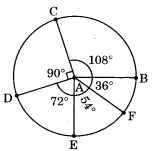
A pie chart is a circular graph that represents data in a way that is easy to understand. Each slice of the pie corresponds to a category of data, and the size of each slice is proportional to the quantity it represents.
Step-by-Step Guide to Constructing a Pie Chart:
1. Collect Your Data : Start with a set of data that you want to represent. For example, let's say we have the following data about students’ grades :
| Grade | Number of Students |
| A | 12 |
| B | 10 |
| C | 8 |
| D | 6 |
| E | 4 |
2. Calculate the Total: Find the total number of students. In this case :
Total Students = 12 + 10 + 8 + 6 + 4 = 40
3. Determine the Angle for Each Category : The total angle in a circle is 360°. To find the angle for each slice of the pie chart, you will use the formula :
Angle for a category
= [latex]\left(\frac{\text { Number of Students in Category }}{\text { Total Number of Students }}\right)[/latex] × 360°
Now, let's calculate the angles for each grade:
Grade A : Angle A = [latex]\left(\frac{12}{40}\right)[/latex] × 360°
= [latex]\frac{12 \times 360}{40}[/latex] = 108°
Grade B : Angle B = [latex]\left(\frac{10}{40}\right)[/latex] × 360°
= [latex]\frac{10 \times 360}{40}[/latex] = 90°
Grade C : Angle C = [latex]\left(\frac{8}{40}\right)[/latex] × 360°
= [latex]\frac{8 \times 360}{40}[/latex] = 72°
Grade D : Angle D = [latex]\left(\frac{6}{40}\right)[/latex] × 360°
= [latex]\frac{6 \times 360}{40}[/latex] = 54°
Grade E : Angle E = [latex]\left(\frac{4}{40}\right)[/latex] × 360°
= [latex]\frac{4 \times 360}{40}[/latex] = 36°
Draw the Circle : Using a compass, draw a circle on a piece of paper. This circle will represent the pie chart.
Inverse Proportions
Inverse proportions occur when one quantity increases while the other decreases, such that their product remains constant. This means that if one quantity goes up, the other must go down to keep the overall product the same.
In mathematical terms, if two quantities (x) and (y) are inversely proportional, we can express this relationship as :
x × y = k, where k is a constant.
Example of Inverse Proportions : Let’s consider a practical example involving speed and time. Imagine you are traveling a fixed distance. If you travel faster, you will take less time to cover that distance.
For instance, if you travel at a speed of 30 km/h, it takes you 3 hours to reach your destination. If you increase your speed to 60 km/h, how long will it take you?
Here, we can set up the relationship as follows :
- Speed x : 30 km/h and 60 km/h
- Time y : 3 hours and (x) hours (unknown)
According to the inverse proportion relationship,
we have: .
30 × 3 = 60 × x
Calculating this gives :
90 = 60x
To find (x), we rearrange the equation :
x = [latex]\frac{90}{60}[/latex] = 1.5 hours
So, if you travel at 60 km/h, it will take you 1.5 hours to reach your destination.
Direct Proportions
Direct proportions occur when two quantities increase or decrease together. This means that if one quantity doubles, the other quantity also doubles.
In mathematical terms, if two quantities (a) and (b) are directly proportional, we can express this relationship as :
[latex]\frac{a}{b}[/latex] = k, where (k) is a constant.
Example of Direct Proportions : Let’s say you are making a fruit punch. If you use 2 litres of juice for every 4 litres of water, the ratio of juice to water is constant. If you decide to use 4 litres of juice, how much water will you need?
Using the direct proportion relationship :
- Juice ((a)) : 2 litres and 4 litres
- Water ((b)): 4 litres and (x) litres (unknown)
We can set up the equation :
[latex]\frac{2}{4}[/latex] = [latex]\frac{4}{x}[/latex].
Cross-multiplying gives :
2x = 16
Soling for (x) gives :
x = [latex]\frac{16}{2}[/latex] = 8 litres
So, if you use 4 litres of juice, you will need 8 litres of water to maintain the same ratio.