Proportional Reasoning 2 Class 8 Short Question Answer
easyProportional Reasoning 2 Class 8 Short Question Answer
Proportional Reasoning 2 Class 8 Short Question Answer
Question 1.
The following ingredients are required to make halwa for 5 persons : Suji/Rawa = 250 g, Sugar = 300 g,
Ghee = 200 g, Water = 500 mL.
Using the concept of proportion, estimate the changes in the quantity of ingredients, to prepare halwa for your class.
Solution:
Let the class consists of 25 students. Clearly, it is a case of direct variation. Therefore, we require 25 ÷ 5 = 5 times the ingredients given :
i.e., Suji/Rawa = 250 g × 5 = 1250 g = 1.250 kg, Sugar = 300 g × 5 = 1500 g = 1.500 kg, Ghee = 200 g × 5 = 1000 g =1 kg, Water = 500 mL × 5 = 2500 mL.
Question 2.
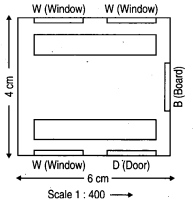
Choose a scale and make a map of your classroom, showing windows, doors, blackboard, etc. (An example is given here).
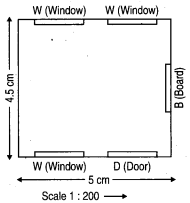
Solution:
Let the scale be 1: 400. Then, the map is drawn as shown in the given figure :
Question 3.
In a Television game show, the prize money of ₹? 1,00,000 is to be divided equally amongst the winners. Complete the following table and find whether the prize money given to an individual winner is directly or inversely proportional to the number of winners ?
| Number of winners | Prize for each winner (in ₹) |
| 1 | 1,00,000 |
| 2 | 50,000 |
| 4 | ... |
| 5 | ... |
| 8 | ... |
| 10 | ... |
| 20 | ... |
Solution:
Clearly, more the number of winfters, less is the prize for each winner. So, it is a case of inverse proportion.
∴ 4 × x = 1 × 100000
or x = [latex]\frac{100000}{4}[/latex] = 25000.
Thus, for 4, it is 25000.
5 × y = 1 × 100000
So, y = [latex]\frac{100000}{5}[/latex] = 20000.
Thus, for 5, it is 20000.
8 × z = 1 × 100000
So, z = [latex]\frac{100000}{8}[/latex] = 12500.
Thus, for 8, it is 12500.
10 × t = 1 × 100000
So, t = [latex]\frac{100000}{10}[/latex] = 10000.
Thus, for 10, it is 10000.
20 × w = 1 × 100000
So, w = [latex]\frac{100000}{20}[/latex] = 5000.
Thus, for 20, it is 5000.
Question 4.
Rehman is making a wheel using spokes. He wants to fix equal spokes in such a way that the angles between any pair of consecutive spokes are equal. Help him by completing the following table.
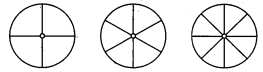
| Number of spokes | 4 | 6 | 8 | 10 | 12 |
| Angle between a pair of consecutive spokes | 90° | 60° | ... | ... | ... |
(i) Are the number of spokes and the angles formed between the pairs of consecutive spokes in inverse proportion?
(ii) Calculate the angle between a pair of consecutive spokes on a wheel with 15 spokes.
(iii) How many spokes would be needed, if the angle between a pair of consecutive spokes is 40° ?
Solution:
Clearly, more is the number of spokes, less is the measure of angle between a pair of consecutive spokes.
Also, we observe here
4 × 90° = 6 × 60° (= 360°).
So, it is a case of inverse proportion.
∴ 8 × x = 4 × 90°
or x = [latex]\frac{4 \times 90}{8}[/latex] = 45°
Thus, for 8, it is 45°.
10 × y = 4 × 90°
or y = [latex]\frac{4 \times 90}{10}[/latex] = 36°
Thus, for 10, it is 36°.
12 × z = 4 × 90°
or z = [latex]\frac{4 \times 90}{12}[/latex] = 30°.
Thus, for 12, it is 30°.
(i) Yes, the number of spokes and the angles formed between the pairs of consecutive spokes are in inverse proportion.
(ii) Let x° be the angle between a pair of consecutive spokes on a wheel with 15 spokes.
∴ 15 × x = 4 × 90°
or x = [latex]\frac{4 \times 90}{15}[/latex] = 24°.
Thus, the required angle is 24°.
(iii) Let x spokes are needed on a wheel, if the angle between a pair of consecutive spokes is 40°.
∴ x × 40° = 4 × 90°
or x = [latex]\frac{4 \times 90}{40}[/latex] = 9
Thus, the required number of spokes is 9.
Question 5.
If a box of sweets is divided among 24 children, they will get 5 sweets each. How many would each get, if the number of the children is reduced by 4 ?
Solution:
Since the number of the children were reduced by 4, therefore their number becomes 24 - 4 = 20.
Let each child get x sweets when their number is 20.
Thus, we have the following table :
| Number of children | 24 | 20 |
| Number of sweets | 5 | x |
Since less children will get more sweets, so it is a case of inverse proportion.
∴ 24 × 5 = 20 × x or x =[latex]\frac{24 \times 5}{20}[/latex] = 6.
Hence, each child will get 6 sweets.