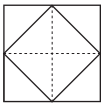
Why should the extension of the vertical and horizontal sides of the original square pass through the vertices of the dotted square? Class 8
easyWhy should the extension of the vertical and horizontal sides of the original square pass through the vertices of the dotted square? Class 8
Question 1.
Why should the extension of the vertical and horizontal sides of the original square pass through the vertices of the dotted square? Class 8
[Hint : From the diagonal property of a square, the line that bisects an angle passes through the opposite vertex. Argue why the vertical and horizontal sides of the original square bisect the two angles of the dotted square.]
Solution:
Bisector of an angle of a square passes through the opposite vertex.
Question 2.
Moreover, all these small triangles are congruent to each other. Can you explain why? Class 8
Solution:
By RHS condition.
Question 3.
Why is the smaller inside square half the area of the larger square?
Again, adding some east-west and north-south lines can explain it: Class 8
Solution:
In the above figure, bigger square has been divided into eight congruent triangles and the smaller square is made up of four such congruent triangle. Hence, area of smaller square is [latex]\frac{4}{8}[/latex] i.e., half of that of the bigger square.