Represent diagrammatically the changes in the arrangement of particles as ice melts and transforms into water vapour Class 8
hardRepresent diagrammatically the changes in the arrangement of particles as ice melts and transforms into water vapour Class 8
Represent diagrammatically the changes in the arrangement of particles as ice melts and transforms into water vapour. Class 8
Answer:
As ice melts into water and then vaporises into steam, the arrangement of water particles changes significantly. Initially, in ice (a solid), water molecules are tightly packed in a fixed, crystalline structure with limited movement (vibrations).
As ice melts, the particles gain kinetic energy, breaking free from their fixed positions and becoming able to slide past each other, forming liquid water. Further heating increases the kinetic energy, causing the particles to move more rapidly and spread out, eventually breaking free from the liquid and becoming water vapour, a gas with particles moving randomly and freely.
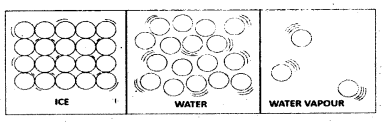
Solid (Ice)
- Particles are tightly packed in a fixed, orderly arrangement.
- They vibrate in place but don't move freely.
- Strong intermolecular forces hold them together.
Liquid (Water)
- As ice melts, heat energy increases particle movement.
- Particles become loosely packed and can slide past each other.
- The arrangement is random but still relatively close.
- Intermolecular forces weaken but still exist.
Gas (Water Vapour)
- With more heat, water evaporates or boils.
- Particles gain enough energy to break free completely.
- They move rapidly and randomly, far apart from each other.
- Intermolecular forces are negligible.