Two friends, one sitting in Porbandar (Gujarat) and the other in Tinsukia (Assam). Class 6
mediumTwo friends, one sitting in Porbandar (Gujarat) and the other in Tinsukia (Assam). Class 6
Let us Explore (Page 21)
Question 1.
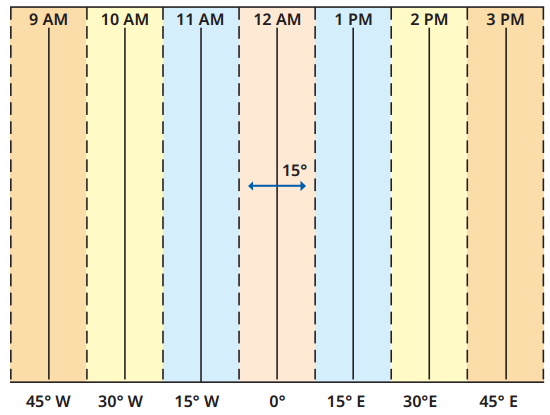
Two friends, one sitting in Porbandar (Gujarat) and the other in Tinsukia (Assam), are speaking on the phone late afternoon. The latter remarks that the sun has set in Assam and it’s now dark. The former is surprised and says, “But it’s still full daylight here!” Explain why. And, as a class activity, calculate the difference in local time between those two cities. Class 6
[Hint : For now, consider the difference in longitude between Porbandar and Tinsukia to be 30°; later, you can find out the precise value.]
Answer:
The Earth rotates on its axis from west to east. That is why, the Sun rises in the east and sets in the west. Tinsukia (Assam) is in the east, while the Porbandar in the west. When there is dark started in Tinsukia, there must be day light in Porbandar. This is due to the difference of longitude between the two.
A full turn of Earth is 360°. A full day has 24 hours.
1 hour = 360° ÷ 24 = 15°.
There is a difference of longitudes between the two places of 30°.
15° = 1 hour, 30° = 2 hours
The difference in local time of the two cities is 2 hours.
Question 2.
Return to the two friends sitting in Gujarat and Assam. Use this example to explain the difference between local time and standard time. Class 6
Answer:
Difference between local time and standard time
| Aspect | Local Time | Standard Time |
| Definition | Time based on the position of the Sun at a specific location | Uniform time reference used within a region or country |
| Determination | Determined with longitude, changes throughout the day in a country | Based on a standard meridian, consistent within a region or country |
| Variation | Varies with different locations, affected by longitude | Consistent within a region, unaffected by longitude |
| Purpose | Reflects actual time at a specific place | Facilitates coordination and scheduling across regions |
| Application | Used for daily activities and local events | Employed for national or regional timekeeping |
| Example | Varies from city to city within a country | Indian Standard Time (IST) in India is fixed 5 hours and 30 minutes ahead of the local time at Greenwich. |
In the case of the friends in Gujarat and Assam, even though there is a 2-hour time difference between the two locations based on their longitudes. They both follow the same standard time of Indian Standard Time (IST), since they are within the same country.