Understanding the Weather Class 7 Notes
hardUnderstanding the Weather Class 7 Notes
Understanding the Weather Class 7 Notes
1. Weather: The state of the Earth's atmosphere at a particular time and place, including factors such as temperature, humidity, precipitation, wind, and visibility.
2. Sleet: Frozen or partly frozen rain.
3. Hail: Small, hard balls of ice that fall from the sky like rain.
4. Troposphere: The lowest layer of the atmosphere, extending from the Earth's surface to about 6 to 18 kilometres high, where most weather phenomena occur.
5. High-Pressure System: An area where the atmospheric pressure is higher than surrounding areas, often associated with clear skies and calm weather.
6. Low-Pressure System: An area where the atmospheric pressure is lower than surrounding areas, often leading to cloudy skies and precipitation, and can develop into storms or cyclones.
7. Humidity: The amount of water vapour present in the air. It is usually expressed as a percentage, indicating how saturated the air is with moisture.
8. Acclimatisation: The process by which the body adjusts to changes in its environment, such as changes in altitude or temperature.
9. Forecasting: The process of predicting future weather conditions based on current weather data.
10. Relative Humidity: The ratio of the current amount of water vapour in the air to the maximum amount of water vapour that the air can hold at that temperature, expressed as a percentage.
11. Cyclone: A large-scale air mass that rotates around a strong centre of low atmospheric pressure, often resulting in severe weather conditions.
12. Weather Warning: A notification issued by meteorological agencies to alert the public about severe weather conditions that may pose a risk to safety.
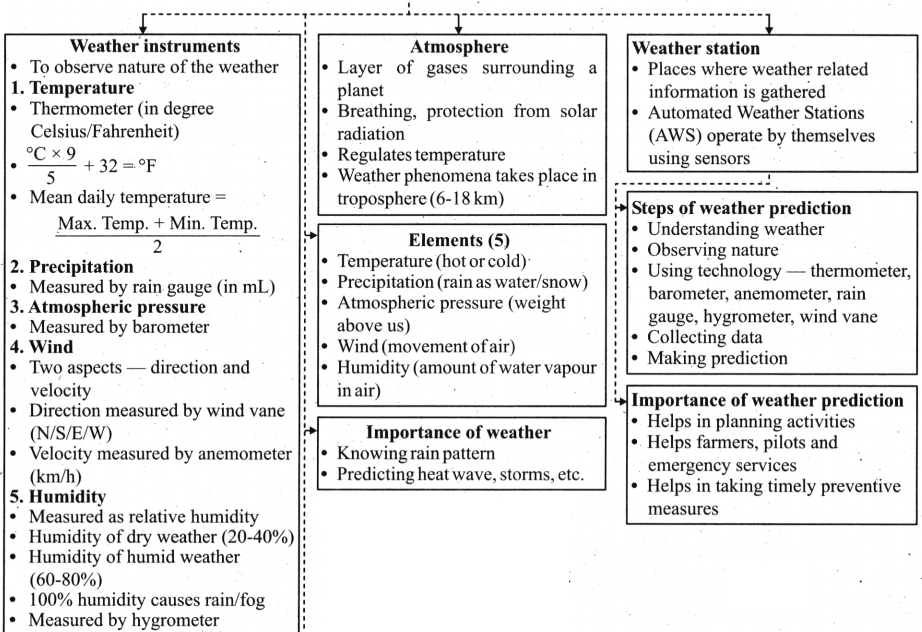
13. Weather is a state of earth's atmosphere at a particular time and place
14. Has 5 main elements
15. Described as hot, cold, rainy, windy, cloudy, etc.