Which Gupta ruler was also known as the 'Vikramaditya'? Class 7
hardWhich Gupta ruler was also known as the 'Vikramaditya'? Class 7
Question 1.
Which Gupta ruler was also known as the 'Vikramaditya'? Class 7
Answer:
The Gupta ruler known as 'Vikramaditya' is Chandragupta II.
Question 2.
'Periods of peace support the development of various aspects of sociocultural life, literature, and the development of science and technology.' Examine this statement in the light of the Gupta empire. Class 7
Answer:
1. Stability and Prosperity: The Gupta period was marked by peace, which allowed for economic stability. This prosperity enabled the state to support scholars, artists, and scientists, leading to cultural and intellectual growth. Some historians label this period the 'Classical Age'.
2. Flourishing Literature: It was also the time when knowledge from previous eras was consolidated and compiled into numerous texts. Kalidasa works and wrote many poems and major Puranas. Sanskrit literature flourished during this period. One of the Kalidasa's celebrated compositions is Meghadutam, or "The Cloud Messenger'.
3. Advancements in Science: During this period, Aryabhata in his treatise Aryabhattiya gave formulas to calculate the motion of the Sun, the Moon and the planets. He proposed that the Earth spins on its axis, which explains the alternation of day and night. He estimated the size of the Earth and correct explanation for solar and lunar eclipses. Ayurveda was written in an organised and systematic way. They prepared medicines, surgical techniques, importance of diet in maintaining good health. Ayurveda emphasises holistic healing and deep connection between the mind, body and nature.
4. Cultural Growth: The peaceful environment fostered artistic expression, leading to remarkable achievements in art and architecture. Many key centres of art like Sarnath known as exquisite sculptures of the Buddha, Ajanta Caves, the rock-cut caves at Udaygiri. The beautiful temples and intricate carvings that still inspire us today.
Question 3.
Match the two columns:
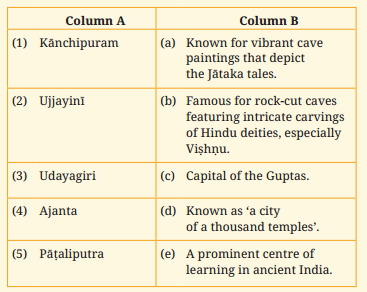
Answer:
| Column A | Column B |
| (1) Kanchipuram | (d) Known as 'a city of a thousand temples'. |
| (2) UjjayinI | (e) A prominent centre of learning in ancient India. |
| (3) Udayagiri | (b) Famous for rock-cut caves featuring intricate carvings of Hindu deities, especially Vishu. |
| (4) Ajanta | (a) Known for vibrant cave paintings that depict the Jataka tales. |
| (5) Pataliputra | (c) Capital of the Guptas. |