Area Class 8 Short Question Answer
easyArea Class 8 Short Question Answer
Area Class 8 Short Question Answer
Question 1.
Consider the obtuse angled triangle ABC of base 6 cm.
Its height AD which is perpendicular from the vertex A is outside the triangle.
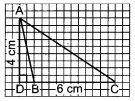
Can you find the area of the triangle ?
Solution:
Yes, its area can be found out.
Area of ∆ABC = [latex]\frac{1}{2}[/latex] × Base × Height
= [latex]\frac{1}{2}[/latex] × BC × AD ²
= ([latex]\frac{1}{2}[/latex] × 6 × 4) cm² = 12cm².
Question 2.
Find the area of the following paral-lelogram :

Solution:
Area of the parallelogram = Base × Height
= (2.5 × 3.5) cm².
= 8.75 cm².
Question 3.
DL and BM are the heights on sides AB and AD respectively of parallelogram ABCD. If the area of the parallelogram is 1470 cm², AB = 35 cm and AD = 49 cm, find the lengths of BM and DL.
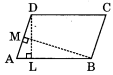
Solution:
We have :
Area of parallelogram ABCD
= 1470 cm²
AB = 35 cm and AD = 49 cm
Area of parallelogram ABCD
= AD × BM
So, 1470 = 49 × BM
or BM = [latex]\frac{1470}{49}[/latex] cm
= 30 cm.
Again,
Area of parallelogram ABCD
= AB × DL
So, 1470 = 35 × DL
or DL = [latex]\frac{1470}{35}[/latex] cm
= 42 cm.
Question 4.
∆ABC is right angled at A. AD is perpendicular to BC. If AB = 5 cm, BC = 13 cm and AC = 12 cm. Find the area of ∆ABC. Also, find the length of AD.
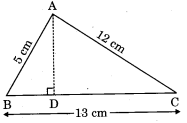
Solution:
Since ∆ ABC is right ∠d at A, therefore
Area of ∆ABC = [latex]\frac{1}{2}[/latex] × AB × AC
= ([latex]\frac{1}{2}[/latex] × 5 × 12) cm²
= 30 cm².
Again, area of ∆ABC = [latex]\frac{1}{2}[/latex] × BC × AD
So, 30 = [latex]\frac{1}{2}[/latex] × 13 × AD
or AD = [latex]\frac{2 \times 30}{13}[/latex] cm
= [latex]\frac{60}{30}[/latex] cm.
Question 5.
∆ABC is isosceles with AB = AC = 7.5 cm and BC = 9 cm. The height AD from A to BC is 6 cm. Find the area of ∆ABC. What will be the height from C to AB i.e., CE?
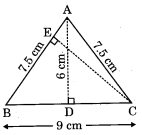
Solution:
Area of ∆ABC = [latex]\frac{1}{2}[/latex] × BC × AD
= ([latex]\frac{1}{2}[/latex] × 9 × 6) cm²
= 27 cm².
Also, area of ∆ABC
= [latex]\frac{1}{2}[/latex] × AB × Corresponding height z
So, 27 = [latex]\frac{1}{2}[/latex] × 7.5 × Height from C to AB or height from C to AB
= [latex]\frac{2 \times 27}{7.5}[/latex] = 7 2 cm.