Area Class 8 MCQ
easyArea Class 8 MCQ
Area Class 8 MCQ
Question 1.
Consider a rectangle shown, divided into two congruent triangles. The length of the rectangle is twice its breadth.
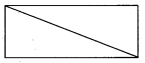
If the length is 14 cm, what is the area of each triangle?
(a) 21 cm²
(b) 49 cm²
(c) 98 cm²
(d) 196 cm²
Answer:
(b) 49 cm²
Question 2.
Observe the figure below :

Which of these options represents the area of each small rectangle ?
(a) 90 cm²
(b 60 cm²
(c) 180 cm²
(d) 360 cm²
Answer:
(a) 90 cm²
Question 3.
Consider a parallelogram shown.
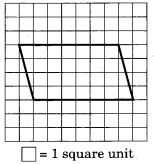
What is the area of the parallelogram?
(a) 11 cm²
(b) 14 cm²
(c) 22 cm²
(d) 28 cm²
Answer:
(d) 28 cm²
Question 4.
The height of a parallelogram is 5 cm more than its base. If the length of the base is 6 cm, what is the area of the parallelogram?
(a) 30 cm²
(b) 33 cm²
(c) 34 cm²
(d) 66 cm²
Answer:
(d) 66 cm²
Question 5.
A pathway 8 m wide is built outside and around a square park of side length 45 m. Which of these options represents the area of the pathway?
(a) 1696 m²
(b) 1864 m²
(c) 2895 m²
(d) 4834 m²
Answer:
(a) 1696 m²
Case Study
Question 1.
Following diagram shows a map of natural reserve :
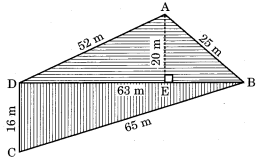
Fill in the blanks :
(а) Measure of ∠BDC is _______ .
(b) Perimeter of ∆BCD is _________ .
(c) Area of ∆BCD is _______ .
(d) Perimeter of ∆ABD is _________ .
(e) Perimeter of the natural reserve is _____ .
(f) Area of the natural reserve is _________ .
Answer:
(a) 90°
(b) 144 m
(c) 504 m²
(d) 140 m
(e) 158 m
(f) 1134 m²
Question 2.
Sunil has designed a garden and has put a diagonal path across his rectangular garden as shown in the figure. This path separates the garden into two triangular gardens.
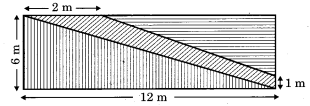
(a) Area of the smaller triangular bed is
(i) 48 m²
(ii) 36 m²
(iii) 30 m²
(iv) 25 m²
(b) Area of the bigger triangular bed is
(i) 36 m²
(ii) 48 m²
(iii) 64 m²
(iv) 72 m²
(c) Perimeter of the rectangular garden is
(i) 18 m
(ii) 21 m
(iii) 36 m
(iv) 42 m
(d) Area of the rectangle is
(i) 48 m²
(ii) 64 m²
(iii) 72 m²
(iv) 76 m²
(e) Area of the path is
(i) 11 m²
(ii) 9 m²
(iii) 7 m²
(iv) 5 m²
Answer:
(a) (iv)
(b) (i)
(c) (iii)
(d) (iii)
(e) (i)