Geometric Twins Class 7 MCQ
hardGeometric Twins Class 7 MCQ
Geometric Twins Class 7 MCQ
Question 1.
Consider the four figures below.
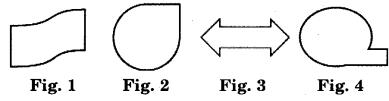
Each figure is cut along a line to get two parts. The two parts generated from three of the figures are congruent.
Which figure result in parts that are not congruent?
(a) Fig. 1
(b) Fig. 2
(c) Fig. 3
(d) Fig. 4
Solution:
(d) Fig. 4
Question 2.
Consider the triangles :
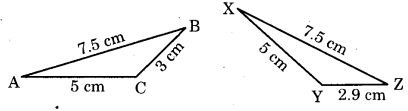
Are the triangles congruent? why not?
(a) Yes, as they both are obtuse angles.
(b) No, as one of the angles in both the triangles is an obtuse.
(c) Yes, as at least two sides in both the triangles are congruent.
(d) No, for the triangles to be congruent BC should be equal to YZ.
Solution:
(d) No, for the triangles to be congruent BC should be equal to YZ.
Question 3.
Consider the statements :
Statement 1: All equilateral triangles are congruent.
Statement 2: All right triangles are congruent.
Which of these is/are true?
(a) Statement I
(b) Statement II
(c) Both the statements
(d) Neither of the statements
Solution:
(d) Neither of the statements
Question 4.
Vivek constructed 4 triangles and labelled some parts. He then asked his friend to choose the triangles with the same size.
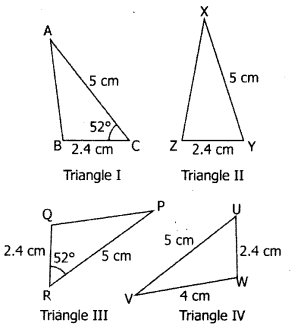
Which triangles have the same size?
(a) Triangle I and II
(b) Triangle I and III
(c) Triangle II and IV
(d) All four of them
Solution:
(b) Triangle I and III
Question 5.
Which among the following is not congruent with other triangles?
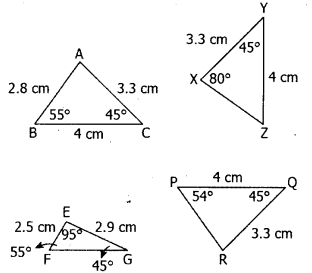
(a) ∆EFG
(b) ∆XYZ
(c) ∆ABC
(d) ∆PQR
Solution:
(a) ∆EFG
Question 6.
Consider the following two right-angled triangles.
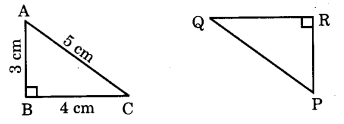
A student made following claims about the triangles.
Claim I: Knowing that PQ = 5 cm and PR = 3 cm, it can be concluded that triangles are congruent.
Claim II : Knowing that PQ = 5 cm and QR = 4 cm, it can be concluded that triangles are congruent.
Which claim is correct?
(a) only claim I
(b) only claim II
(c) both the claims
(d) neither of the claims
Solution:
(c) both the claims
Question 7.
Consider the triangles below.
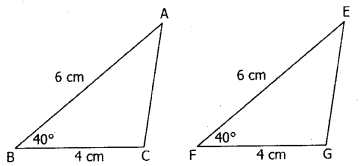 imggg
imggg
Are the triangles congruent? Justify.
(a) Yes, by SAS criterion.
(b) Yes, by SSS criterion.
(c) No valid conclusion can be made as the third side in each triangle is not unknown.
(d) No valid conclusion can be made as only one of the angles is known for each triangle.
Solution:
(a) Yes, by SAS criterion.
Case Study
Question 1.
A figure has been drawn on the blackboard as shown below in which PQ = PR and PS is the bisector of ∠QPR.
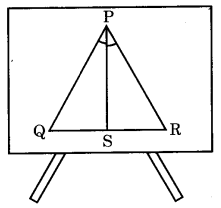
(a) Triangles PQS and PRS are congruent by following rule :
(i) SSS (ii) SAS (iii) ASA (iv) AAA
Fill in the blanks :
(b) QS = ______.
(c) ∠RPS = _______.
(d) ∠PQS = ______.
(e) Correct correspondence is PQS ↔ _____.
Solution:
(a) (ii);
(b) RS;
(c) ∠QPS;
(d) ∠PRS;
(e) PRS.
Question 2.
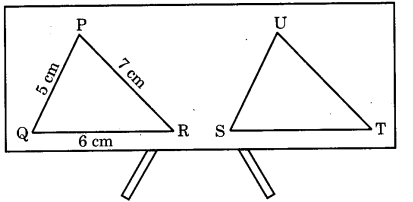
Two triangles PQR and STU are drawn on the blackboard by the teacher such that the two triangles are congruent under the correspondence PQR ↔ UST.
(a) Length of side ST is
(i) 5 cm (ii) 6 cm (iii) 7 cm (iv) 9 cm
(b) Is ∠P = ∠S ?
(c) Is ∠Q = ∠T ?
(d) Is PQ = ST ?
(e) Is SU = PQ ?
Solution:
(a) (ii);
(b) No;
(c) No;
(d) No;
(e) Yes.