Geometric Twins Class 7 Notes
hardGeometric Twins Class 7 Notes
Geometric Twins Class 7 Notes
1. Geometric Twins
Figures with the same shape and size are called congruent figures.
Superimpose : One figure can fit perfectly over another through rotation or flipping.
2. Congruence of Triangles
Symbol for Congruence:
Example : ∆ABC ≅ ∆XYZ
Conditions for Congruence:
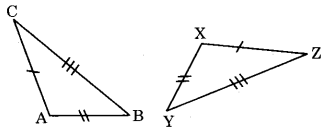
SSS (Side Side Side):
All three sides of one triangle equal to the three sides of another triangle.
SAS (Side Angle Side) :
Two sides and the included angle of one triangle equal to those of another.
ASA (Angle Side Angle):
Two angles and the included side of one triangle equal to those of another.
AAS (Angle Angle Side):
Two angles and a non-included side of one triangle are equal to two angles and the corresponding side of the other triangle.
RHS (Right Hypotenuse Side):
One side and the hypotenuse of one right triangle equal to those of another.
3. Properties of Congruent Triangles
When two triangles are congruent, there are corresponding vertices, sides and angles which fit exactly over each other when the triangles are made to overlap.
They are,
(a) Corresponding Vertices: A and X, B and Y, C and Z
(b) Corresponding Sides : AB and XY, BC and YZ,AC and XZ
(c) Corresponding Angles: ∠Aand ∠X, ∠B and ∠Y, ∠C and ∠Z
∆ABC ≅ ∆XYZ
Order Matters : The order of vertices must be maintained in congruence notation.
4. Angle Properties
Angle Sum Property: The sum of angles in a triangle is always 180°).
Isosceles Triangle: Two sides are equal; angles opposite those sides are equal.
Example : AB = AC leads to ∠B = ∠C.
Equilateral Triangle:
All sides and angles are equal; each angle is 60°.
5. Real-Life Examples of Congruent Triangles Architecture:
The Louvre Museum features congruent triangular shapes.
The Pyramids of Giza utilize congruent triangles in their design.
CHAPTER AT A GLANCE
1. Congruent Triangles : Two triangles are congruent if they have the same shape and size.
2. Congruence Conditions : There are specific conditions that help us determine if two triangles are congruent. These conditions include :
- SSS (Side-Side-Side) : If all three sides of one triangle are equal to the three sides of another triangle, then the triangles are congruent.
- SAS (Side-Angle-Side) : If two sides and the included angle (the angle between the two sides) of one triangle are equal to two sides and the included angle of another triangle, then the triangles are congruent.
- ASA (Angle-Side-Angle) : If two angles and the included side of one triangle are equal to two angles and the included side of another triangle, then the triangles are congruent.
- AAS (Angle-Angle-Side) : If two angles and a non-included side of one triangle are equal to two angles and a corresponding non-included side of another triangle, then the triangles are congruent.
- RHS (Right Hypotenuse Side): In right triangles, if the hypotenuse (the longest side opposite the right angle) and one other side are equal in both triangles, then the triangles are congruent.
3. Non-Congruent Triangles : These are triangles that do not have the same shape and size. They may have the same angles or sides but are not identical in size.
4. SSA (Side-Side-Angle) : This condition does not guarantee that two triangles are congruent. For example, two triangles can have two sides of the same length and an angle that is not included between those sides, but they can still be different sizes.
5. Isosceles Triangle : A triangle that has at least two sides that are equal in length. The angles opposite those equal sides are also equal.
6. Equilateral Triangle : A triangle where all three sides are equal in length, and therefore all three angles are also equal (each measuring 60°).
7. Angle : A figure formed by two rays (sides of the angle) that share a common endpoint (the vertex). Angles are measured in degrees.
8. Side : A straight line that forms part of the boundary of a shape. In triangles, sides are the line segments that connect the vertices.
Geometric Twins
In geometry, figures that have the same shape and size are referred to as congruent. This means that one figure can be superimposed onto another, fitting perfectly over it.
When we talk about geometric twins, we are essentially discussing congruent figures, particularly triangles, and how they can be manipulated through rotation or flipping to achieve superimposition.
Congruence of Triangles
Triangles can be compared based on their sides and angles to determine if they are congruent.
Conventions to Express Congruence
To express the congruence of triangles, we use the symbol =. For example, if triangles ∆ABC and ∆XYZ are congruent, we write :
∆ABC ≅ ∆XYZ
SSS (Side Side Side)
The SSS condition states that if all three sides of one triangle are equal to the three sides of another triangle, then the triangles are congruent.
For example, if triangle ∆ABC has sides AB = 5 cm, AC = 6 cm, and BC = 7 cm, and triangle ∆XYZ has sides XY = 5 cm, XZ = 6 cm, and YZ = 7 cm, then ∆ABC ≅ ∆XYZ.
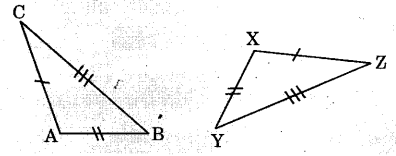
The triangles are congruent shows that their respective angles are equal: '
∠A= ∠X, ∠B = ∠Yand ∠C = ∠Z
When two triangles are congruent, there are corresponding vertices, sides and angles which fit exactly over each other when the triangles are made to overlap.
In above case, they are
(a) Corresponding Vertices : A and X, B and Y, C and Z.
(b) Corresponding Sides: AB andXY, BC and YZ, AC and XZ.
(c) Corresponding Angles: ∠A and ∠X, ∠B and ∠Y, ∠C and ∠Z.
∆ABC ≅ ∆XYZ
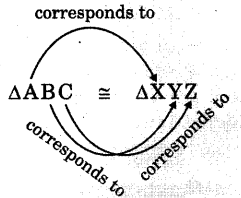
To express the congruence of two triangles
Order Matters: It is important to maintain the order of the vertices when expressing congruence.
For example, writing ∆ABC ≅ ∆XZY would not be correct because it does not maintain the proper correspondence between the vertices.
However, ∆ABC ≅ ∆XYZ is correct because it still matches the corresponding vertices appropriately. Measuring the Angles
When measuring angles, it is important to note that the sum of the angles in any triangle is always 180°. This property can help in establishing congruence when angles are involved.
Two Sides and the Included Angle
The SAS (Side Angle Side) condition states that if two sides and the included angle of one triangle are equal to the two sides and the included angle of another triangle, then the triangles are congruent.
For example, if AB = 6 cm, AC = 5 cm, and ∠A = 30° in triangle AABC, and the same measurements are true for triangle ∆XYZ, then :
AB = XY = 6 cm, AC = XZ = 5 cm, and ∠A = ∠X = 30°. .
So, ∆ABC ≅ ∆XYZ
Two Sides and a Non-included Angle
The SSA (Side Side Angle) condition states that if two sides and a non-included angle of one triangle are equal to the two sides and the non-included angle of another triangle, the triangles may not necessarily be congruent.
This is because there can be two different triangles that can be formed with the same measurements, leading to the possibility of non- congruent triangles.
Two Angles and the Included Side
The ASA (Angle Side Angle) condition states that if two angles and the included side of one triangle are equal to the two angles and the included side of another triangle, then the triangles are congruent.
For example, if ∠A = 50°, ∠B = 30°, and AB = 5 cm in triangle AABC, and the same measurements apply to triangle ∆XYZ, then :
∆ABC ≅ ∆XYZ
What are the Corresponding Vertices?
When two triangles are congruent, their corresponding vertices are the points that match up when the triangles are superimposed. For example, if ∆ABC ≅ ∆XYZ, then :
- Vertex (A) corresponds to vertex (X)
- Vertex (B) corresponds to vertex (Y)
- Vertex (C) corresponds to vertex (Z)
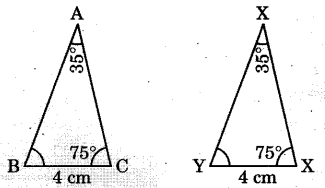
Two Angles and a Non-included Side
The AAS (Angle Angle Side) condition states that if two angles and a non-included side of one triangle are equal to the two angles and the corresponding non-included side of another triangle, then the triangles are congruent. This condition guarantees congruence.
Two Sides in a Right Triangle
The RHS (Right Hypotenuse Side) condition applies specifically to right triangles.
If one side and the hypotenuse of one right triangle are equal to a side and the hypotenuse of another right triangle, then the triangles are congruent.
Consider two right-angled triangles, ∆ABC and ∆DEF, where :
Triangle ∆ABC has :
- Right angle at C
- Hypotenuse AB
- Side AC
Triangle ADEF has :
- Right angle at F
- Hypotenuse DE
- Side DF
Given Measurements
Suppose we have the following measurements :
- AC = DF (one side)
- AB = DE (hypotenuse)
Applying the RHS Condition
Since both triangles are right-angled and we know one side and the hypotenuse are equal, we can conclude that: ,
∆ABC ≅ ∆DEF
Angles of Isosceles and Equilateral Triangles
Angle Sum Property : The sum of the angles in any triangle is always 180°.
Example: Consider an isosceles triangle ∆ABC where AB = AC and ∠A = 80°.
To find the measures of angles B and C :
Since AB = AC, we know ∠B = ∠C.
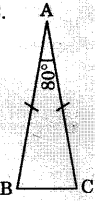
Using the angle sum property :
∠A + ∠B + ∠C = 180°
80° + ∠B + ∠B = 180°
80°+ 2 ∠B =180°
2 ∠B = 100°
∠B = 50°
Thus, ∠B= ∠C = 50°.
In an isosceles triangle, two sides are equal, and the angles opposite those sides are also equal.
For example, if AB = AC in triangle ∆ABC, then ∠B = ∠C.
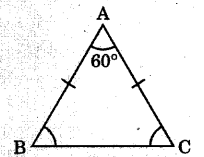
In an equilateral triangle, all three sides are equal, and consequently, all angles are equal to 60°.
Angles in an Equilateral Triangle
In an equilateral triangle, since all angles are equal, we can conclude :
∠A = ∠B = ∠C = 60°
Real-Life Examples of Congruent Triangles
Congruent triangles are not just theoretical; they appear in various real-life structures and designs. Examples include :
- The Louvre Museum in Paris, which features congruent triangular shapes in its architecture.
- The Pyramids of Giza, where congruent triangles form the base and sides.