A Journey through States of Water Class 6 MCQ
easyA Journey through States of Water Class 6 MCQ
1. Which activities should NOT be considered if the consumption of water by a person for daily activities needs to be calculated?
(а) cooking and drinking
(b) bathing and in the toilets
(c) washing of utensils and clothes
(d) Growing of fruits and vegetables
Answer:
(d) Growing of fruits and vegetables
2. Which of these is a major source of water?
(a) Lake
(b) Pond
(c) River
(d) Spring
Answer:
(c) River
3. The diagram shows the amount of water held by different sources of water on Earth.
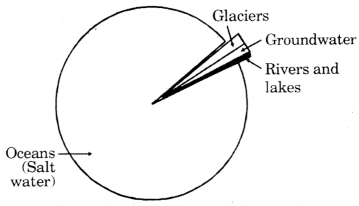
Based on the diagram, which water body has the maximum amount of water on Earth?
(a) Oceans
(b) Glaciers
(c) Groundwater
(d) Rivers and lakes
Answer:
(a) Oceans
4. A student makes a model to show the processes of the water cycle, as shown.
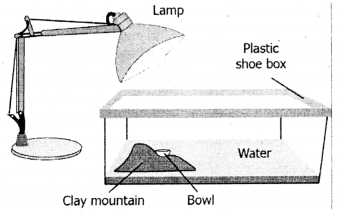
In what way would the lamp affect the processes of the water cycle shown in the model?
(a) By lighting the lid of the box
(b) By evaporating the water in the box
(c) By forming droplets of water on the lid
(d) By precipitating the water droplets onto the clay mountain
Answer:
(b) By evaporating the water in the box
5. Which of these would most likely happen if it rains heavily for a long period?
(a) Crops would get damaged
(b) Fish would increase in number
(c) The water level in rivers would go down
(d) Organisms present in soil would grow faster
Answer:
(a) Crops would get damaged
6. Which is the most appropriate method of rainwater harvesting at the household level?
(а) Cover the roof with grass
(b) Dig open pits in the lawn area
(c) Construct drains directed to rivers
(d) Connect the rooftop with pipes to a pit in the ground
Answer:
(d) Connect the rooftop with pipes to a pit in the ground
7. What will happen if the humidity level is higher?
(a) Clothes will dry faster
(b) Clothes will dry comparatively more slowly
(c) It would not affect the clothes
(d) None of these
Answer:
(b) Clothes will dry comparatively more slowly
8. Which is NOT a part of the water cycle?
(a) Cloud formation
(b) Rain
(c) Drinking by animals
(d) Sun
Answer:
(c) Drinking by animals
9. Which one of the following is the purest form of water?
(a) River water
(b) Groundwater
(c) Rainwater
(d) Ocean water
Answer:
(c) Rainwater
10. In which of the following cases will the evaporation of water be the slowest?
(a) A kettle of water is kept on a burner.
(b) A kettle of water is kept on a rooftop.
(c) A glass of water is kept in a room.
(d) A tray of water is kept in Sunlight.
Answer:
(c) A glass of water is kept in a room.
Case Study Questions
I. Ice (solid state) retains its shape irrespective of the container in which it is placed, while water takes the shape of the container. Ice does not flow or spread.
Water (liquid state) flows and changes its shape. Water does not have a fixed shape. It takes up the shape of the container in which it is kept, but the volume of water remains constant. Water also has the property to spread while keeping the volume constant.
Water vapour (gaseous state) exhibits a property of spreading out in the entire available space. Gases do not possess a fixed shape. Water vapour exists even at room temperature, though it is invisible to us. It is present in the air around us. The water that evaporates during processes like drying clothes or mopping floors contributes to the water vapour in the air around us.
1. How many states of water exist in nature?
(a) 5
(b) 3
(c) 2
(d) 1
Answer:
(b) 3
2. Which state of water does not change its shape?
(a) Solid
(b) Liquid
(c) Gas
(d) Both (b) and (c)
Answer:
(a) Solid
3. Which of the following states has the property to spread?
(a) Solid
(b) Liquid
(c) Gas
(d) Both (b) and (c)
Answer:
(d) Both (b) and (c)
4. This state of water has no fixed shape but fixed volume:
(a) Solid
(b) Liquid
(c) Gas
(d) All of these
Answer:
(b) Liquid
5. This state of water has neither fix shape nor fixed volume ___________
(a) Sdlid
(b) Liquid
(c) Gas
(d) None of these
Answer:
(c) Gas
II. The water from the ocean and the Earth’s surface evaporates into the atmosphere as vapour and returns as rain, hail, or snow, ultimately flowing back to the oceans. This circulation of water is known as the water cycle. Only a small portion of the water available on the Earth is fit for use by plants, animals, and humans. Most of the water is in the oceans, and it cannot be used directly. We use water for drinking and also for many other activities.
1. Which process brings the water lost back to Earth’s surface?
(a) Condensation
(b) Evaporation
(c) Heating
(d) Melting
Answer:
(a) Condensation
2. Water cycle is ___________
(a) The whirl of water in the ocean
(b) The circulation of water from the ocean to clouds and back to the Earth.
(c) The circulation of water within the household.
(d) The storage of water.
Answer:
(b) The circulation of water from the ocean to clouds and back to the Earth.
3. What is the state of hail?
(a) Liquid
(b) Solid
(c) Gas
(d) Both (a) and (c)
Answer:
(b) Solid
4. Condensation is the process of conversion of ___________
(a) solid to gas
(b) gas to solid
(c) gas to liquid
(d) liquid to gas
Answer:
(c) gas to liquid
5. Is water cycle a ___________
(a) physical change and reversible
(b) physical change and non-reversible
(c) chemical change and reversible
(d) chemical change and non-reversible
Answer:
(a) physical change and reversible