Diversity in the Living World Class 6 MCQ
easyDiversity in the Living World Class 6 MCQ
1. A student wants to identify a shrub in a garden, but he is getting confused between a herb and a shrub. Which characteristics of the plant will help the student to identify the shrub?
(a) Green stems
(b) Hard and thick stems
(c) Branches developed at the base of the stem
(d) Branches developed in the upper part of the stem
Answer:
(c) Branches developed at the base of the stem
2. The image shows a watermelon plant.
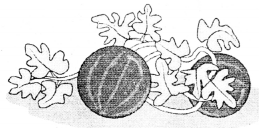
A student claimed that it a herb. Is the claim made by the student correct?
(a) Yes. The plant has green stems, so it is an herb.
(b) Yes. The plant has many branches, so it is an herb.
(c) No. The plant has weak stems and spreads on the ground, so it is a creeper.
(d) No. The plant has weak stems that support the watermelon on the ground, so it is a climber.
Answer:
(c) No. The plant has weak stems and spreads on the ground, so it is a creeper.
3. A farmer designed a home vineyard to plant grapevines, as shown in the image.
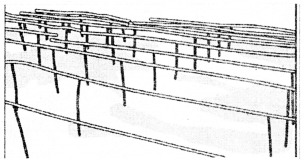
What could be the reason for the farmer to design it in this way?
(a) To make the yard beautiful, as grape flowers will cover all these poles.
(b) To manage the space so that some other plants can be grown on the ground.
(c) To provide equal space to each grapevine, as these require a lot of ground to grow.
(d) To get good productivity of grapes, as grape vines are climbers that need supports to climb upward.
Answer:
(d) To get good productivity of grapes, as grape vines are climbers that need supports to climb upward.
4. A student pulled a herb out of the soil and observed that a plant part came out with it.
Some hair-like structures were coming out from that part. What could be the plant part?
(a) Flower
(b) Leaf
(c) Stem
(d) Root
Answer:
(d) Root
5. Ravi conducted an experiment in which he filled a glass with one-third of the water. He added a drop of red ink into that glass and then stirred it for a few minutes. After that, he made an oblique cut at the base of the stem of a tender twig and then put it into the water as shown in the image.
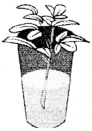
This setup was left by the student overnight. What can be observed by the student on the next day?
(a) Shedding of leaves from the stem
(b) Rise of the colour into the stems
(c) Development of red coloured roots
(d) Development of more branches at the stem
Answer:
(b) Rise of the colour into the stems
6. The image shows an unlabelled diagram of a leaf.
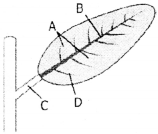
Which of the following options correctly names the labelled parts?
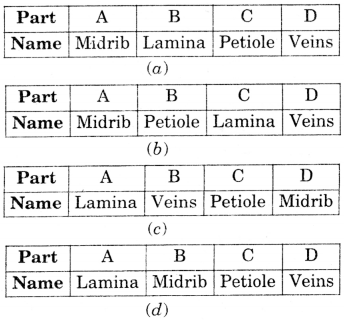
Answer:
(d)

7. A student took a leaf from a mango plant and started to take its impression with the help of a pencil and paper. The image shows the impression of the mango leaf.
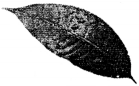
What likely can be concluded about the venation of the leaf?
(a) Parallel venation, as the obtained design represents net-like veins.
(b) Parallel venation; as the obtained design represents parallel veins.
(c) Reticulate venation, as the obtained design represents net-like veins.
(d) Reticulate venation, as the obtained design represents parallel veins.
Answer:
(c) Reticulate venation, as the obtained design represents net-like veins.
8. The image shows two types of plants with their root system.
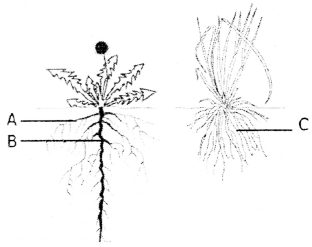
Which of the following correctly describes the names of the roots that are labelled as A, B, and C?
(a) A - Lateral Root, B - Tap Root, C - Fibrous Root
(b) A - Tap Root, B - Fibrous Root, C - Lateral Root
(c) A - Fibrous Root, B - Lateral Root, C - Tap Root
(d) A - Tap Root, B - Lateral Root, C - Fibrous Root
Answer:
(a) A - Lateral Root, B - Tap Root, C - Fibrous Root
9. A student observed the leaves of different plants listed in the table.
- Peepal
- Mango
- Neem
- Banana
- Grasses
In which of these plants might the student have observed parallel venation?
(a) Banana and Peepal
(b) Mango and Neem
(c) Neem and Grasses
(d) Banana and Grasses
Answer:
(d) Banana and Grasses
10. The table shows some blank cells that need to be filled with the type of root and leaf venation of the respective plants.
| Name of the Plant | Type of Root | Type of Leaf Venation |
| Carrot | Taproot | A |
| Banana | B | Parallel |
| Maize | Fibrous | C |
| Mango | D | Reticulate |
Which of the following correctly represents the labels A, B, C, and D?
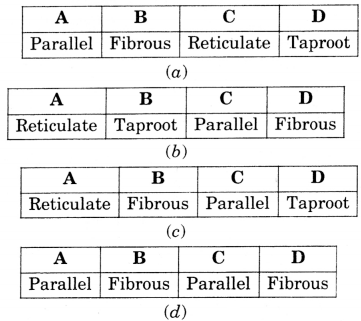
Answer:
(c)

11. Which of the following trees is found in the mountains?
(a) Bamboo
(b) Banyan
(c) Oak
(d) Deodar
Answer:
(d) Deodar
12. How many humps are present in the mountain region camel?
(a) 1
(b) 2
(c) 3
(d) 4
Answer:
(b) 2
13. Which of the following is not a characteristic of terrestrial habitats?
(a) Soil as a substrate
(b) Presence of water bodies
(c) Air as the medium for respiration
(d) Fluctuating temperature and humidity levels
Answer:
(b) Presence of water bodies
Case Study Questions
I. The populations of the Bengal Tiger, Cheetah, and Great Indian Bustard have declined in India due to loss of natural habitats caused by human activities. The Government of India has initiated several projects to conserve our biodiversity. 'Project Tiger’ was initiated in 1973 to protect the declining population of the Bengal Tiger. The ‘Cheetah Reintroduction Project’ was initiated in 2022 to restore the Cheetah population. Similarly, habitats of the Great Indian Bustards have been declared protected areas in Gujarat, Rajasthan, and Maharashtra.
1. Which project was initiated to restore the population of the Cheetah?
(a) Cheetah Conservation Project
(b) Cheetah Protection Project
(c) Cheetah Reintroduction Project
(d) Cheetah Save Project
Answer:
(c) Cheetah Reintroduction Project
2. Why did the Cheetah or the Tiger become extinct in India in the early 20th century?
(a) Climate change
(b) Hunting and habitat loss
(c) Competition with tigers
(d) Disease outbreak
Answer:
(b) Hunting and habitat loss
3. Which organisation is leading the Cheetah Reintroduction Project in India?
(a) WWF
(b) IUCN
(c) WII
(d) Greenpeace India
Answer:
(c) WII
4. In which year was Project Tiger launched in India?
(a) 1960
(b) 1973
(c) 1980
(d) 1990
Answer:
(b) 1973
5. Which is India’s oldest tiger reserve established under Project Tiger?
(a) Ranthambhore National Park
(b) Bandhavgarh National Park
(c) Jim Corbett National Park
(d) Kanha Tiger Reserve
Answer:
(c) Jim Corbett National Park
II. Sacred groves are undisturbed patches of forests. Their sizes may vary from quite small to very large. Sacred groves are found all over India. They are home to different kinds of plants and animals, including numerous medicinal plants. These are protected by the local community, and no one is allowed to harm any animals, cut trees in these groves, or disturb the area. This way, sacred groves are a community-protected treasure of biodiversity. Find out about the sacred groves in your region.
1. Sacred groves are primarily known for:
(a) Industrial development
(b) Agricultural cultivation
(c) Conservation of biodiversity
(d) None of these
Answer:
(c) Conservation of biodiversity
2. Which of the following regions is known for its tradition of sacred groves?
(a) Arctic Circle
(b) Sahara Desert
(c) Amazon Rainforest
(d) Western Ghats
Answer:
(d) Western Ghats
3. Choose the main reason behind the conservation of sacred groves.
(a) Religious and cultural benefits
(b) Research benefits
(c) Economic benefits
(d) Industrial benefits
Answer:
(a) Religious and cultural benefits
4. Sacred groves are protected by:
(a) NGOs
(b) Private Cooperations
(c) Local Communities
(d) None of these
Answer:
(c) Local Communities