Materials Around Us Class 6 MCQ
easyMaterials Around Us Class 6 MCQ
1. From the given list, which pair of objects could be made of both plastic and metal components?
A: Toothbrush
B: Saree
C: Spectacles
D: Buckets
E: Frying pan
(a) A and E
(b) B and C
(c) C, D, and E
(d) A and D
Answer:
(c) C, D, and E
2. An ordinary chair requires a strong structure to support the weight of a person sitting on it. Which of the following materials should not be considered for building a chair?
(a) Glass
(b) Metal
(c) Wood
(d) Plastic
Answer:
(a) Glass
3. Which of the following objects would show lustre?
(a) Earthen pot
(b) Plastic bottle
(c) Aluminium foil
(d) Wooden plank
Answer:
(c) Aluminium foil
4. Some materials are naturally lustrous, while others are coated with compounds to make them appear lustrous. Over time, all materials tend to lose lustre due to their environment. Which of the following objects cannot regain their lustre upon being rubbed with sandpaper?
(a) Rusted nails
(b) Old silver cutlery
(c) Dusty ceramic mug
(d) Tarnished copper jug
Answer:
(c) Dusty ceramic mug
5. Students were asked to examine different materials and substances. These were butter paper, aluminium foil, cardboard, white cotton cloth, frosted glass, and water. Which of the following is a correct observation?
(а) Only cardboard is opaque
(b) Only water is transparent
(c) Butter paper and water are translucent
(d) Aluminium foil, frosted glass, and cotton cloth are opaque
Answer:
(b) Only water is transparent
6. A source of light was observed through three sheets of paper. These were,
Sheet 1: Butter paper
Sheet 2: White tissue paper
Sheet 3: Paper painted with black acrylic paint.
Which of the following is a correct statement regarding these sheets of paper?
(a) 1 is translucent, 2 is transparent, and 3 is opaque
(b) 1 is transparent while 2 and 3 are translucent
(c) 1 is translucent while 2 and 3 are opaque
(d) 1 and 2 are translucent, while 3 is opaque
Answer:
(d) 1 and 2 are translucent, while 3 is opaque
7. Bulbul wants to pack her art and craft items to carry them to school the next day. What material is often used for making such containers for packaging?
(a) Glass
(b) Expensive metals
(c) Wood
(d) Recycled craft paper
Answer:
(d) Recycled craft paper
8. Nikhil has spilled water on the table. Which type of cloth will you suggest him to wipe the water?
(a) Silk
(b) Cotton
(c) Nylon
(d) Georgette
Answer:
(b) Cotton
9. Take two samples, one of mustard oil and the other of water. Mix the two. You observe that:
(a) They are soluble
(b) Oil floats on water
(c) Water floats on oil
(d) None of the above
Answer:
(b) oil floats on water
10. We feel the need to group things because:
(a) It is convenient to study their properties and observe patterns
(b) It looks better
(c) It saves time to study, organize or use
(d) both (a) and (c)
Answer:
(d) both (a) and (c)
Case Study Questions
I. Take 10 ml of water in 6 test tubes, each, and add different samples of substances to each test tube as shown in the given figure. Shake the test tubes vigorously for a couple of seconds and leave them undisturbed.
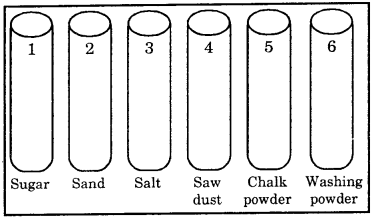
1. In which of these test tubes will sample substances remain insoluble in water?
(a) 1, 2, and 3
(b) 2, 4, and 5
(c) 2, 3, and 4
(d) 4, 5, and 6
Answer:
(b) 2, 4, and 5
2. Which of the test tubes becomes clear after dissolving the samples?
(a) Only 1
(b) Both 1 and 2
(c) Only 3
(d) Both 1 and 3
Answer:
(d) Both 1 and 3
3. Identify the test tube in which the sample is soluble but gives a translucent appearance.
(a) 3
(b) 3 and 4
(c) Only 5
(d) Only 6
Answer:
(d) Only 6
4. Identify the test tube that can be filtered to separate the samples.
(a) 1, 2, 3
(b) 2, 4
(c) 6
(d) 4 and 5
Answer:
(b) 2, 4
5. What is the nature of sand and sawdust?
(a) Both are translucent.
(b) Sand is opaque, but sawdust is translucent
(c) Both are opaque.
(d) Only sand is transparent.
Answer:
(c) Both are opaque.
II. Make your own ORS!
ORS (Oral Rehydration Solution) is used to treat dehydration due to diarrhoea or other illnesses. These ready-made ORS packets are available in primary health centres and also in the market. Each packet is dissolved in a litre of water before use. If these are not available, ORS can be prepared at home by mixing six teaspoons of sugar and half a teaspoon of common salt in one litre of boiled and cooled water.
1. What is the full form of ORS?
(а) Oral Restore System
(b) Oral Rehydration Symptom
(c) Oral Rehydration Solution
(d) Open Rehydration Solution
Answer:
(c) Oral Rehydration Solution
2. When do we use ORS?
(a) to treat dehydration during illness
(b) to increase haemoglobin after illness
(c) to lower blood pressure
(d) all of these
Answer:
(a) to treat dehydration during illness
3. We can make ORS at home by mixing:
(a) 5 teaspoons of sugar and 1 teaspoon of salt in 1 litre of water.
(b) ½ teaspoon of salt and sugar in 1 glass of water.
(c) ½ teaspoon of sugar and 6 teaspoons of salt in 1 litre of water.
(d) 6 teaspoons of sugar and ½ teaspoon of salt in 1 litre of water.
Answer:
(d) 6 teaspoons of sugar and ½ teaspoon of salt in 1 litre of water.
4. How many litres of water should be used for mixing one packet of ORS?
(a) [latex]\frac {2}{3}[/latex] L
(b) 2 L
(c) 1 L
(d) [latex]\frac {1}{2}[/latex] L
Answer:
(c) 1 L
5. What type of solution is ORS?
(a) Insoluble and translucent
(b) Soluble and transparent
(c) Insoluble and opaque
(d) Soluble and opaque
Answer:
(b) Soluble and transparent